



Tackling intimacy issues is never about a single, quick fix. It's a journey that involves improving the way you communicate, learning to set healthy boundaries, and finally facing the underlying reasons for the disconnect—whether that's old trauma, mental health struggles, or something else entirely. The path back to each other is paved with small, consistent actions that rebuild trust, and sometimes, it requires getting a little professional guidance to help you find your way.
The Silent Struggle With Intimacy in Modern Relationships

It almost always starts quietly. It's that feeling you get when you and your partner are in the same room but feel like you’re miles apart. This isn’t just about a lack of sex; it's the emotional, intellectual, and experiential threads of your life that stop weaving together. You end up feeling profoundly lonely, even when you’re not alone.
If you’re searching for ways to overcome intimacy issues, you’re in good company. In high-pressure places like the Dallas-Fort Worth area, the grind of work and life can easily shove connection to the bottom of the to-do list. What begins as a packed schedule can slowly morph into a pattern of emotional withdrawal, where your conversations become all about logistics and being vulnerable feels like too big a risk.
Why Does Rebuilding Intimacy Feel So Hard?
For many, there's a huge gap between wanting to be close and actually feeling close. One recent national survey on sexual health found that while 64% of adults say their sex life is a big part of their overall happiness, only 38% are actually satisfied with it. That gap is where intimacy issues live, quietly chipping away at a relationship's foundation.
The same sexual health insights revealed another telling statistic: fewer than one in four couples (24%) dealing with sexual health problems feel they can be completely honest with their partners.
This creates a frustrating cycle. You crave connection, but you’re held back by a very real fear of being rejected, starting a fight, or showing a vulnerability that could be used against you. From our experience helping couples in Dallas and Euless, this isn't just a "phase"—it's often a symptom of deeper challenges that have been simmering for a long time.
These root causes often include:
- Unresolved Trauma: Past experiences, especially from your formative years, can hardwire your brain to view closeness as unsafe, making it difficult to trust.
- Poor Communication Habits: Let's be honest, most of us were never taught how to express our needs without blame or listen with true empathy. This leads to endless cycles of misunderstanding.
- Mental Health Conditions: Things like anxiety, depression, or PTSD aren't just in your head; they create real, internal walls that make it tough to be present and emotionally available for someone else.
- Substance Use: The often-hidden impact of alcohol or drugs can do more than just numb emotions. It can fuel secrecy and physically disrupt your body's ability to connect.
The most important thing to realize is that these issues aren't a personal failing or a sign that your relationship is doomed. They are signals—road signs pointing to something deeper that needs attention and healing. Seeing them this way is the first real step toward change.
A Path Forward Is Possible
Before we dive into the specific "how-to's," let's get a high-level view of the strategies that work. This table summarizes the core pillars of rebuilding intimacy, giving you a quick reference for the journey ahead.
A Quick Guide to Rebuilding Intimacy
| Strategy Pillar | What It Means | Your First Action Step |
|---|---|---|
| Open Communication | Moving beyond surface-level talk to share feelings, fears, and needs without judgment. | Set aside 15 minutes this week to ask your partner, "How are you really doing?" and just listen. |
| Healthy Boundaries | Defining what you are and are not okay with to create a sense of safety and respect in the relationship. | Identify one small boundary you need (e.g., "I need 10 minutes to myself after work"). |
| Mindful Connection | Being fully present with your partner in small moments, free from distractions like phones or TV. | Plan one screen-free activity together, even if it's just a 20-minute walk. |
| Addressing Root Causes | Acknowledging and getting help for underlying issues like trauma or mental health conditions. | Acknowledge to yourself that past experiences might be affecting your present. That's a huge step. |
This table is just a starting point, but it shows that the process is built on concrete, manageable actions.
The good news is that rebuilding what you've lost is absolutely possible, even if it feels like a monumental task right now. The journey isn't about grand, romantic gestures you see in movies. It’s built on a foundation of small, steady actions that create safety, foster understanding, and slowly re-establish that connection you miss.
For couples in Euless, Dallas, and across the DFW area, there is support available to help guide you. Whether you're stuck in communication gridlock or navigating the complex overlap of mental health and addiction, a compassionate and structured approach can truly change everything.
Taking that first step is often the hardest part, but it’s the one that opens the door to healing. If you’re ready to start that journey, call (888) 385-2051 for a completely confidential conversation about your options.
How Mental Health and Addiction Sabotage Connection

It’s a deeply painful experience—being in the same room, even in the same bed, with someone you love, yet feeling a million miles away. This emotional distance often isn't just about a simple disagreement. More often than not, it's a chasm carved out by the silent, powerful forces of mental health struggles and substance use.
Truly learning how to overcome intimacy issues requires looking past the surface arguments and understanding what’s really driving the disconnection.
The Chemical Walls of Substance Use
Substance use is far more than a "bad habit"; it’s a physiological and psychological force that fundamentally changes brain chemistry. Whether the substance is alcohol, opioids, or stimulants, it hijacks the brain's reward system and dulls emotions.
Think about it: the joy and connection once found with a partner simply can't compete with the chemical high. The substance becomes an unwelcome third party in the relationship, creating a devastating triangle of loyalties.
Each substance chips away at intimacy in its own way. Alcohol, a depressant, might seem to lower inhibitions at first, but it quickly numbs feeling and impairs physical ability, leading to shame and frustration. Opioids deliver such a powerful sense of artificial contentment that real, earned emotional connection can start to feel dull or even unnecessary.
Stimulants like cocaine or meth can spike libido but also bring paranoia, erratic behavior, and brutal emotional crashes. The trust that intimacy is built on? It's often the first thing to go. Even a hidden struggle with prescription pills can show up as confusing mood swings, defensiveness, or a cold withdrawal that leaves a partner feeling hurt and bewildered.
When a substance takes hold, intimacy doesn't just become difficult; it starts to feel unsafe. The unpredictability, the broken promises, and the emotional void make vulnerability feel more like a risk than a gift.
This is why seeing the link between addiction and mental health is so crucial. The two are often tangled together, creating a cycle that feels impossible to escape on your own. You may find our guide on understanding mental health in recovery offers some helpful perspective here.
How Mental Health Builds Walls of Fear
Just as substances put up chemical barriers, mental health conditions build psychological ones. These aren't choices or character flaws; they are legitimate conditions that profoundly alter how a person sees the world, themselves, and their partner.
- Anxiety: Living with chronic anxiety puts the nervous system on constant high alert. The vulnerability required for intimacy can feel terrifying, not comforting. A partner’s simple request for closeness can feel like an overwhelming demand, causing the anxious person to pull away.
- Depression: This condition is a thief of energy and emotion. It makes it hard to feel desire, find joy in shared moments, or even muster the will to connect. Depression casts a shadow of hopelessness that can make intimacy feel pointless or just too exhausting to attempt.
- Post-Traumatic Stress Disorder (PTSD): For someone with a history of trauma, intimacy itself can be a trigger. A gentle touch or a moment of deep emotional sharing can activate the brain’s survival-mode response, causing them to shut down or push their partner away—not out of a lack of love, but as a deep-seated act of self-protection.
For example, a person with unresolved childhood trauma might interpret their partner's desire for emotional honesty not as an invitation, but as a threat. Their nervous system, long wired for survival, screams "danger" when vulnerability is requested. To the partner, it just feels like cold, baffling rejection, creating a painful cycle of misunderstanding.
The Need for a Dual Diagnosis Approach
When a substance use disorder and a mental health condition exist at the same time, it’s known as a dual diagnosis or co-occurring disorders. In these cases, the conditions feed each other. Someone might drink to numb their anxiety, only for the alcohol to make the anxiety worse in the long run. Or their opioid use might deepen their underlying depression.
Trying to treat one without the other is like trying to patch one hole in a sinking boat while ignoring a second, much larger one. It just won’t work.
Real healing requires a comprehensive approach that treats the whole person. For couples in the Dallas and Euless areas, this means finding support that addresses both the addiction and the mental health challenges head-on. This is the key to rebuilding trust and intimacy, allowing both partners to finally understand the true source of the pain and move forward with empathy.
If this dynamic sounds painfully familiar, please know that specialized, compassionate help is out there. You can start a confidential conversation with our team today by calling (888) 385-2051.
Practical Steps for Rebuilding Connection and Trust
Knowing why you feel disconnected is one thing, but actually fixing it is another. This is where the real work begins—the small, intentional things you can do at home to move from feeling like strangers to actively rebuilding what you've lost.
Forget the idea of grand, movie-like gestures. The path back to one another is paved with consistent, everyday actions. These are the practical, empathy-building techniques that create real momentum, helping you find your way back to each other one day at a time.
Master Vulnerable Conversations Without a Fight
One of the biggest hurdles we see with couples is simply talking. When trust has been eroded, any attempt at a real conversation can feel like walking through a minefield. The first step, always, is to make it feel safe again.
This often starts with changing how you bring things up. Instead of letting frustration build until you blurt out a complaint, try scheduling a time to talk when you’re both calm. It sounds simple, but it signals respect and gives your partner a chance to show up ready to listen, not just react.
Using a simple script can feel a bit strange at first, but it's about learning a new language when the old one just leads to fights.
Instead of saying: "You never talk to me anymore."
Try this: "I've been feeling a little distant from you lately, and I really miss you. Could we find some time this week to just catch up, without any distractions?"
That small shift can change the entire dynamic. It moves from blame ("you never") to a personal feeling ("I feel") and offers a shared solution ("could we"). This approach invites your partner to connect rather than forcing them onto the defensive.
The Power of Truly Listening
Communication is a two-way street, but most of us listen with the goal of forming our reply, not truly understanding. Active listening is about giving your partner your undivided attention, with the genuine goal of grasping their perspective without judgment.
This isn't just fluff—it has a measurable impact. Recent data from over 1,200 adults showed that even a 20% improvement in listening skills can create significant gains in intimacy. The research highlighted a strategy called 'Solve the Problem' as a major factor in improving communication, which hinges on hearing each other out before jumping to solutions. This focus is critical, as 46% of couples say spending more time together is a top priority. You can dig deeper into these relationship communication findings and see the data for yourself.
Setting Boundaries That Create Safety, Not Walls
Many people hear the word "boundaries" and think of walls meant to keep people out. In a healthy relationship, boundaries are more like the fence around a yard—they create a safe, defined space to connect and play in. They outline what you need to feel respected and secure, which is the absolute foundation of intimacy.
When boundaries are blurry or non-existent, resentment is almost guaranteed to build. You might find yourself saying "yes" when you mean "no," or putting up with behaviors that leave you feeling hurt or disrespected. Healthy boundaries are really about taking responsibility for your own needs and well-being.
Here’s what this can look like in real life:
- A Time Boundary: "I need about 15 minutes to decompress by myself after work. After that, I’d love to connect and hear all about your day."
- An Emotional Boundary: "I want to hear what you're feeling, but I can't have a productive conversation if there's yelling. Can we please take a 20-minute break and try again?"
- A Digital Boundary: "It makes me feel so much more connected to you when we put our phones away during dinner. Can we agree to make that our dedicated time?"
Remember, setting a boundary isn’t about controlling your partner. It’s about clearly and respectfully communicating what you need. It’s an act of self-care that prevents burnout and allows genuine connection to flourish.
Rediscover Shared Joy with Tech-Free Connection
In a world filled with endless notifications and scrolling, choosing to spend intentional, tech-free time together is one of the most powerful things you can do. This is what we call experiential intimacy—sharing activities and creating new memories together. It rebuilds your bond in a physical, tangible way that words alone can't always accomplish.
For busy couples in the Dallas-Fort Worth area, we know finding time feels like a huge challenge. But the goal isn’t a week-long vacation; it’s about creating small, consistent pockets of connection.
Here are a few simple, tech-free ideas for anyone in DFW:
- Take a walk or bike ride around White Rock Lake.
- Explore the Dallas Arboretum and Botanical Garden.
- Stroll through the historic downtown of Grapevine or the Fort Worth Stockyards.
- Visit a local farmers market in Euless or another nearby community.
- Pack a simple picnic and relax at Klyde Warren Park.
The activity itself isn't nearly as important as the intention behind it. By carving out this time, you're sending a powerful message: "You are my priority." These shared moments become the new, positive memories that begin to outweigh the painful history of disconnection.
If you’ve tried these steps and still feel stuck, or if complex issues like addiction and mental health are part of the picture, it may be time for professional support. A compassionate expert can provide the structure and guidance you need to navigate these challenges safely. For a confidential talk about how we can help, call our team at (888) 385-2051.
When You Need Professional Guidance for Intimacy Issues
Sometimes, the exercises and strategies you try at home just aren’t enough to bridge the gap. That’s not a reflection on you or your efforts; it’s an acknowledgment that the issues are deep, complex, and may need a skilled, compassionate guide to help you navigate them. Knowing when to call in a professional is one of the most courageous and effective steps you can take toward real, lasting healing.
This flowchart can help you visualize the path forward, whether you're starting with a conversation or simply creating space for yourself to process.
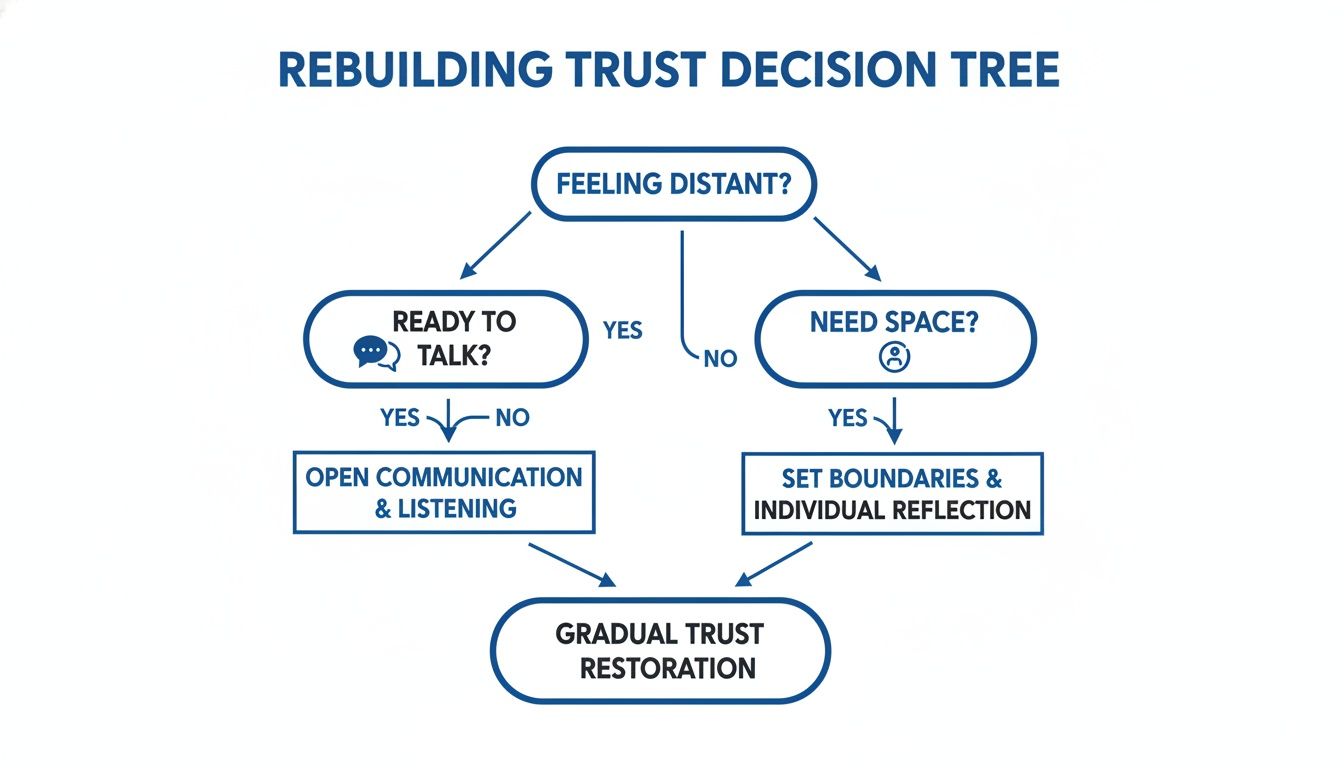
As you can see, there's no single "right" way to start. Both direct communication and setting healthy boundaries are valid starting points that can lead to rebuilding a stronger, more authentic connection.
Signs It's Time for Professional Help
Good intentions can only go so far when the patterns of disconnection are deeply ingrained. It might be time to seek professional guidance if any of these situations feel familiar:
- Communication Is Completely Stalled: You’re either having the same fight on a loop or you’ve given up on meaningful conversations entirely. It just feels too painful or pointless to even try.
- Past Trauma Is Resurfacing: Instead of feeling comforting, intimacy feels threatening. A partner’s touch or a vulnerable moment might trigger a fight-or-flight response, often because of past experiences that taught you closeness isn't safe.
- Substance Use Is in the Picture: If alcohol or drugs are causing secrecy, broken promises, or emotional chaos, that instability has to be addressed first. You can't build true intimacy on a shaky foundation.
- One or Both Partners Are Struggling with Mental Health: Conditions like depression, anxiety, or PTSD can drain the joy and connection from a relationship. Specialized support can help manage the illness and its ripple effects on your partnership.
Seeking help isn't about admitting defeat. It’s about investing in your relationship’s future and acknowledging that you deserve a structured, supportive environment to heal.
Does Getting Help Actually Work?
It’s completely normal to feel hesitant. In fact, national data shows that 26% of people avoid discussing their sexual health with a doctor simply because of embarrassment.
But the evidence for getting expert guidance is compelling. One study found that "External Input" from clinicians has a high success factor loading of 0.752. In plain English, that means getting an outside perspective from a professional who normalizes these conversations is incredibly effective. Many couples see significant improvement in just 8-12 sessions.
What Does Professional Support Look Like?
For busy professionals and students in the Dallas-Fort Worth area, getting help is more accessible and flexible than ever. Treatment is designed to fit into your life, not take it over.
Here’s what your options might include:
- Individual Therapy: This is your confidential space to unpack your own history, attachment style, and personal needs. It's a fantastic starting point, especially if a partner isn't ready for counseling. Learning new tools and gaining clarity on your own often creates a positive shift in the relationship dynamic. If you're thinking about this route, you might find it helpful to read our guide on how to prepare for your first therapy session.
- Couples Counseling: Here, a therapist acts as a neutral guide, helping you both break out of toxic communication cycles. The goal is to understand each other’s world without blame and find new ways to connect.
- Flexible Programs (IOP/PHP): For those navigating intimacy issues alongside substance use or mental health conditions, more structured support can make all the difference. Intensive Outpatient (IOP) and Partial Hospitalization (PHP) programs offer focused care for a few hours a day, several days a week. This structure allows you to maintain your work, school, and family life while getting the support you need.
Deciding to seek professional help is a powerful act of hope. If you’re ready to take that step, a confidential conversation is the best place to start. Call us at (888) 385-2051 to learn how we can support you.
Finding Your Way Back to Connection in Dallas and Euless
Figuring out the "why" behind your struggles with intimacy is a huge breakthrough. But insight alone isn't enough to create lasting change. This is where the real work begins—turning that understanding into new habits and healthier ways of relating, often with the help of professionals who get it.
For so many adults and families we have worked with across the Dallas and Euless area, the moment they decide to seek structured support is the moment everything starts to shift.
At Maverick Behavioral Health, we know how much courage it takes just to pick up the phone. We honor that by creating a truly judgment-free and love-driven space to heal. Our modern, private facility in Euless isn't just a building; it's a sanctuary where you can safely unpack the complex issues that have been quietly sabotaging your connections.
Outpatient Care That Fits Your Life
Let's be honest—the thought of pressing pause on your entire life for treatment can feel impossible. You have a job, classes, or a family that depends on you.
That’s exactly why our outpatient programs are designed for the realities of life in the DFW metroplex. We firmly believe you shouldn't have to choose between your responsibilities and getting the high-quality care you deserve.
Intensive Outpatient Program (IOP): This is a great fit for people who need more than just a weekly therapy session but don't require 24/7 care. You’ll get a solid block of therapy for several hours a day, a few times a week, allowing you to dive deep into your recovery work while still going home each evening.
Partial Hospitalization Program (PHP): As our most structured outpatient option, PHP offers a full day of treatment—much like a residential program—but with the flexibility to return home at night. It's a powerful choice for those who need significant, daily support to build a stable foundation for recovery.
These programs give you the robust clinical care needed to make real progress, without demanding you step away from your life completely.
Healing from intimacy issues, especially when they’re tangled with other challenges, is rarely a straight line. It's a process of learning new skills, unlearning old patterns, and having a team of experts guide you through the setbacks and celebrate the victories.
Getting to the Root Cause with Dual Diagnosis Care
As we've explored, intimacy problems are often just the tip of the iceberg. When substance use is intertwined with mental health conditions like anxiety, depression, or PTSD, you simply can't treat one in isolation and expect the other to get better.
Our expertise in dual diagnosis is the core of our entire philosophy.
At Maverick Behavioral Health, we don't just see an addiction or a mental health label; we see a whole person. Our integrated team treats both the substance use and any co-occurring mental health conditions at the same time. This stops the cycle of fragmented care and helps you see exactly how these issues fuel one another, giving you the skills to manage both. For many, this is the approach that finally helps them break through. If this resonates with you, you can learn more about how we support couples seeking rehab in the Dallas area and address these interconnected challenges.
A Safer Path Forward When Opioids Are Involved
When opioid dependence is part of your story, the fear of withdrawal can feel like an insurmountable wall keeping you from getting help. Our Medication-Assisted Treatment (MAT) program offers a safe, evidence-based way to move forward.
Using FDA-approved medications like Suboxone, our MAT program is carefully managed to:
- Safely and comfortably manage withdrawal symptoms.
- Dramatically reduce the cravings that can derail your progress.
- Free you up to focus on your therapy without being distracted by physical pain.
This medical support is always combined with intensive counseling. It provides the stability you need to do the deep emotional work of rebuilding trust and intimacy, all under the compassionate supervision of our medical team.
Your first step is a simple, confidential phone call. We accept most PPO insurance plans and are here to help you figure out your options without any pressure. If you’re in Euless, Dallas, or anywhere in the DFW area and are ready to heal your relationships for good, we are here for you.
Call our team today at (888) 385-2051 to start the conversation.
Answering Your Questions About Overcoming Intimacy Issues
Even when you're ready to tackle intimacy issues, a lot of "what ifs" can pop up. It's completely normal to have questions and even some doubts about what healing really entails. We've heard just about every question there is from individuals and couples across the Dallas-Fort Worth area, and we want to address some of the most common ones head-on.
Can Our Relationship Really Recover if Addiction Broke All Our Trust?
The straightforward answer is yes. It’s not just possible; it’s a core focus of specialized recovery work. But it’s important to be realistic—this isn’t a quick fix. Rebuilding trust is a deliberate, gradual process that asks for commitment from both of you, though your roles will look different.
For the person in recovery, the work is about building a new history—one of consistency, honesty, and reliability. For their partner, the work often involves learning to manage the very real anxiety and fear that come with opening up to trust again. In our couples and family therapy sessions here in Euless, we create a safe, professionally mediated space for these hard conversations to happen.
Together, we’ll help you establish new ways of communicating and build clear, healthy systems for accountability. This approach doesn't just put a bandage on the problem; it addresses both the addiction and the deep relational wounds it caused. With genuine commitment and professional guidance, many couples find they can build a foundation of trust that’s even more resilient than before.
What if I’m the Only One Who Thinks We Have a Problem?
This is one of the most common and painful roadblocks we see. It can feel like you're stuck in neutral when you’re ready for change but your partner isn't on the same page.
Your best first move is to share how you feel without pointing fingers or placing blame. "I" statements are your most powerful tool here. For instance, instead of saying, "You’re so distant all the time," try something like, "I've been feeling lonely and I really miss feeling connected to you."
If your partner still isn’t ready, the most powerful thing you can do is start therapy for yourself. It gives you a space to sort through your own needs and frustrations while learning new communication skills that can subtly, yet profoundly, shift the dynamic at home.
Time and again, we've seen one person's commitment to their own growth create a positive ripple effect. It can be the very thing that inspires a resistant partner to see the benefits for themselves and become more open to joining the process down the road. It’s very common for us to begin working with one partner and later welcome the other into couples sessions when they’re ready.
How Do Intensive Programs (IOP/PHP) Fit into a Busy Life?
Many people put off getting help because they think it means dropping everything—their job, family, and all other responsibilities. That's exactly the problem that Intensive Outpatient (IOP) and Partial Hospitalization (PHP) programs were designed to solve.
These programs offer a high level of structured care without requiring a full-time residential stay. At our facility near Dallas, you might attend treatment for several hours a day, a few days per week, but you’ll go home every single night.
This structure is perfect for people who need to keep up with a demanding career, university classes, or family obligations. We work directly with you to build a treatment schedule that supports your recovery and your life, making healing an integrated part of your world instead of a total disruption to it.
Is It Possible to Be Intimate Without Being Sexual?
Yes, and internalizing this truth is a game-changer for recovery. Intimacy is a rich, layered experience that goes far beyond the physical. In fact, deliberately focusing on non-sexual forms of connection is one of the best ways to rebuild a relationship, especially when trust is fragile or you’re in early recovery.
Think of intimacy as having several different "flavors":
- Emotional Intimacy: This is the bedrock—feeling safe enough to share your true feelings, fears, and dreams without judgment.
- Intellectual Intimacy: This is about connecting over ideas. You share thoughts, debate interesting topics, and truly value each other's minds.
- Experiential Intimacy: This is built by doing things together. You create shared memories, whether it's tackling a home project, taking a walk, or trying a new restaurant.
When you intentionally nurture these other forms of closeness, you take the pressure off. You build a foundation of safety and friendship first. From that secure place, a healthy and meaningful sexual connection often has the space to grow back naturally, when both of you are genuinely ready.
The path back to connection is different for everyone. If you still have questions or feel ready to see what your options are, the team at Maverick Behavioral Health is here. We offer confidential, compassionate answers. Give us a call at (888) 385-2051 to learn how our programs in the Dallas-Fort Worth area can help you or someone you love.