


Early recovery can feel disorienting. A person may leave treatment, finish a meeting, or make it through a hard first week sober, then suddenly wonder what happens next when cravings, stress, loneliness, or old habits show up at home, at work, or on the drive through Dallas-Fort Worth traffic.
That confusion is common. Many people understand that meetings help and therapy helps, but they still ask a basic question: what does a sponsor do in real life, day to day?
A sponsor is not a rescuer and not a replacement for treatment. A sponsor is closer to a guide who has already walked the same rough path and can help another person stay pointed in the right direction. For someone in Euless, Dallas, or the wider DFW area, that kind of guidance can make recovery feel less abstract and more doable. Sponsorship gives recovery a human voice between sessions, between meetings, and during the moments when temptation becomes personal.
Table of Contents
- Navigating Early Recovery When You Feel Lost
- The Core Responsibilities of a Recovery Sponsor
- Sponsor vs Therapist Clarifying Critical Roles
- Essential Boundaries for a Healthy Sponsor Relationship
- How Sponsorship Amplifies Outpatient Treatment in Dallas
- A Practical Guide to Finding Your Sponsor in DFW
- Build Your Foundation for Recovery in Euless Today
Navigating Early Recovery When You Feel Lost
A person in early recovery often knows what needs to stop, but may not yet know how to live differently hour by hour. The hardest moments are usually ordinary ones. A stressful lunch break. A fight at home. A lonely evening. A sudden urge to drive past an old liquor store, call an old contact, or hide in isolation.
That is where many people feel lost. They may hear phrases in meetings that sound helpful, but still not know how to apply them when emotions spike. They may want support without wanting to burden family. They may need someone who understands addiction from the inside, not just from the outside.
A sponsor helps close that gap.
The role makes more sense when it is compared to a trail guide. If two people are walking through rough terrain, the guide does not carry the other person to the destination. The guide points out unsafe turns, explains where others usually get stuck, and keeps the traveler moving when fear or confusion takes over.
A sponsor offers direction, accountability, and lived experience. The sponsor does not do recovery for the other person.
For many newcomers, confusion starts with simple questions:
- When should someone call a sponsor? Usually before a bad decision turns into action.
- What if the problem seems small? Small problems often grow quickly in early recovery.
- Does asking for help mean weakness? No. It usually shows that the person is interrupting an old pattern instead of hiding it.
In Dallas and Euless, where people often balance work, family, school, commuting, and treatment schedules, recovery support has to work in daily life. Sponsorship can make that possible by giving recovery a steady person to reach for when structure drops off and temptation rises.
The Core Responsibilities of a Recovery Sponsor
A sponsor is more than a friendly face at a meeting. In 12-step recovery, the sponsor has a specific job. The sponsor helps a newer person move through the program, stay honest, and respond to relapse risks with action instead of denial.
A sponsor is a guide through the program
The clearest way to understand what does a sponsor do is to focus on function.
A sponsor helps the sponsee work through the steps, not just talk about them. That includes answering questions, suggesting readings or assignments, and helping the person connect recovery principles to daily decisions. If the sponsee is confused by a step, overwhelmed by guilt, or resisting change, the sponsor helps break the work into manageable pieces.
A sponsor also provides accountability. That word can sound harsh, but in recovery it usually means something humane. It means one person agrees to tell the truth to another person and stay reachable when old thinking starts to return.
According to research on the importance of a sponsor in recovery, sponsors in AA and NA help sponsees work through the 12 steps and offer accountability, and a controlled study found that patients with a sponsor at treatment end had 33% greater odds of no illicit drug use/problems and 50% greater odds of no stimulant use at 1-month follow-up.
That finding matters because it turns sponsorship from a vague tradition into something with measurable value.
A good sponsor does not cheer a person on. A good sponsor helps that person act differently when stress, cravings, and distorted thinking show up.
What that support looks like in practice
The day-to-day role usually includes several core responsibilities:
- Step guidance: The sponsor helps the sponsee understand what the steps ask for, when to slow down, and when avoidance is starting to look like caution.
- Reality checks: If a person says, “It was just one drink,” or “Calling an old dealer is not a big deal,” the sponsor can challenge that thinking early.
- Availability for support: Many sponsors make themselves available for calls or messages when the sponsee is struggling, especially during vulnerable moments.
- Modeling sober living: The sponsor shows what recovery can look like in ordinary life, including relationships, work stress, honesty, and making amends.
A simple example helps. A person leaves an outpatient group in the evening feeling steady. Two hours later, an argument at home triggers shame and anger. The old instinct is to leave the house and use. A sponsor may remind that person to pause, go to a meeting, review the situation, and avoid turning one emotional surge into a relapse.
That is why the trail-guide analogy works. The sponsor cannot remove every obstacle. The sponsor can say, “That turn looks familiar. Slow down. Here, people often slip.”
In DFW outpatient care, this role often becomes especially useful between sessions. Therapy may identify triggers. Group work may build coping skills. Medication support may reduce cravings. A sponsor helps a person use those tools in the unpredictable moments when recovery is tested in everyday situations.
Sponsor vs Therapist Clarifying Critical Roles
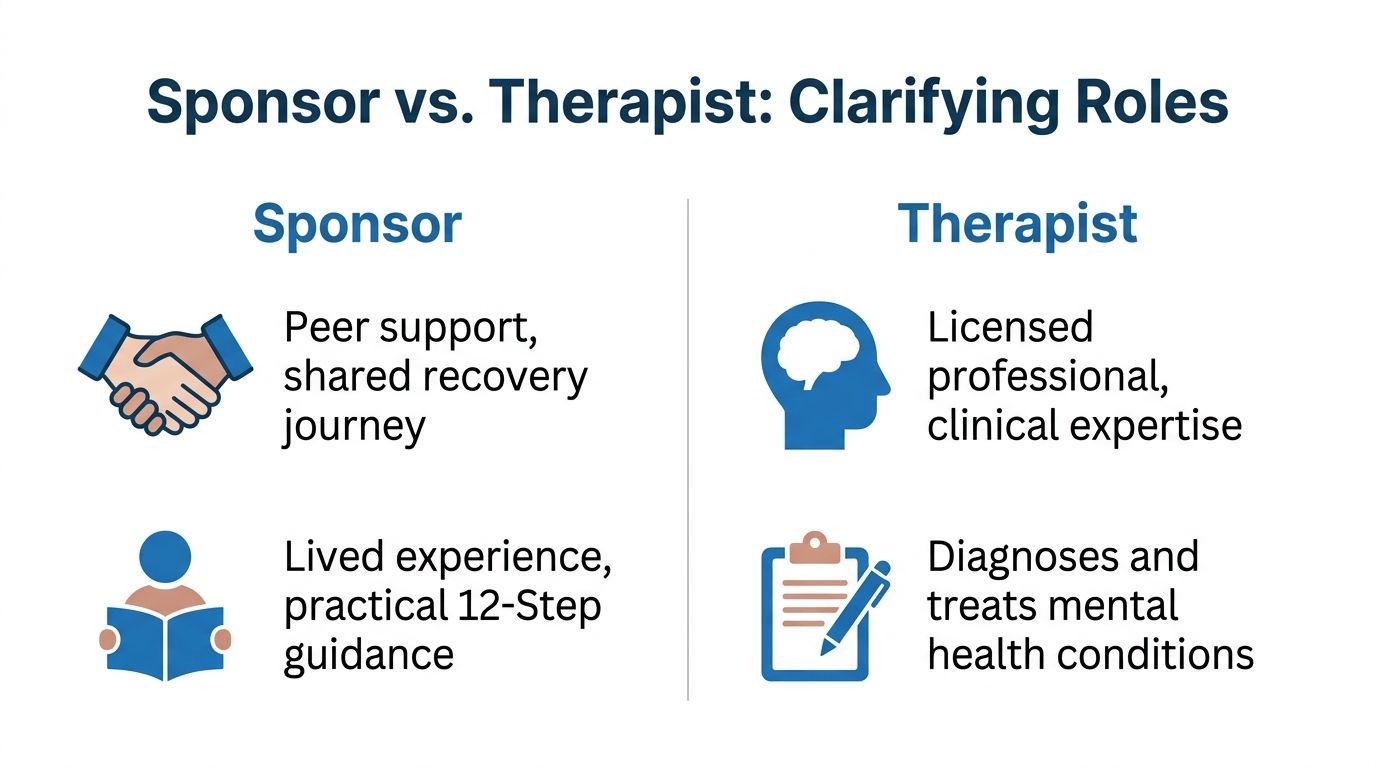
Confusion between a sponsor and a therapist can create real problems. Some people expect a sponsor to handle trauma, mental health symptoms, family conflict, or medication questions. Others expect a therapist to provide round-the-clock peer accountability. Neither expectation fits.
Two forms of help with different jobs
A sponsor is a peer in recovery. A therapist is a licensed clinician. Both can be valuable. Their roles are not interchangeable.
| Attribute | Sponsor | Therapist |
|---|---|---|
| Primary role | Peer guide in recovery | Clinical provider |
| Main basis of support | Lived experience | Professional training and licensure |
| Focus | 12-step work, accountability, sober decision-making | Assessment, therapy, treatment planning, mental health care |
| Relationship style | Peer-to-peer mentorship | Professional therapeutic relationship |
| Can diagnose mental health conditions | No | Yes |
| Can provide clinical treatment | No | Yes |
| Can help with step work | Yes | May discuss recovery, but not as a sponsor substitute |
| Can address trauma in a clinical way | No | Yes |
| Can prescribe or manage medications | No | Only appropriate medical professionals within treatment settings |
| Availability | Often informal and direct | Structured appointments and clinical follow-up |
This difference matters most when someone is facing more than cravings alone. If a person has panic attacks, depression, suicidal thinking, trauma symptoms, or a dual diagnosis, a sponsor can offer support and encourage honesty, but clinical care still has to lead.
A sponsor says, “Call your counselor. Go to group. Do not isolate.”
A therapist helps the person understand what is driving the crisis and how to treat it safely.
For readers who want a practical look at entering professional care, this guide on how to prepare for your first therapy session can help reduce some of the uncertainty.
Why both roles matter
The strongest recovery plans often use both roles for different reasons.
A therapist can help a person uncover patterns such as trauma responses, shame cycles, anxiety, depression, or relationship dynamics that fuel substance use. A sponsor can then help that same person apply recovery principles after the session ends, when the insight has to become action.
Consider a common example. A therapist helps a person identify that criticism from a partner triggers intense feelings of worthlessness tied to earlier experiences. That is clinical work. Later that night, after another argument, the sponsor may help the person avoid acting on those feelings through impulsive use, secrecy, or disappearing from support.
Therapists treat. Sponsors walk alongside. Recovery often goes better when both are in place.
The sponsor is also not a parent, parole officer, spiritual authority, or emergency service. The therapist is not a friend, a step guide, or a substitute for community. Keeping these distinctions clear protects the person in recovery from misplaced expectations and unsafe dependence.
When people ask what does a sponsor do, part of the answer is also what a sponsor does not do. The sponsor offers lived guidance inside recovery. The therapist provides clinical care inside treatment. Both roles can reinforce each other without blending into confusion.
Essential Boundaries for a Healthy Sponsor Relationship
A healthy sponsor relationship is supportive, direct, and respectful. It is not limitless. Boundaries are not cold. In recovery, boundaries protect trust and keep the relationship focused on sobriety.
What a sponsor is not
Many newcomers benefit from saying this plainly. A sponsor is not:
- A therapist: The sponsor can listen and share experience, but does not provide clinical treatment.
- A banker: Recovery support should not depend on loans, repeated financial rescue, or money pressure.
- A chauffeur: Rides may happen sometimes, but transportation should not become the core of the relationship.
- A legal advisor: Court issues, probation questions, and legal decisions need qualified help.
- A romantic interest: Sponsorship needs clarity and safety. Romantic tension can distort honesty and power.
- A personal assistant: The sponsor supports recovery work, not every life task.
These limits help both people stay in the right role. Without them, the relationship can shift from guidance into dependency, resentment, guilt, or manipulation.
A practical example makes this easier to see. If a sponsee calls every night for emotional regulation but refuses meetings, step work, therapy, or basic self-care, the sponsor may start carrying a load that belongs to a larger support system. That is not sustainable.
How healthy boundaries protect both people
Research discussed in this article on what a sponsor does notes that among long-term sponsors with more than five years in the role, 25% report increased stress from 24/7 availability without clear boundaries. That matters because burnout can weaken the very support system recovery depends on.
Boundaries may include simple agreements such as:
- Call before using, not after disappearing: This shifts support toward prevention.
- Use reasonable communication expectations: Late-night calls may be for urgent recovery issues, not every frustration.
- Keep the focus on recovery tasks: Meetings, step work, honesty, relapse prevention, and spiritual or personal growth.
- Respect family, work, and privacy: Sponsors have jobs, responsibilities, and limits too.
Boundaries do not mean rejection. They mean the relationship is staying healthy enough to last.
This is especially relevant in busy areas such as Dallas-Fort Worth, where many people in recovery are balancing treatment, commuting, parenting, school, and demanding work schedules. A sponsor may be generous and committed while still needing structure around calls, meetings, and emergencies.
If a boundary problem develops, the best response is usually direct and calm. A sponsee can ask, “What is the best way to reach out when things get difficult?” A sponsor can say, “Calls are welcome, but this issue also needs a therapist, doctor, or treatment team.”
Healthy sponsorship is built on honesty, not mind-reading. When expectations stay clear, the relationship has a better chance of helping both people stay grounded in recovery.
How Sponsorship Amplifies Outpatient Treatment in Dallas

Outpatient treatment gives people structure, therapy, skill-building, and in some cases medication support. Sponsorship helps those gains survive contact with everyday life.
Clinical care teaches skills and sponsorship helps apply them
That partnership is one of the strongest answers to what does a sponsor do. The sponsor helps a person use treatment tools outside the treatment setting.
A person in IOP or PHP may learn to identify triggers, challenge distorted thinking, create a relapse prevention plan, and handle cravings more effectively. Those skills matter. But recovery usually gets tested in the parking lot, in a text message from an old using contact, during a rough shift at work, or after a fight at home.
A sponsor can help the person pause and apply what treatment already taught.
Examples of that connection include:
- After group therapy: The person recognizes a resentment pattern and calls a sponsor before turning that emotion into a relapse setup.
- During MAT support: The person is medically supported but still needs help with routines, meetings, honesty, and social change.
- After a triggering workday: The sponsor helps the person move toward a meeting or safe accountability instead of isolation.
A landmark study highlighted by Recovery Answers on the benefits of 12-step sponsors found that individuals with a sponsor at the end of treatment had 33% to 50% greater chances of achieving no illicit drug or stimulant use at one month post-treatment.
That does not mean sponsorship replaces professional care. It means sponsorship can reinforce what care is already building.
People exploring structured support can learn more about outpatient rehab options and how they fit around work, family, and daily obligations in the Dallas area.
Why this matters in daily life across DFW
Dallas-Fort Worth presents recovery challenges that are ordinary but significant. Long drives, inconsistent schedules, social drinking culture, isolation in apartments or hotel rooms, and pressure to keep performing at work can all wear down motivation.
Clinical treatment creates a foundation. Sponsorship gives that foundation a daily contact point.
One person may leave a PHP day feeling regulated, then feel shaky three hours later after seeing an old neighborhood, old friend, or old payday pattern. Another may be doing well on medication for opioid use disorder but still feel vulnerable when boredom, shame, or relationship strain rises. In those moments, a sponsor can encourage immediate recovery action instead of delay.
Treatment gives a person tools. Sponsorship helps that person reach for the tools before the crisis takes over.
This combination often works best when expectations stay realistic. The treatment team handles clinical care. The sponsor supports the recovery walk between appointments. One brings professional structure. The other brings lived accountability in real time.
A Practical Guide to Finding Your Sponsor in DFW
Finding a sponsor can feel awkward at first. Many people worry about asking the wrong person, getting rejected, or not knowing what counts as a good fit. The process is usually simpler than feared.
What to look for in a sponsor
A useful sponsor is not necessarily the loudest person in a meeting or the most impressive storyteller. The better question is whether that person has the kind of recovery a newcomer wants to learn from.
Qualities that often matter include:
- Steady sobriety: AA guidance commonly points to at least one year of continuous sobriety for a sponsor, along with clear progress in their own recovery.
- Active step work: A sponsor should not only talk about the program. The sponsor should live it.
- Availability: The relationship works better when the sponsor has enough time and willingness for regular contact.
- Honesty with compassion: The best sponsors can be direct without being cruel.
- A life that reflects recovery: Not perfection. Consistency, responsibility, humility, and integrity.
Research summarized in this publication on sponsorship and abstinence found a 91% abstinence rate among AA members serving as sponsors in a ten-year follow-up study, and 82% of AA members report having a sponsor. That can reassure newcomers that sponsorship is not a fringe part of recovery. It is a common and stable feature of many 12-step communities.
For people attending local or virtual meetings while searching, this resource on Narcotics Anonymous meetings on Zoom may help widen the options, especially for those juggling work or transportation in DFW.
How to ask without overthinking it
Asking someone to sponsor can be brief and respectful. It does not need to sound polished.
A simple script might sound like this:
“Recovery seems stronger in the way that person shares. Would that person be willing to talk about temporary sponsorship?”
Temporary sponsorship is often a good starting point. It lowers pressure and gives both people room to see whether the fit is right.
Other practical steps can help:
- Listen before asking. Notice who shares with clarity, humility, and consistency.
- Speak after a meeting. A short conversation is enough to begin.
- Ask direct questions. Does the person have a sponsor? Do they work the steps? Are they available to sponsor someone new?
- Stay open to a no. A refusal usually means lack of time, capacity, or fit. It is not a statement about worth.
- Change sponsors if needed. If the relationship becomes unhelpful, unsafe, or misaligned, it is acceptable to move on respectfully.
A common fear is choosing wrong and being stuck. That fear keeps some people from asking anyone at all. Sponsorship is important, but it is not a life sentence. It is a recovery relationship that should support growth, honesty, and forward movement.
In Euless and the larger Dallas area, a person may need a sponsor who understands professional stress, parenting demands, school pressures, or dual diagnosis recovery. It is reasonable to look for someone whose recovery feels grounded in the same kind of life reality.
Build Your Foundation for Recovery in Euless Today
A sponsor can play a powerful role in recovery. The sponsor helps with step work, accountability, practical sober decision-making, and support during vulnerable moments. That role becomes stronger when the relationship has healthy boundaries and realistic expectations.
A sponsor is still not enough by itself for many people. Someone dealing with alcohol misuse, opioid dependence, stimulant use, relapse patterns, trauma, depression, anxiety, or a dual diagnosis often needs more than peer guidance. Professional treatment gives recovery structure, clinical insight, and a safe place to build skills before life tests them.
That is especially important for adults in Euless and across Dallas-Fort Worth who are trying to stay functional while getting well. Work obligations do not erase addiction. Parenting responsibilities do not erase cravings. A sponsor can help with daily accountability, but treatment is often what helps a person understand the pattern, stabilize physically and emotionally, and build a plan that can hold up under pressure.
The strongest recovery foundation usually includes several layers of support:
- Clinical treatment: Therapy, group support, structured programming, and individualized planning.
- Peer recovery support: Meetings, sponsorship, and honest community.
- Medical support when appropriate: Including medication-assisted treatment for opioid use disorder.
- Aftercare planning: A realistic bridge from treatment into everyday life.
No one has to wait until things become catastrophic. A person can reach out while still unsure, still scared, or still deciding what kind of help is needed. Recovery often begins with one honest conversation.
Maverick Behavioral Health helps adults in Euless and the Dallas-Fort Worth area build that foundation with individualized outpatient care, including IOP, PHP, standard outpatient treatment, dual diagnosis support, and MAT options such as Suboxone. For anyone asking what does a sponsor do, the best answer is often to pair peer guidance with strong clinical care. To talk through options with a compassionate team, call (888) 385-2051 today.