



A parent in Euless picks up pain medicine after dental work. A professional in Dallas fills a prescription after a back injury. A college student takes “just one” pill from a friend after a sports strain. In each case, the goal is simple. Get relief, rest, and get back to normal.
That's why opioid risk confuses so many families. The first use may look ordinary. It may even be medically prescribed. But the short term effects of opioids can begin fast, and some of those effects are far more dangerous than generally expected.
The broader picture shows why this concern is reasonable. In the United States, the overdose death rate involving all opioids rose from 7.3 per 100,000 people in 2011 to 24.0 per 100,000 in 2023, and roughly 80,000 overdose deaths involved opioids in 2023, according to opioid epidemic data summarized by SHADAC. For families already worried about parenting, custody, or household safety, legal consequences can become part of the stress too. In those situations, Bryan Fagan legal guidance may help clarify how substance use concerns can affect child neglect cases in Texas.
Table of Contents
- The Hidden Dangers in a Common Prescription
- What Happens Minutes After Taking an Opioid
- Common and Unexpected Short-Term Side Effects
- Understanding Your Risk of Dangerous Interactions
- How to Recognize an Opioid Overdose and Save a Life
- Breaking the Cycle with Outpatient Treatment in Euless
- How Suboxone Treatment Counteracts Opioid Effects
The Hidden Dangers in a Common Prescription
A person can take an opioid exactly as directed and still feel uneasy. That hesitation often comes from hearing two messages at once. One message says the medication can help with pain. The other says opioids can be dangerous. Both are true.
In the short term, opioids can relieve pain and create a sense of relaxation or well-being. That's part of why they're used medically and why they can also be misused. The danger is that the same drug that dulls pain can also slow key body functions, especially breathing.
Why “short term” sounds safer than it is
Many people hear “short term use” and assume the risk stays small. Families often imagine that serious problems happen only after months or years. In reality, the body doesn't wait long to respond to opioids.
A short prescription after surgery, an injury, or dental work can still lead to heavy sleepiness, mental fog, slowed reaction time, and breathing changes. If alcohol, sleep medication, or another depressant enters the picture, the risk rises further. Even routine activities can become unsafe.
Practical rule: If a person seems unusually hard to wake, confused, or slow to breathe after taking an opioid, that is not something to “sleep off.”
Why families in Dallas Fort Worth ask these questions
The concern is often immediate and practical. A spouse wants to know if a loved one can drive. A parent wants to know whether a teen's leftover pills are dangerous. A worker wants to know whether it's safe to take a prescribed opioid before bed and still function the next morning.
Those are the right questions. The short term effects of opioids aren't limited to pain relief. They can affect judgment, coordination, breathing, sleep, and the body's response to pain itself.
That last point surprises many readers most. Some people take opioids expecting less pain, but over time, even on a short timeline, the body can start reacting in ways that make pain harder to control.
What Happens Minutes After Taking an Opioid
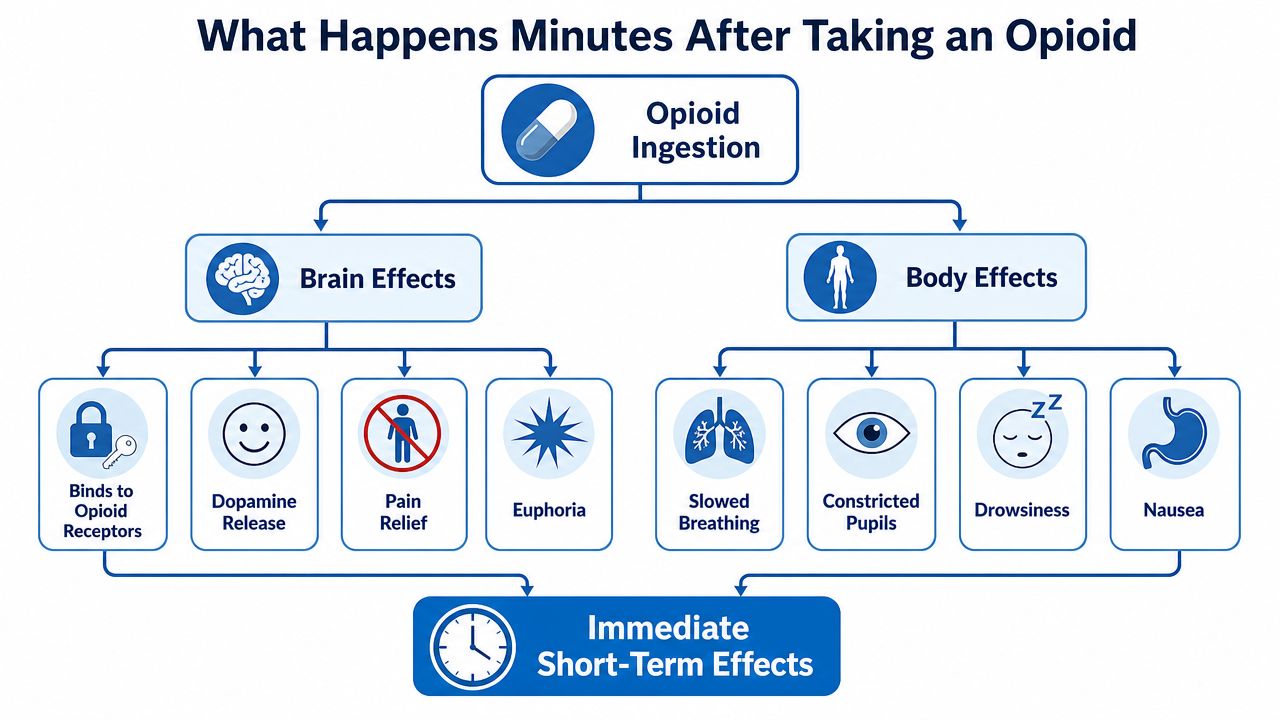
Opioids work by attaching to receptors in the brain and body. A simple way to picture it is a key fitting into a lock. Once that lock is opened, the brain receives a different message about pain, comfort, and reward.
For some people, the early effect feels like warmth, relief, or emotional settling. For others, it feels more like heaviness, grogginess, or stomach upset. The same medication can produce both wanted and unwanted effects almost at the same time.
How opioids change pain and mood quickly
Short acting oral opioids may begin working within 10 to 15 minutes and may last 3 to 6 hours, while injected or smoked illicit opioids can act within seconds, according to opioid timing information from the Alcohol and Drug Foundation. That fast onset matters because the body can move from relief to impairment very quickly.
Early effects may include:
- Pain relief: The person may feel that the original injury hurts less.
- Euphoria or calm: Some people feel relaxed, emotionally lighter, or detached from discomfort.
- Drowsiness: Staying awake can become harder, especially if the dose is stronger than expected.
- Slowed body functions: Breathing and heart rate may slow, which is where danger begins.
- Physical signs: Pupils may become constricted, and nausea can appear.
Why the timeline matters
A person may think, “The pill was prescribed, so the first few hours are the safe part.” That assumption causes problems. The first few hours are often when the strongest body changes happen.
A common point of confusion is the difference between feeling sleepy and being medically at risk. Normal tiredness means a person can still wake, respond, and breathe normally. Opioid sedation can look deeper. The person may drift off mid-conversation, struggle to stay alert, or breathe more slowly than usual.
Breathing problems don't always start with a dramatic collapse. They can begin as subtle slowing, shallow breaths, and unusual sleepiness.
Families should also know that different routes of use matter. A swallowed pill usually has a slightly slower onset than a smoked or injected opioid. That doesn't make it harmless. It only changes how fast the danger appears.
Common and Unexpected Short-Term Side Effects
Many people know the obvious side effects. Fewer understand the strange ones. That gap matters, because a person may think the medication “isn't working” when the body is reacting in a risky or paradoxical way.
Expected effects people often notice first
These are the effects families tend to recognize quickly:
- Sleepiness: The person seems unusually tired or drifts in and out of wakefulness.
- Nausea: Some people feel sick to their stomach soon after taking the medication.
- Confusion: Thinking may slow down. Answers may come late or not make sense.
- Pinpoint pupils: The eyes may look unusually constricted.
- Reduced reaction time: Driving, cooking, climbing stairs, or supervising children can become less safe.
These effects may sound mild on paper, but the context matters. A drowsy office worker may make a dangerous drive home. A sedated parent may miss a child crying at night. A confused patient may accidentally take the next dose too early.
Unexpected effects that catch families off guard
The more surprising short term effects of opioids include opioid-induced hyperalgesia, which means a paradoxical increase in pain sensitivity, plus early tolerance and withdrawal symptoms after only a few weeks of regular use, as described in Stanford's discussion of opioid side effects and pain sensitivity.
That sounds backward, so it helps to say it plainly. A person may start taking opioids for pain and then notice that pain feels sharper, more diffuse, or harder to control. The natural reaction is often to assume the underlying injury is worsening. Sometimes the drug itself is part of the problem.
The body can also adapt faster than people expect. After regular use for only weeks, stopping can trigger distress that feels out of proportion to the timeline. That doesn't mean the person lacks willpower. It means the brain and body have already started adjusting to the opioid.
| Effect Type | Symptoms | What It Means |
|---|---|---|
| Common early effect | Drowsiness, nausea, confusion, pinpoint pupils | The opioid is affecting the brain and body in ways that can impair safety |
| Functional impairment | Slowed reaction time, poor judgment, heavy sedation | Routine tasks like driving or childcare may no longer be safe |
| Paradoxical effect | Increased pain sensitivity | The medication may be making pain harder to manage rather than easier |
| Early adaptation | Needing more effect or feeling unwell after stopping | Tolerance and dependence can begin sooner than many families expect |
Some “short term” opioid problems don't feel dramatic at first. They feel confusing. More pain, more fatigue, more emotional distress, and less control.
Understanding Your Risk of Dangerous Interactions
The most dangerous short term opioid effect is not nausea or itching. It is respiratory depression, which means breathing slows down too much.
That risk becomes much greater when opioids are mixed with other substances that also slow the central nervous system. Alcohol is a common example. Certain anti-anxiety or sleep medications can also make the situation much more dangerous.
Why slowed breathing is the real emergency
Opioids can cause significant drowsiness, confusion, and slowed reaction times, and combining them with alcohol or other depressants dramatically increases the likelihood of severe respiratory depression and lethality. Breathing problems can also happen during sleep in routine use, according to Lake County guidance on physical health risks of opioid use.
People often imagine overdose as a sudden, obvious event. Sometimes it is. Sometimes it begins with a person who seems to be “sleeping it off” on the couch. What loved ones are seeing may be a body that is not getting enough air.
Everyday situations that become unsafe fast
Risk isn't limited to obvious misuse. It shows up in ordinary settings:
- After-work drinking: A person takes a prescribed opioid, then has alcohol later because it “was only one drink.”
- Bedtime dosing: Someone takes pain medicine before sleep and doesn't realize opioids can worsen breathing during the night.
- Driving too soon: Sedation and slower reactions turn a normal commute into a hazard.
- Stacking medications: A person uses an opioid with another sedating medicine without understanding the combined effect.
A family member may ask, “But the person was awake and talking earlier. How can it become serious now?” Because opioid effects can deepen as the medication peaks, and because adding another depressant can tip the body from sedation into dangerous breathing suppression.
A person doesn't have to look reckless to be in danger. Many opioid emergencies begin during ordinary routines.
How to Recognize an Opioid Overdose and Save a Life
When an opioid overdose happens, the central problem is often acute respiratory compromise. If breathing slows enough, the brain gets less oxygen. That oxygen loss is called hypoxia, and it can lead to confusion, coma, permanent brain injury, or death if it isn't reversed quickly with naloxone and supportive care, according to the ASPE review on non-fatal opioid overdose outcomes.
That's why recognition matters so much. Families don't need perfect certainty to act. They need enough awareness to treat the situation like the emergency it may be.
Warning signs that need immediate action
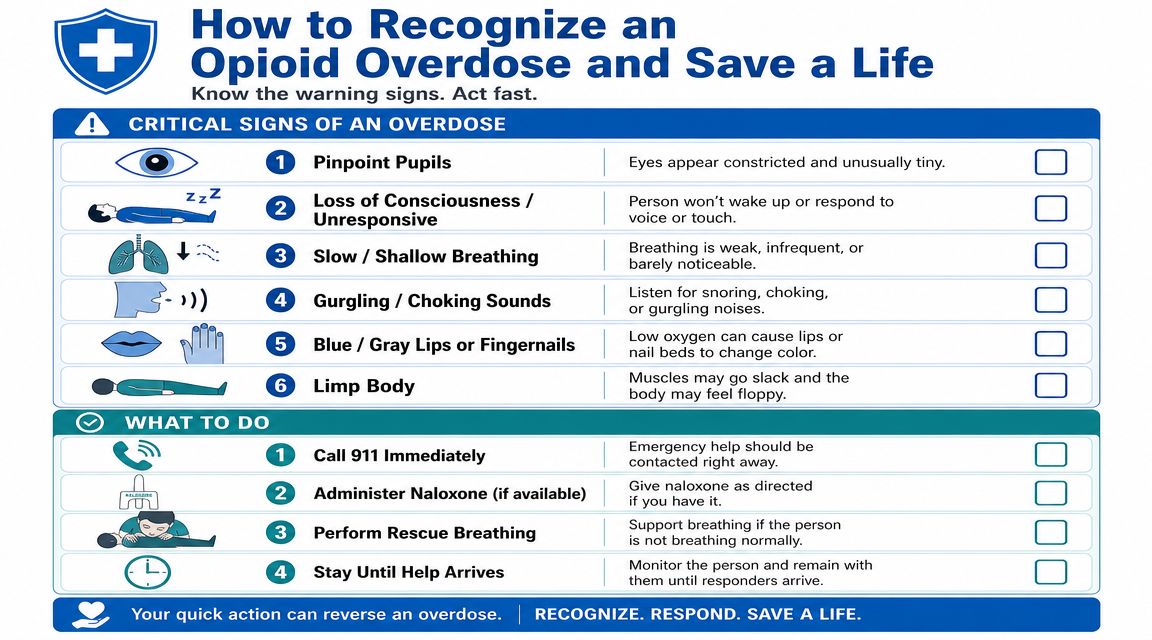
Several signs should raise alarm right away:
- Pinpoint pupils: The center of the eye looks very small.
- Unresponsiveness: The person won't wake up, won't answer, or can't stay awake.
- Slow or shallow breathing: Breaths are infrequent, weak, or barely noticeable.
- Choking or gurgling sounds: These sounds can mean the airway is compromised.
- Blue or gray lips or fingernails: This can signal poor oxygenation.
- Limp body: The person may seem floppy or unable to hold themselves up.
For families in North Texas trying to prepare ahead of time, these Dallas Fort Worth harm reduction strategies can help people think through overdose prevention and safer responses before a crisis happens.
What to do right away
If overdose is suspected, quick action matters.
- Call 911 immediately. Emergency help should be on the way as soon as overdose is suspected.
- Give naloxone if available. Naloxone can reverse opioid effects and restore breathing long enough for emergency care to take over.
- Try to keep the airway open. If trained to do so, provide rescue breathing or other basic supportive steps.
- Stay with the person. Do not assume they are safe because they briefly wake up.
- Watch breathing closely. A person can worsen again after a temporary improvement.
When breathing is the problem, waiting is the danger.
A lot of people hesitate because they fear overreacting. In a possible opioid overdose, overreacting is far safer than underreacting.
Breaking the Cycle with Outpatient Treatment in Euless
Many adults delay treatment because they think help is only for people who have “hit bottom.” That belief keeps people stuck. Opioid problems often become easier to treat when support starts earlier, before job loss, family breakdown, or a medical emergency forces the issue.
This is especially important when a person has started noticing fast changes. More sedation than expected. More pain instead of less. Anxiety about running out. Feeling sick after cutting back. Those are signs that the situation deserves attention now, not months from now.
Why early help makes sense
Outpatient care can work well for people who need real structure but still have responsibilities at home, school, or work. That includes professionals commuting across Dallas Fort Worth, parents managing school pickups, and adults who need treatment without stepping away from daily life completely.
Programs such as PHP and IOP give people a middle path. They don't leave the person isolated with a growing opioid problem, and they don't always require full residential separation from normal life. Readers looking for a local option can review outpatient rehab in Euless and Tarrant County.
Why outpatient care fits real life
A flexible treatment model can help with several immediate needs:
- Stabilizing routines: People often need help rebuilding sleep, work, and family structure.
- Learning triggers: A person can identify when pain, stress, exhaustion, or access to medication increases risk.
- Addressing co-occurring struggles: Anxiety, depression, and trauma often sit alongside opioid misuse.
- Reducing shame: Support works better when treatment feels practical and humane, not punitive.
Many families in Euless and the Dallas area aren't looking for a dramatic label. They're looking for the next safe step. Outpatient treatment can be that step. It's not a last resort. It's a timely response.
How Suboxone Treatment Counteracts Opioid Effects
Medication-assisted treatment can sound intimidating to families who are already overwhelmed. Some hear the name of a medication and worry that treatment is just “replacing one drug with another.” That misunderstanding prevents people from using a medical tool that can reduce harm and support recovery.
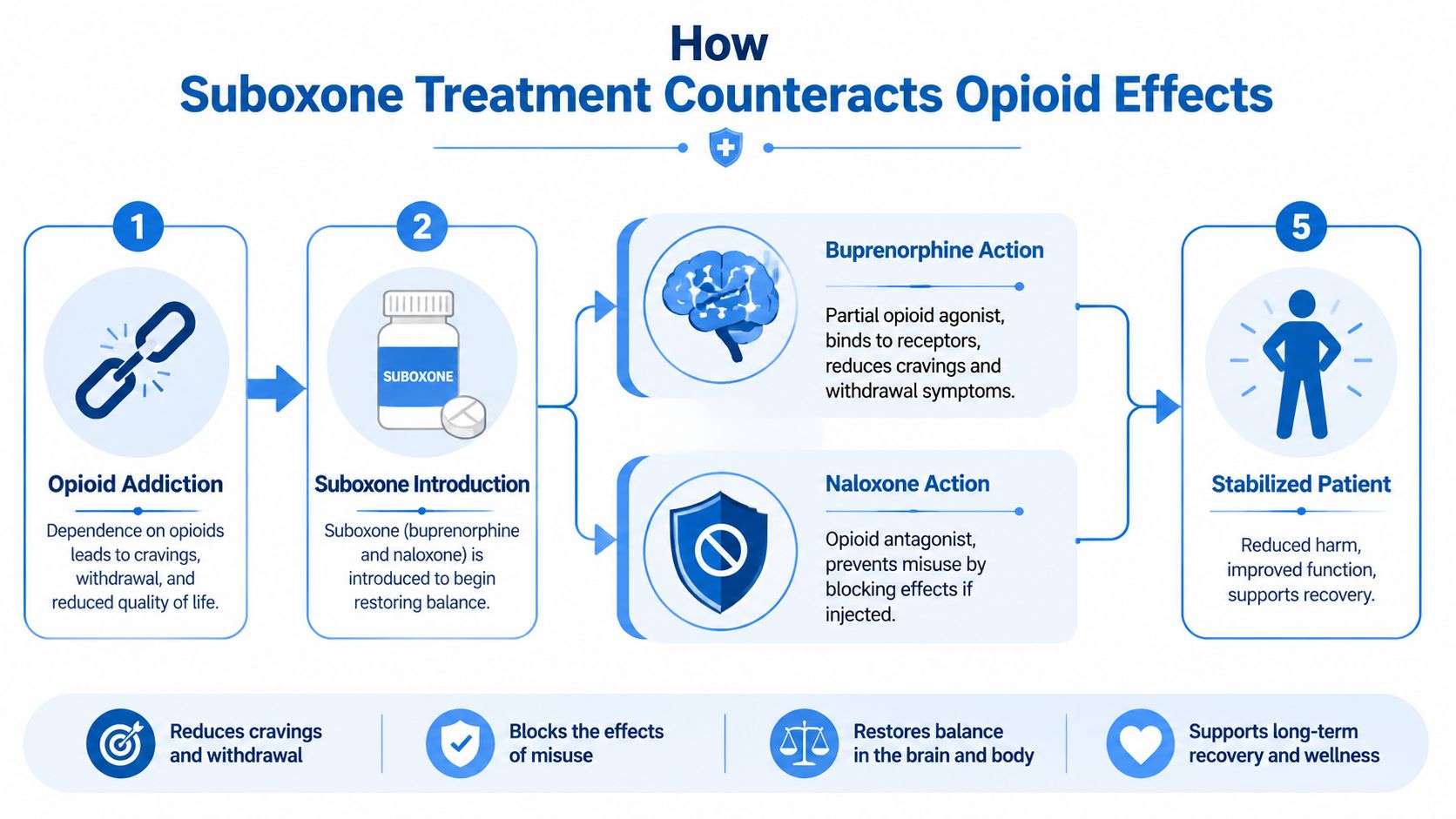
Suboxone is used in opioid treatment because it helps steady the brain's response to opioids. It's designed to reduce cravings and withdrawal symptoms while lowering the pull of unstable opioid use.
What Suboxone does in the brain
Suboxone contains buprenorphine and naloxone. In simple terms, buprenorphine attaches to opioid receptors in a controlled way. That can help calm withdrawal, reduce cravings, and make the brain less reactive to chaotic cycles of use. Naloxone is included to discourage misuse in certain forms of administration.
This is why medication treatment often feels different from active opioid misuse. The goal isn't intoxication. The goal is stabilization. For readers who want broader dual-diagnosis MAT insights, that overview may help explain why medication can be part of integrated mental health and substance use care.
Why medication can support long-term recovery
Suboxone can help a person move from crisis response to steady functioning. That may include sleeping more normally, thinking more clearly, and participating more fully in therapy and daily responsibilities. Instead of chasing relief or fearing withdrawal, the person has a chance to build consistency.
Medication isn't the whole answer by itself. People often need counseling, structure, relapse prevention planning, and support for mental health symptoms too. But for many adults with opioid dependence, it can create the breathing room needed to recover.
Readers who want to understand more about timing, metabolism, and related concerns can learn more in this guide on how long Suboxone stays in the system.
For adults and families in Euless, Dallas, and the wider DFW area, opioid problems don't have to become a crisis before treatment begins. Maverick Behavioral Health provides outpatient care for substance use and co-occurring mental health needs, including support for opioid recovery and MAT services. A confidential call can help clarify what's happening, what level of care may fit, and what to do next. To speak with someone directly, call (888) 385-2051.