


A lot of families in Dallas-Fort Worth reach the same breaking point. A son is using again after promising he'd stop. A spouse is drinking more than anyone wants to admit. Someone is mixing pills, alcohol, or street drugs, and every phone call feels like it could be bad news. The family wants treatment, but the person using isn't ready for detox, isn't ready for rehab, or says they can handle it alone.
That's where harm reduction strategies matter.
For many people in Euless, Dallas, Fort Worth, and the surrounding area, the first real step isn't immediate abstinence. It's reducing the chances of overdose, infection, medical crisis, legal fallout, or another lost month of isolation. Done well, harm reduction creates enough safety and trust for treatment to become possible.
Table of Contents
- What Are Harm Reduction Strategies and Why Do They Matter
- Understanding the Principles That Guide Harm Reduction
- A Look at Evidence-Based Harm Reduction Strategies
- How We Integrate Harm Reduction in Our Dallas-Fort Worth Programs
- Support Systems That Amplify Harm Reduction
- How to Find Harm Reduction Support in Dallas and Euless
- Answering Your Questions About Harm Reduction
What Are Harm Reduction Strategies and Why Do They Matter
When a family is scared, the conversation usually gets narrow fast. People ask whether the person will quit, whether treatment will finally stick, or whether another relapse means nothing works. Harm reduction strategies widen that conversation. They ask a more urgent question first. How can the risk of death, disease, trauma, and chaos be reduced today?
Harm reduction is a practical, compassionate approach that focuses on lowering the harmful consequences of substance use instead of demanding perfect behavior before help is offered. That can include overdose prevention, safer use education, medication support, sterile supplies, linkage to counseling, and a clear path into higher levels of care when the person is ready.
In real life, this means a person doesn't have to “earn” care by being fully abstinent first. If someone in the DFW area is still using but willing to talk openly, learn how to stay safer, carry naloxone, or consider medication for opioid use disorder, that's movement in the right direction. It may not look dramatic from the outside, but clinically it matters.
What this looks like on the ground
A harm reduction approach often starts with simple priorities:
- Keep the person alive: overdose prevention comes first.
- Reduce immediate medical risk: lower the chance of infection, dangerous mixing, and withdrawal complications.
- Maintain connection: keep the person engaged with people who can help.
- Build toward treatment: use trust and stability to open the door to outpatient care, therapy, and recovery planning.
Small gains count. Fewer overdoses, fewer risky situations, and more contact with care are not minor wins. They're often the steps that make recovery possible later.
In Euless and across Dallas-Fort Worth, families often feel pressured to choose between “tough love” and doing nothing. That's a false choice. Harm reduction strategies offer a third option. Protect safety, reduce damage, and keep the relationship with care intact.
Understanding the Principles That Guide Harm Reduction
A seatbelt doesn't encourage reckless driving. It accepts reality and reduces the chance that a mistake becomes fatal. Harm reduction works the same way. It starts from the fact that some people will keep using for a time, whether families approve or not. The practical response is to reduce the danger while creating opportunities for change.
This isn't a fringe idea. Harm reduction has moved into mainstream public health policy. Harm Reduction International reports that 108 countries include harm reduction in national policies, with opioid agonist therapy available in 94 countries and needle and syringe programmes in 93 countries as of 2024. That kind of adoption matters because it shows the model is recognized, operational, and used across very different healthcare systems.
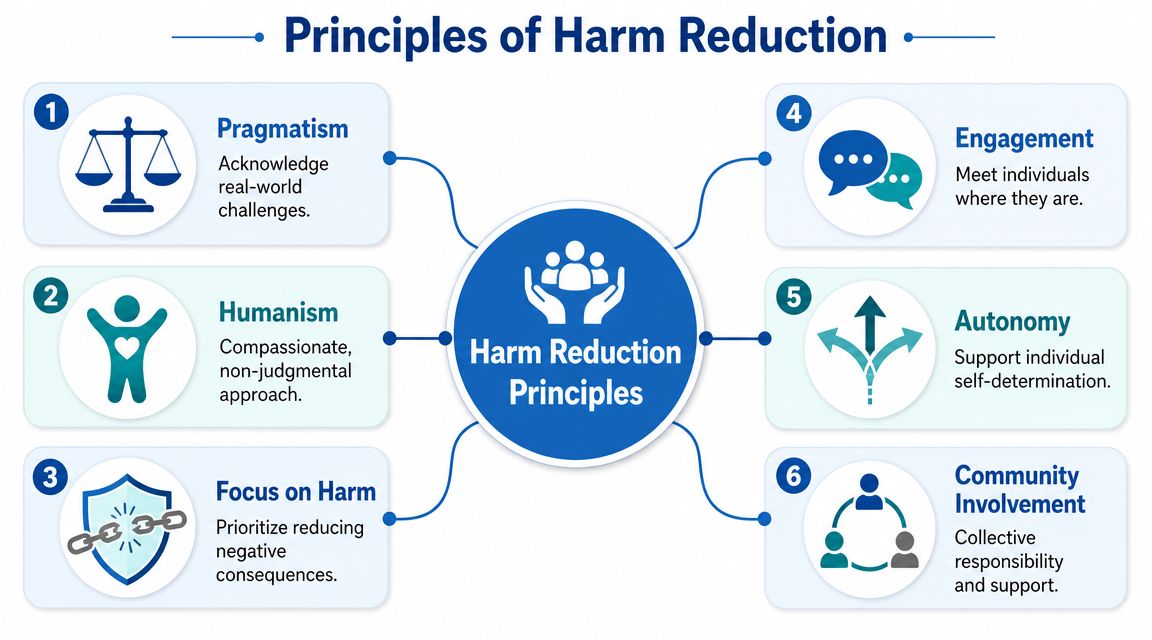
Pragmatism over fantasy
Some families understandably want one clear rule. Stop using now. The problem is that rigid demands often collapse under real-world conditions like cravings, trauma, unstable housing, untreated anxiety, depression, or social pressure.
Pragmatism: Work with the reality in front of you, not the version everyone wishes existed.
A pragmatic plan asks what will reduce risk this week. It might be naloxone access. It might be avoiding use alone. It might be starting medication support. It might be showing up to outpatient therapy while abstinence is still inconsistent.
Human dignity and non-judgment
Shame rarely produces honesty. Fear rarely produces sustained engagement. People are more likely to accept help when they're treated like human beings rather than problems to control.
That's one reason many clinicians lean into a client-centered care in healthcare approach. Respect, listening, and shared planning aren't soft skills. They improve engagement and give people a better chance of staying connected to treatment.
Autonomy matters
Harm reduction doesn't mean every choice is equally safe. It means the person still has agency. When people have some control over the plan, they're more likely to participate openly and less likely to disappear after one setback.
A person may reject abstinence today and still accept safety planning, medication, therapy, or support for the next right step.
Community responsibility
Substance use doesn't happen in isolation. Families, peers, clinicians, emergency services, and local systems all affect outcomes. Good harm reduction strategies recognize that safety improves when more than one person is involved in support, monitoring, and care transitions.
A Look at Evidence-Based Harm Reduction Strategies
Some harm reduction strategies are broad ideas. Others are concrete tools with clear clinical purposes. The most useful question isn't whether a tool sounds good. It's what specific harm it reduces and how it fits into a treatment pathway.
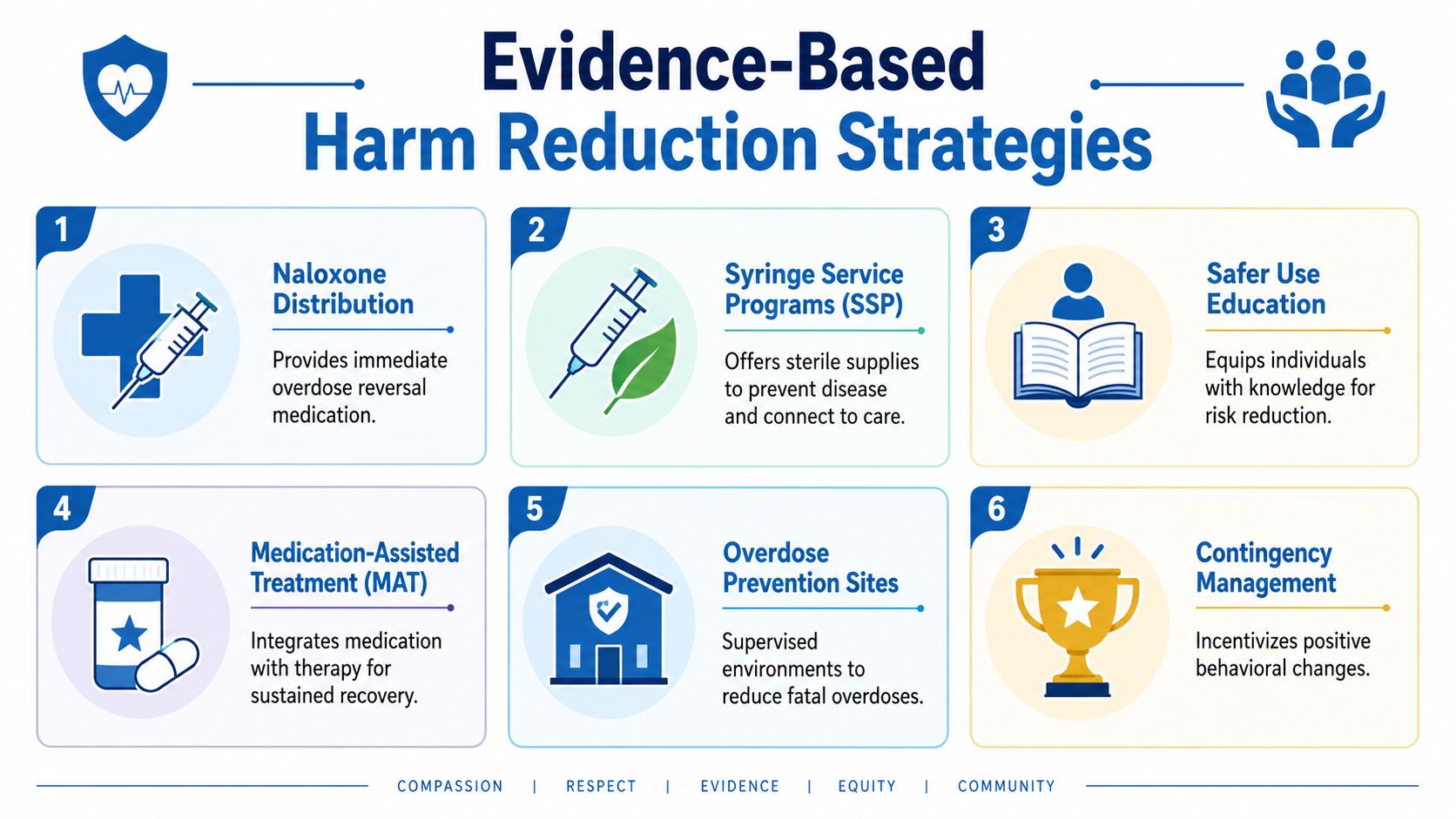
The strongest strategies do two things at once. They lower immediate risk, and they keep a person connected to care.
Naloxone Distribution
Naloxone is used to reverse opioid overdose. It doesn't treat addiction, and it doesn't solve the larger pattern by itself. What it does do is create a chance to survive long enough for treatment to happen.
The CDC describes harm reduction as a public health approach that reduces overdose and infectious disease risk, and notes that overdose prevention depends on partnerships across emergency services, healthcare, justice systems, and harm reduction services. The same CDC-linked review reports that overdose education and naloxone distribution programs reduce opioid overdose-related deaths, and that syringe service programs reduce HIV and HCV transmission while increasing entry into treatment. It also cites $363,821 in incremental cost savings per hepatitis C case avoided in an economic analysis summarized there, which highlights that these interventions affect both health and long-term system burden. That evidence is summarized in the CDC's overdose prevention and harm reduction guidance.
Medication-Assisted Treatment With Suboxone
Medication-assisted treatment is one of the clearest examples of harm reduction functioning as a bridge to recovery. For opioid use disorder, medications such as Suboxone can reduce withdrawal and cravings enough for someone to think clearly, sleep, work, show up to therapy, and stop living from one emergency to the next.
Medication works best when it isn't treated like a stand-alone fix. It needs monitoring, counseling, and a plan for relapse risk, triggers, and co-occurring mental health symptoms. For a detailed overview, this guide on medication-assisted treatment for opioid addiction explains how medication support fits into a larger treatment framework.
Syringe Service Programs
Syringe service programs reduce the risks tied to injection drug use by providing sterile equipment and a consistent point of contact with care. That matters because partial access isn't the same as real access.
A peer-reviewed review reports that syringe distribution and injecting-equipment access reduce HIV transmission and soft-tissue infections, that hepatitis C incidence can be dramatically lowered when sterile syringe access is paired with medication for opioid use disorder, and that harm reduction services do not increase drug use while functioning as access points for treatment, naloxone, and other health services. The review is available through this peer-reviewed article on harm reduction services and young people who use drugs.
Clinical takeaway: Coverage matters. Intermittent help is better than none, but sustained access linked with treatment has a much stronger practical effect.
Fentanyl Test Strips
Drug checking tools such as fentanyl test strips fit under modern harm reduction because they help people make safer decisions in a contaminated drug supply. They don't remove all risk, and they shouldn't create false confidence. But they can support conversations about not using alone, carrying naloxone, taking a small test dose, and reconsidering whether use should happen at all.
Safer Use Education
Safer use education sounds basic, but it often fills the gap between crisis and readiness for treatment. Clear guidance about mixing substances, spacing doses, recognizing overdose signs, avoiding solitary use, and planning for panic or respiratory distress can prevent a bad night from becoming a fatal one.
For people who get anxious, panicky, or short of breath when trying to slow down or avoid impulsive use, simple regulation skills can help in the moment. This resource on expert advice on breathing for anxiety can be a useful addition to a broader coping plan.
How We Integrate Harm Reduction in Our Dallas-Fort Worth Programs
A good outpatient program doesn't treat harm reduction as a side conversation. It builds it into assessment, therapy, medication planning, group work, and aftercare. That matters because people rarely move from unstable use to long-term recovery in one clean leap. Most need a sequence. Stabilize first. Reduce danger. Build trust. Increase structure. Strengthen recovery skills.
Frameworks aligned with SAMHSA emphasize safer settings, easier healthcare access, stronger transitions to care, and sustainable support systems. That implementation lens is outlined in this harm reduction framework for safer settings and care transitions. In practice, that means the setting itself has to help people stay engaged instead of pushing them out at the first sign of struggle.
What structured integration looks like
In a Dallas-Fort Worth outpatient setting, harm reduction often gets applied through a sequence like this:
- Assessment with honesty first: the care team asks what substances are being used, how often, whether the person uses alone, whether there have been overdoses, what mental health symptoms are active, and what situations create the most risk.
- Immediate safety planning: naloxone access, overdose education, withdrawal monitoring, and clear guidance about dangerous combinations come before bigger recovery promises.
- Medication support when appropriate: for opioid use disorder, MAT can reduce the chaos that keeps people from participating in therapy.
- Therapy that matches readiness: a person in early ambivalence needs a different conversation than someone ready for full abstinence and relapse prevention.
- Stepped structure: PHP, IOP, and outpatient levels make it possible to increase or decrease intensity without losing contact.
A common example is a client who starts treatment while still unsure about long-term abstinence. The first wins may be fewer dangerous episodes, better attendance, improved sleep, more honesty in group, and reduced opioid use after starting medication support. Those early gains are not separate from recovery. They're often the beginning of it.
What usually does not work
Families often ask why progress stalls. The answer is usually not that the person “doesn't care.” More often, the plan didn't match the reality.
What tends to fail:
| Approach | Why it often falls short |
|---|---|
| Ultimatums with no treatment path | Fear may produce short-term compliance, but not stability or skills |
| Education without follow-up | People may understand risk and still be unable to change alone |
| Medication without therapy | Cravings may improve while trauma, depression, and behavior patterns remain active |
| Therapy without safety planning | Insight doesn't protect against overdose or dangerous use patterns |
Treatment works better when the plan accepts where the client is today and still moves firmly toward where they need to go.
Support Systems That Amplify Harm Reduction
A client can do well in PHP or IOP for several days, then lose ground fast after program hours end. I see it when someone leaves group with a solid plan but goes home to conflict, an empty refrigerator, no ride to the pharmacy, and nobody safe to call when cravings spike at 10 p.m. In outpatient care, those details shape outcomes as much as the treatment schedule does.
That is why support systems matter in real clinical work. Harm reduction is easier to apply when daily life has some structure. It is much harder to ask a person to use coping skills, take medication as prescribed, or follow a safety plan when housing is unstable and basic needs are not met.
Why basic stability changes clinical outcomes
In a structured outpatient program in the Dallas-Fort Worth area, we pay close attention to what happens between sessions. If a client misses meals, has no transportation, or lives with people who are actively using, the treatment plan has to account for that. Otherwise, even a good clinical plan can fail in practice.
Two clients may both say they want to cut back on stimulant use. One has a steady place to sleep, a sibling who answers the phone, and reliable rides to treatment. The other is couch surfing and trying to manage panic symptoms alone. They do not need the same support, and they will not respond to the same plan at the same pace.
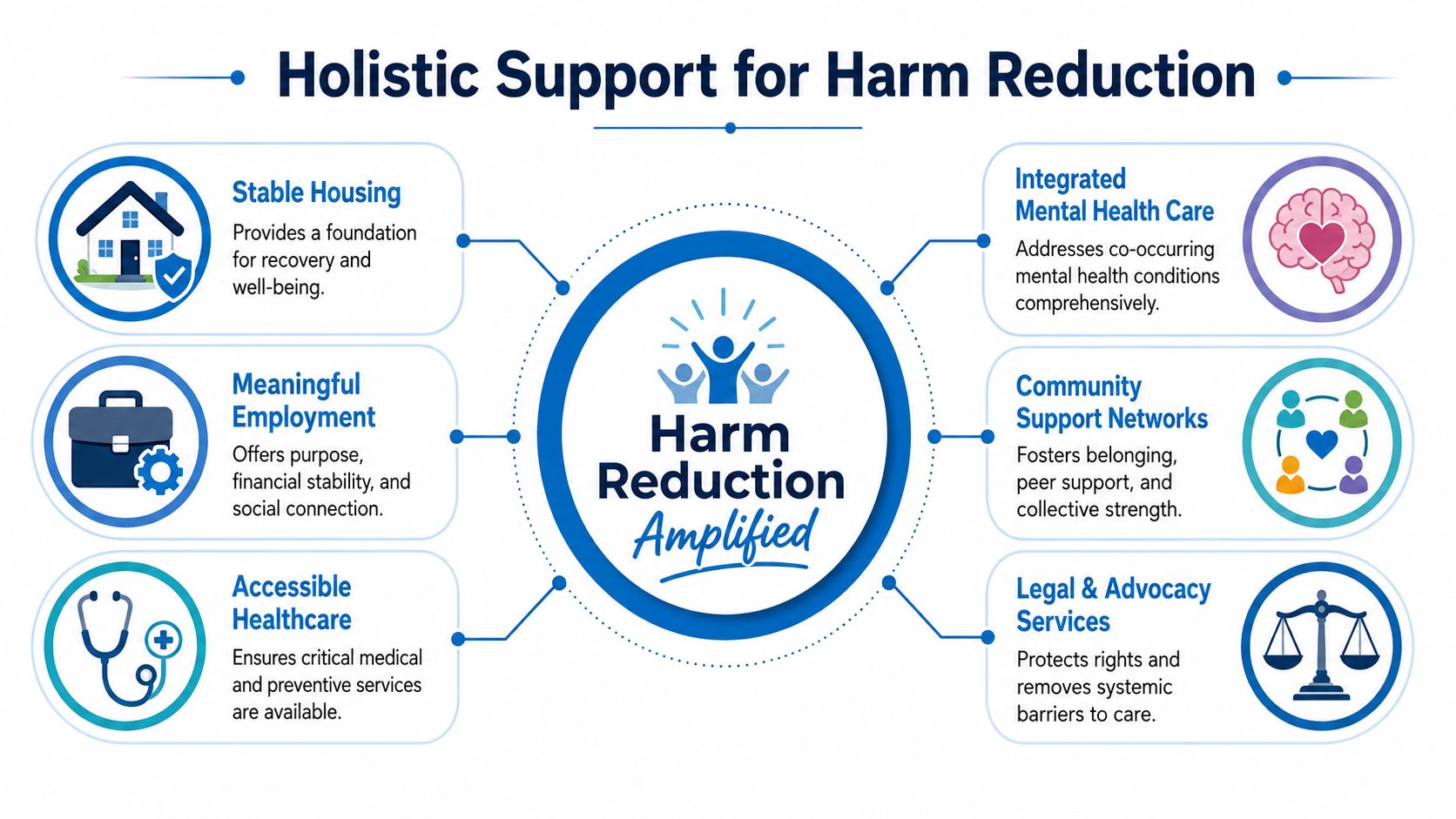
The support systems that often make the biggest difference include:
- Stable housing: lowers exposure to people, places, and routines tied to higher-risk use
- Food and transportation: make it easier to attend treatment, pick up prescriptions, and think clearly enough to use coping skills
- Mental health treatment: helps when substance use is closely tied to trauma, depression, anxiety, or mood instability
- Peer connection: gives clients support after hours, when urges, shame, and isolation tend to hit hardest
- Planned aftercare: keeps momentum going when someone steps down from PHP to IOP or from IOP to standard outpatient care
Peer support deserves special attention. Clinical treatment gives structure and accountability. Peer relationships often help people stay connected to recovery in real life, especially on weekends and after difficult days. Families who want a clearer sense of that role can read this overview of what a sponsor does in recovery.
What families can support right now
Families do not need to act like clinicians to strengthen harm reduction. They help most when they reduce friction and make follow-through more likely.
Useful support often looks like this:
- Reward honesty: accurate information helps the treatment team respond to real risk
- Help with logistics: rides, childcare, schedule reminders, and pharmacy pickup often matter more than another argument
- Support steadier routines: meals, sleep, medication adherence, and showing up for sessions all reduce vulnerability
- Stay calm during setbacks: a lapse should trigger a tighter plan, not a collapse in contact
In outpatient treatment, recovery rarely grows from pressure alone. It grows when accountability is paired with safety, structure, and enough support to help the person come back the next day.
How to Find Harm Reduction Support in Dallas and Euless
A common call sounds like this: a spouse has found pills in a backpack, a parent is watching alcohol use get less predictable, or an adult child has started missing work and denying there is a problem. The family is scared, but the person using is not ready to commit to abstinence. That is still enough to start.
In Dallas-Fort Worth, the most useful support is usually the support that lowers immediate risk and creates a clear path into treatment. In a structured outpatient program, harm reduction is not separate from recovery planning. It is often the first workable step that gets someone through the door, helps the clinical team accurately assess risk, and builds enough stability for PHP, IOP, medication support, or standard outpatient care to be effective.
Practical Next Steps
- Start with a confidential assessment: call Maverick Behavioral Health at (888) 385-2051 to discuss current substance use, mental health symptoms, safety concerns, and which outpatient level of care may fit.
- Compare levels of care before choosing a program: this guide to opioid addiction treatment options in Dallas-Fort Worth can help clarify what to look for close to home.
- Ask local pharmacies about naloxone: families often wait until a scare to look for overdose reversal medication. It is better to have it available before judgment gets clouded by panic.
- Look for support between sessions: peer groups, family meetings, and recovery communities in the DFW area can help reduce isolation and keep someone connected while outpatient treatment gets established.
- Bring one steady support person: in practice, one calm and informed family member often improves follow-through with appointments, medication pickup, and return to care after a setback.
I tell families to judge the next step by one standard. Does it make the person safer and more reachable this week?
That might mean scheduling an assessment before the person agrees they need treatment. It might mean asking direct questions about fentanyl exposure, alcohol withdrawal risk, or missed psychiatric medication. It might mean starting in an outpatient setting that can hold both truths at once: the person is still using, and the person still needs care now.
Certainty is not required. A workable plan is.
Answering Your Questions About Harm Reduction
Families often worry that harm reduction sends the wrong message. The concern is understandable. The evidence points in a different direction.
The peer-reviewed review cited earlier found that harm reduction services are safe, pragmatic interventions that do not increase drug use and often serve as important access points for treatment and healthcare.
Common Questions About Harm Reduction
| Question | Answer |
|---|---|
| Doesn't harm reduction enable substance use? | No. It reduces the risks tied to ongoing use and keeps people connected to treatment opportunities instead of pushing them away. |
| Is harm reduction the opposite of recovery? | No. It often serves as the bridge that helps a person survive long enough to engage in recovery. |
| What if someone isn't ready to quit? | Safety planning, education, medication support, and outpatient engagement can still begin. Readiness often grows after stability improves. |
| Does it only apply to opioids? | No. Harm reduction also matters for alcohol, stimulants, and polysubstance use, though the tools may differ. |
| Should families lower expectations? | Families can keep clear boundaries while still supporting realistic, life-preserving steps. |
| Is abstinence still a valid goal? | Yes. Harm reduction doesn't replace abstinence-based goals. It helps many people get there more safely and more successfully. |
A useful way to think about it is simple. Harm reduction strategies don't ask families to approve of dangerous behavior. They ask families and clinicians to respond effectively to it.
Maverick Behavioral Health helps adults in Euless and across the Dallas-Fort Worth area take the next step with compassionate, evidence-based outpatient care. Programs include PHP, IOP, standard outpatient treatment, dual diagnosis support, and MAT with Suboxone for opioid dependence. If someone is struggling with substance use, relapse risk, or co-occurring mental health symptoms, call (888) 385-2051 for a confidential assessment and a clear plan for what comes next.