



Kratom can stay detectable in urine for 1 to 9 days in many users, and up to 2 weeks in chronic or heavy users. That wide range matters if someone in Dallas-Fort Worth is trying to protect a job offer, stay compliant on probation, or avoid a setback in treatment.
For many people, the search for how long does kratom stay in urine starts with pressure. A test is coming. A probation check-in is near. A treatment program has clear rules. Someone may have used kratom thinking it was a safer workaround, only to realize that specialized testing can still pick it up.
The difficult part is that there isn't one universal answer. Detection depends on how often kratom was used, how much was used, how the body processes it, and what kind of urine test is ordered. In clinical settings, the practical mistake is assuming that a standard timeline applies to everybody. It doesn't.
This guide gives the most useful version of the answer. It focuses on what affects urine detection, what specialized labs are looking for, and what a positive kratom result can mean for people in Euless, Dallas, and the surrounding DFW area.
Table of Contents
- Kratom Urine Detection Windows at a Glance
- How Urine Tests Detect Kratom Alkaloids
- Key Factors That Influence Kratom Detection Time
- What a Positive Kratom Test Means in the Dallas Area
- Next Steps if You Are Worried About Kratom Use
- Frequently Asked Questions About Kratom Testing
Kratom Urine Detection Windows at a Glance
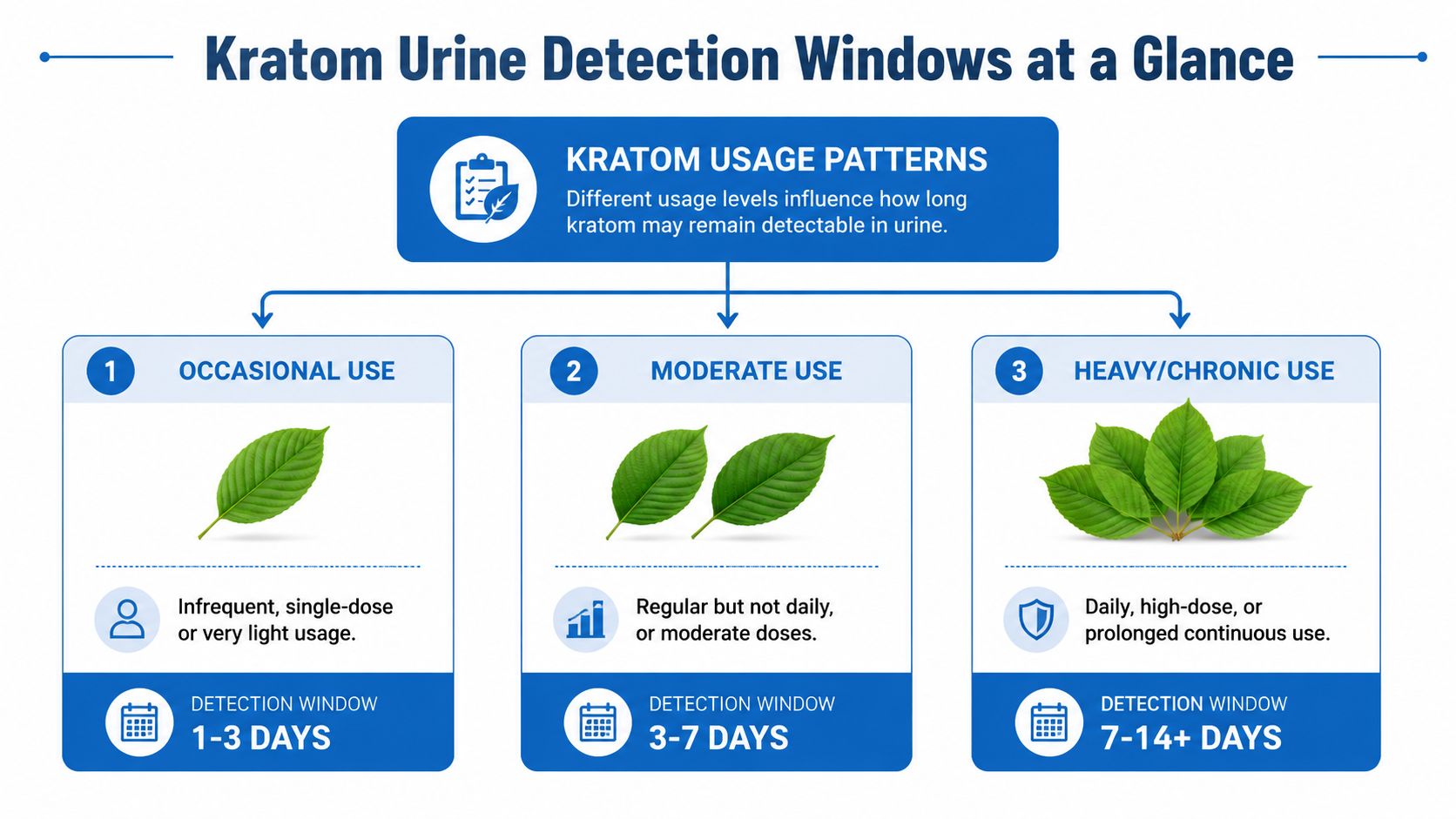
Someone asking how long does kratom stay in urine usually needs a usable timeframe, not a vague "it depends." The most reliable overall range is 1 to 9 days for many users, with detection extending up to 2 weeks in chronic or heavy use, based on aggregated clinical analyses and case reports summarized by Alliance Recovery Center on kratom urine detection timing.
What the timeline usually looks like
A practical way to think about urine detection is by use pattern, not by wishful thinking.
- Occasional use: Infrequent or one-time use often falls on the shorter end. Some sources place occasional clearance in just a few days, while the broader verified range still allows for detection within the larger 1 to 9 day window.
- Moderate use: Repeated but not constant use usually lands in the middle. This is the group that often gets tripped up by assuming a weekend gap is enough.
- Heavy or chronic use: Daily, high-dose, or long-term use can push urine detection up to 2 weeks, especially when specialized testing is used.
That means two people can stop on the same day and have very different results. One may test negative relatively quickly. The other may still produce a positive result well after the obvious effects have worn off.
Practical rule: The more often someone uses kratom, the less useful a short countdown becomes.
Why daily use changes the picture
Heavy use creates a different problem than occasional use. The body isn't just clearing a single exposure. It's working through repeated exposure and lingering metabolites. With chronic use, alkaloids can build up enough that urine stays positive longer than people expect.
This is where people in outpatient treatment, probation, or return-to-work monitoring get into trouble. They often focus on whether they still feel kratom's effects. Urine testing doesn't care about that. It reflects whether the body is still excreting kratom compounds.
A short planning guide can help:
| Use pattern | Practical expectation |
|---|---|
| Occasional | Shorter window, but still variable |
| Moderate | Risk can extend several days |
| Heavy or chronic | Plan for the longest window, not the shortest |
For readers in DFW, the safest mindset is simple. If a kratom-specific or expanded urine test may be involved, assume the longer end of the range matters more than the average.
How Urine Tests Detect Kratom Alkaloids
Kratom doesn't show up on urine testing the same way more common drugs do. What matters is whether the test is designed to look for kratom's alkaloids and their metabolites. The key compound is mitragynine, and its elimination half-life in human plasma is approximately 23 to 24 hours, which helps explain why occasional users may need about 5 days for near-complete elimination while urine can stay positive longer because metabolites persist, according to Alpas Wellness Centers on mitragynine half-life and urine persistence.
What labs are actually measuring
A specialized urine test isn't looking for "kratom" in a casual sense. It is looking for kratom-related chemical markers, especially mitragynine and related metabolites left behind after the body processes the drug.
That distinction matters for two reasons:
- Parent compound versus metabolites: A person may no longer feel anything, but urine can still contain detectable byproducts.
- Urine versus blood: Blood usually reflects more immediate presence, while urine gives a longer look at what the body has recently eliminated.
In forensic settings, this distinction becomes even more important. Readers who want a plain-language example of how professionals interpret lab findings may find value in explaining autopsy toxicology results, because it shows how toxicology reports identify substances through measured compounds rather than guesswork.
Why the test type matters
The biggest misconception is that every drug screen checks for kratom. It doesn't. Standard panels often aren't built for it. Specialized testing such as LC-MS/MS is what makes kratom detection much more likely.
That creates a real-world trade-off:
- If the screening is routine: Kratom may not be part of the panel at all.
- If the screening is targeted: A specialized lab can detect kratom alkaloids far more reliably.
Urine testing is only half the question. The other half is whether the person ordering the test asked the lab to look for kratom in the first place.
This is why people in treatment programs, court monitoring, or medically supervised recovery shouldn't assume a standard workplace test logic applies to them. Clinical and legal systems often use more specialized testing when kratom use is suspected.
Key Factors That Influence Kratom Detection Time
Two people can take the same substance and have different urine detection windows. That's not unusual. Pharmacokinetic research on mitragynine shows a half-life ranging from 3.85 hours to 24 hours, which helps explain why urine detection can vary from 1 to 7 days and extend to 9 days or more in regular users, as summarized by Greenhouse Treatment on kratom pharmacokinetics and urine detection.

The biggest variables
Several factors can push the window shorter or longer.
- Dose and frequency: Someone using kratom once in a while usually clears it faster than someone taking it daily.
- Metabolism: Faster metabolism can help the body process substances more quickly, but it doesn't erase a heavy use pattern.
- Body composition: Kratom alkaloids may linger differently depending on body fat and how the body stores and releases compounds.
- Hydration and urine concentration: Hydration can affect urine concentration, but it doesn't reliably make kratom disappear.
- Test sensitivity: A more sensitive test can pick up lower levels that a basic screen might miss.
This is why online promises about exact detection dates are unreliable. Without knowing use pattern and test type, the answer is only an estimate.
A simple way to think about half-life
Half-life is easiest to understand as a series of reductions, not a switch turning off. The body doesn't go from "full" to "clear" all at once. It removes part of the substance, then part of what's left, then part of what's still left after that.
A useful analogy is a melting ice block. Even after the block looks much smaller, ice is still there. With kratom, someone may feel normal long before urine is fully clear.
The symptom timeline and the testing timeline often don't match. That's one of the most common reasons people misjudge their risk.
A practical checklist for self-assessment looks like this:
- Was use daily or near-daily? If yes, expect a longer window.
- Was the dose repeated over time? If yes, accumulation matters.
- Is the test tied to court, treatment, or a specialized clinic? If yes, assume the lab may use a more sensitive method.
- Is someone trying to estimate clearance based only on how they feel? That's not dependable.
The safest approach is to treat personal factors as reasons the window may be longer, not as excuses to gamble on a short one.
What a Positive Kratom Test Means in the Dallas Area
In Dallas-Fort Worth, a positive kratom test can create very different consequences depending on who ordered it and why. The result may mean little in one setting and a lot in another. That difference catches people off guard.
Workplace and school consequences
A job applicant may pass a standard screen with no issue if kratom wasn't included. But a different employer may order expanded testing, especially for safety-sensitive roles or positions with strict substance policies. In that situation, the question isn't whether kratom is legal in every context. The question is whether the employer prohibits it.
Students and licensed professionals face a similar problem. A board, program, or placement site may treat kratom as a policy violation even if it isn't part of routine public discussion. When the policy language is broad, a positive result can trigger review, suspension, or a demand for further evaluation.
One practical step is to read the exact testing or conduct policy before making assumptions. "Not usually tested" is not the same thing as "allowed."
Probation family court and treatment consequences
A person on probation in Dallas County or Tarrant County may be told to avoid all non-approved psychoactive substances. If kratom is specifically prohibited, a positive test can be treated as noncompliance. If there is any driving-related issue tied to impairment, legal guidance may matter. For readers trying to understand defense issues around substance-related driving allegations, Bryan Fagan PLLC drug DUI representation provides useful context on how these cases are approached.
Family court is another area where kratom can become a problem fast. If one parent raises concerns about substance use, targeted testing may be used to support or challenge those claims. The result may affect visitation, credibility, or court-ordered treatment recommendations.
Treatment programs can be even more immediate. In outpatient care, a positive kratom result may change the treatment plan, increase monitoring, or signal that a person needs a more structured level of support. People looking into drug rehab options in Dallas County often don't realize how important honest disclosure is before testing issues escalate.
A positive result doesn't always mean punishment. In many clinical settings, it means the current plan isn't working well enough yet.
That is often the turning point. The result itself is only part of the issue. The larger question is whether the person now needs closer accountability, better withdrawal support, or treatment for the reason kratom use started in the first place.
Next Steps if You Are Worried About Kratom Use
Worry usually shows up before action does. Someone may already know kratom is becoming a problem, but still hope a few days of stopping, extra water, or strict self-discipline will fix everything. Sometimes that pause helps. Often, it doesn't address the core issue.

What helps and what usually doesn't
When kratom use is starting to affect testing risk, mood, work, or recovery, the most effective next step is honest assessment.
What tends to help:
- Clear disclosure: Tell the probation officer, clinician, prescribing provider, or attorney the truth before a test result forces the conversation.
- Structured support: Outpatient care can help people reduce use, stop safely, and manage cravings while still keeping up with daily responsibilities.
- Plan-based recovery: A written plan for triggers, testing obligations, and relapse prevention works better than vague intentions.
What usually doesn't help:
- Guessing based on internet anecdotes: One person's timeline doesn't predict another person's result.
- Relying on hydration tricks: Diluting urine isn't the same as clearing kratom.
- Waiting until consequences stack up: Job issues, court issues, and treatment setbacks are harder to repair once they multiply.
A lot of people also fear that getting help means disappearing into a hospital or quitting life for weeks. That isn't always the case. For readers who want to understand options that don't require stepping away from everything, this guide on getting addiction help without going to rehab in the traditional sense can help clarify what outpatient care can look like.
When support makes the biggest difference
The right time to seek help is usually earlier than people think. Waiting for a final warning, a failed screen, or a family crisis creates more pressure and fewer options.
Support matters most when someone is dealing with any of the following:
- Repeated failed attempts to stop
- Use tied to opioid withdrawal, anxiety, or low mood
- Fear of testing in work, probation, or treatment
- A pattern of hiding use from family or providers
The goal isn't just to get through one urine test. The goal is to stop living under constant countdown pressure. For many adults in Euless, Dallas, and the surrounding metroplex, outpatient treatment is the most realistic way to do that while still protecting work, family, and basic routine.
Frequently Asked Questions About Kratom Testing
Some questions come up almost every time kratom testing is discussed. The answers below stay focused on practical decision-making rather than rumors.
Common Questions about Kratom Drug Testing
| Question | Answer |
|---|---|
| Will kratom show up on every urine drug test? | No. Some standard drug tests may not include kratom. A targeted or specialized test is a different situation. |
| Will kratom cause a false positive for opioids? | Pure kratom isn't the same thing as an opioid on a lab report. If a result is disputed, confirmatory testing matters. |
| Can someone speed up how fast kratom leaves urine? | There isn't a reliable shortcut. Time, stopping use, and letting the body clear the substance are what matter most. |
| Does feeling sober mean urine is clear? | No. A person can feel normal before metabolites are gone from urine. |
| Are at-home kratom tests available? | Some targeted products may exist, but reliability, sensitivity, and interpretation can vary. High-stakes decisions shouldn't rely on guesswork. |
| Should someone tell a treatment provider about kratom use before testing? | Yes. Early honesty usually creates more options than waiting for a positive result. |
A few of these deserve a little more detail.
Does kratom always create the same risk
No. The level of risk depends on the setting. A casual workplace screen may be very different from monitoring ordered by probation, a treatment provider, or a specialty clinic. The practical question isn't just "Can kratom be detected?" It's "Who is testing, and what did they order?"
That distinction matters because many people read one answer online and apply it everywhere. That's how preventable mistakes happen.
Can drinking water or exercising clear it faster
People often try to outmaneuver the clock with water, exercise, or supplements. Those steps may support general health, but they don't create a dependable way to beat a targeted urine test. Over-focusing on hacks usually distracts from the only issue that consistently matters, which is stopping use and allowing enough time.
If the consequences are serious, it makes more sense to plan conservatively than to gamble on a body-cleansing trick.
What should someone do if they are in treatment already
Tell the treatment team before the result comes back, if possible. Programs are usually in a better position to help when they have the full picture early. A positive kratom screen may lead to more support, schedule changes, relapse prevention work, medication review, or a higher level of care if needed.
For people worried about privacy, it helps to understand what treatment programs can and can't disclose. This overview of confidentiality policies in rehab centers and legal protections is a useful starting point.
Is one positive test the whole story
Not usually. One result matters, but patterns matter more. Clinicians, courts, and employers often look at context. Was use disclosed? Was there a relapse plan? Is the person engaging in treatment? Is the problem escalating?
Those details often shape what happens next. A person who responds quickly and truthfully is usually in a better position than someone who keeps denying an issue that the testing process has already exposed.
If kratom use is creating anxiety about work, probation, family pressure, or treatment compliance, Maverick Behavioral Health offers confidential outpatient support for adults in Euless, Dallas, and the greater DFW area. The team provides individualized care for substance use and co-occurring mental health needs through outpatient, IOP, PHP, and medication-assisted treatment services. To talk through options privately, call (888) 385-2051.