



Searching for opioid addiction treatment near me usually happens in a hard moment. It often starts late at night, after a scare, after another relapse, or after someone realizes life has become too difficult to manage alone.
In Dallas-Fort Worth, that search can feel confusing fast. One program says outpatient. Another says MAT. Another says PHP or IOP. For a person trying to keep a job, stay in school, care for family, and stop opioid use safely, those terms can blur together.
Clear information matters because treatment decisions carry real weight. In 2022, the United States recorded over 81,000 opioid-involved overdose deaths out of nearly 110,000 overdose deaths overall according to the American Psychiatric Association. Finding care close to home is not a paperwork task. It is a safety decision.
Table of Contents
- Understanding Your Options for Opioid Treatment
- A Step-by-Step Guide to Finding Providers in Dallas-Fort Worth
- Confirming Essential MAT and Dual Diagnosis Care
- Navigating Insurance Verification and Treatment Costs
- What to Expect When You Start Your Recovery Journey
- Take the First Step Today Your Path Forward Starts Here
Understanding Your Options for Opioid Treatment
The first useful question is not “Which center should a person choose?” It is “What kind of care fits the current situation?”
A person using opioids every day, struggling with cravings, and trying to avoid losing work may need a different setup than someone stepping down from a hospital or residential stay. The right level of care should match both clinical need and daily life reality.
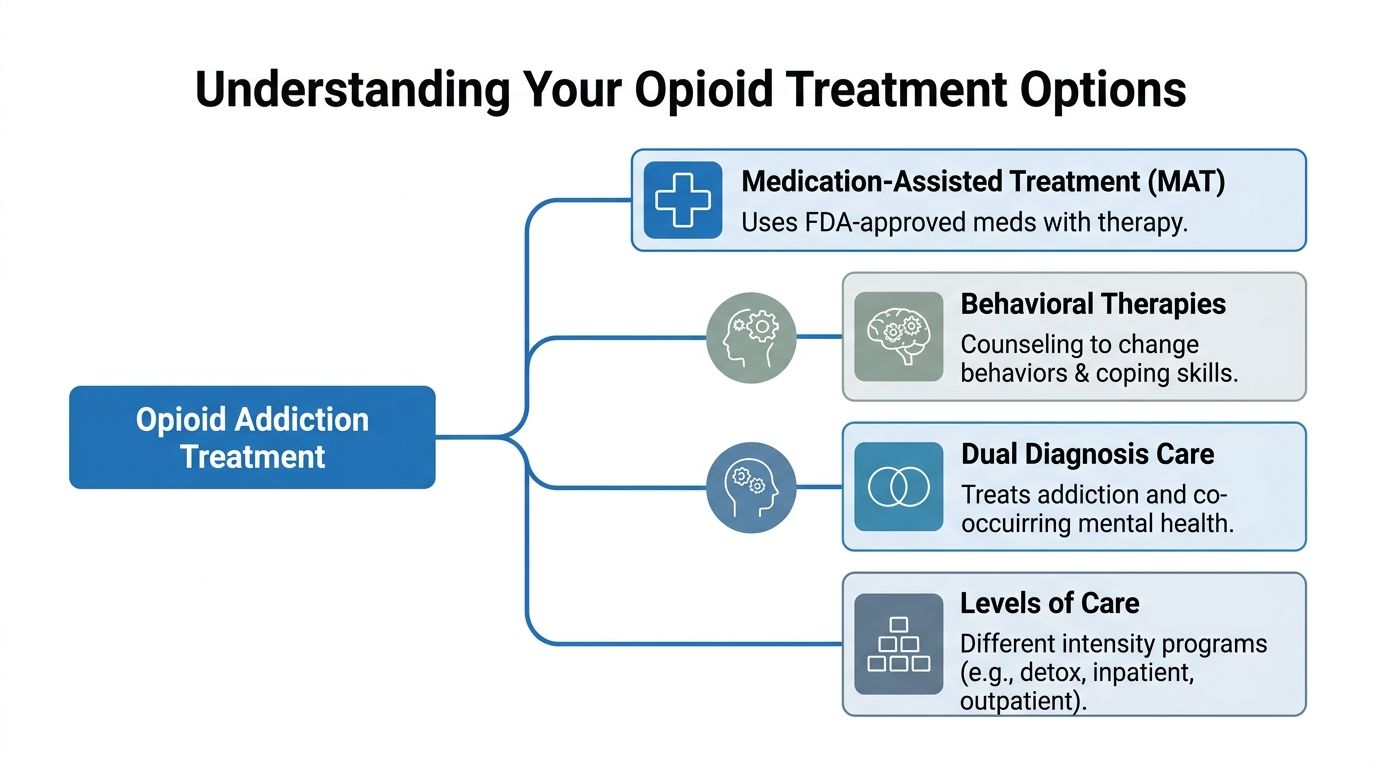
Levels of care in plain English
Partial Hospitalization Program (PHP) is one of the highest-intensity outpatient options. It usually involves several treatment hours on multiple days each week. PHP often fits people who need close structure and frequent clinical contact but do not need inpatient hospitalization.
Intensive Outpatient Program (IOP) offers meaningful structure with more room to keep working, attend school, or handle family responsibilities. Many people searching for opioid addiction treatment near me in Euless or Dallas are specifically looking for IOP because it gives them real treatment without requiring them to disappear from daily life.
Standard outpatient care is less intensive. It may include therapy, medication follow-up, recovery planning, and ongoing support once someone is stable enough for fewer sessions.
Consider this breakdown:
| Level of care | Typical fit | Daily life impact |
|---|---|---|
| PHP | High support needs, frequent symptoms, early stabilization | More time in treatment during the week |
| IOP | Moderate support needs, relapse risk, need for structure | More flexible for work or school |
| Outpatient | Ongoing recovery support, maintenance, step-down care | Least disruptive schedule |
Tip: A strong admissions process should recommend the level of care based on assessment, not on what is easiest to fill.
Why MAT matters for opioid use disorder
For opioid use disorder, Medication-Assisted Treatment (MAT) is not a shortcut. It is evidence-based care.
MAT combines therapy with FDA-approved medication such as Suboxone (buprenorphine) to reduce cravings and withdrawal. That matters because many people do not relapse from lack of motivation. They relapse because the physical pull of opioids stays intense, especially early on.
The treatment gap is large. In 2022, an estimated 9.37 million U.S. adults needed treatment for opioid use disorder, yet only 25.1% accessed medications for opioid use disorder, including buprenorphine, which are proven to substantially reduce overdose deaths according to the CDC.
That gap explains why so many people search for help repeatedly but never land in care that matches the medical reality of opioid addiction. A program that does not offer MAT may still provide counseling, but for many opioid-dependent patients, counseling alone does not address the full problem.
When dual diagnosis care belongs in the search
Many people do not use opioids in isolation from anxiety, depression, trauma, grief, panic, or insomnia. If mental health symptoms drive use, treatment should address both conditions at the same time.
Signs that dual diagnosis care should be part of the search include:
- Mood symptoms before or after use: Ongoing anxiety, depression, irritability, or emotional crashes.
- Sleep disruption: Difficulty sleeping without substances, or severe insomnia during attempts to stop.
- Trauma history: Past events that still affect safety, stress response, or relationships.
- Repeated relapse after treatment: Especially when previous care focused only on substance use.
A good local search is more effective when it includes specific terms, not just “rehab near me.” Searches like “Suboxone IOP Euless,” “PHP for opioid addiction Dallas,” or “dual diagnosis outpatient DFW” tend to produce more relevant options.
A Step-by-Step Guide to Finding Providers in Dallas-Fort Worth
A local search should do more than produce names. It should help narrow the field to providers that are legitimate, clinically appropriate, and realistic for the person’s schedule.
In the Dallas-Fort Worth area, distance matters, but fit matters more. A shorter drive does not help if the program lacks opioid-specific care or cannot accommodate work hours.
Start narrow, not broad
Broad searches often lead to directories, thin listings, or vague program pages. Better search terms include the service and the location.
Useful search combinations include:
- Opioid addiction treatment near me in Euless
- Suboxone outpatient Dallas-Fort Worth
- IOP for opioid addiction Dallas County
- Dual diagnosis opioid treatment Euless
For someone who wants to review one local option, this page for an addiction treatment center in Dallas Dallas County Texas shows the kind of location-specific information that should be easy to find.
What to look for on a provider website
The strongest websites answer practical questions quickly. They do not hide the basics.
A provider page should clearly state:
- Levels of care offered: PHP, IOP, outpatient, or another format.
- Whether MAT is available: This should be stated plainly, not buried.
- Whether dual diagnosis care is offered: Mental health treatment should appear as part of the clinical model.
- Admissions process: There should be a direct path to call, verify insurance, and schedule an assessment.
- Location details: The address, service area, and transportation reality should be easy to understand.
Watch for vague language. If a website repeatedly says “personalized healing” but never names therapies, medication support, or actual program structure, that is a sign to ask harder questions on the phone.
Questions to ask before booking an assessment
Some calls become much easier when the caller uses a short checklist. The goal is not to interrogate the admissions team. The goal is to find out whether the program can safely treat opioid use disorder in real life.
Consider asking:
- How do clinicians decide between PHP, IOP, and standard outpatient?
- Does the program offer MAT for opioid use disorder, including buprenorphine-based care when appropriate?
- How is mental health treatment handled if anxiety, depression, or trauma are part of the picture?
- What does a weekly schedule look like?
- Can the schedule work for employment, school, or parenting responsibilities?
- What happens after the initial assessment if the person needs a different level of care?
Key takeaway: Good providers answer direct questions directly. If basic clinical questions produce vague answers, the caller should keep looking.
There is another practical point. A center should be able to explain who performs assessments, how treatment plans are adjusted, and what happens if a patient misses a session or struggles early. Programs that treat opioid addiction well usually talk openly about relapse risk, medication follow-up, accountability, and support.
The search process can feel clinical on the surface, but it is personal underneath. The right provider should be able to discuss both. That balance matters in DFW, where many patients need serious treatment and a schedule they can sustain.
Confirming Essential MAT and Dual Diagnosis Care
For opioid use disorder, two features should move out of the “nice to have” category and into the essential category. Those features are MAT and dual diagnosis care.
Many programs can offer support. Fewer can deliver opioid treatment that matches how opioid addiction behaves over time.

What works better than therapy alone
Opioid addiction has both a behavioral side and a physical dependence side. Treating only one side leaves patients exposed.
Therapy helps people identify triggers, repair thinking patterns, learn coping skills, and rebuild daily structure. That work is essential. But cravings, withdrawal, and the body’s learned response to opioids can overpower insight alone.
Verified treatment data reflects that difference. Research summarized by The Recovery Village reports that approved medications for opioid use disorder reduce overdose deaths by 50% or more, and that combining medication with behavioral therapy produces better outcomes than medication alone as described here.
That is why a serious search for opioid addiction treatment near me should include medication capability from the start. If the center does not evaluate for MAT, the caller may need to keep searching.
A patient exploring local care can review a dedicated MAT program page to see the kind of service details that should be available before admission.
How to tell if dual diagnosis treatment is integrated
A program may say it treats co-occurring conditions. That phrase can mean very different things in practice.
True integration usually means the same treatment plan addresses both opioid use and mental health symptoms. It means the clinical team understands how anxiety, depression, trauma, panic, sleep disruption, and substance use interact. It also means treatment does not postpone mental health work until “after sobriety.”
Untreated psychiatric symptoms are a common cause of relapse. According to verified data, a 2024 NIH study found relapse rates for individuals with opioid addiction are up to 60% higher if co-occurring mental health disorders are not treated simultaneously, and a 2025 CDC report found 52% of U.S. opioid users have untreated anxiety or depression source: ccbhrecovery.com.
When a caller asks about dual diagnosis care, the answer should cover more than referrals. It should explain how the program handles:
- Assessment: Screening for anxiety, depression, trauma, and other conditions at intake.
- Treatment planning: One plan, not separate tracks that barely connect.
- Therapy mix: Individual therapy, group work, and practical coping skills.
- Medication coordination: Psychiatric care and addiction care working together.
- Family support: Help for the people who live with the day-to-day impact.
Tip: If the program says it can “refer out” for mental health treatment, that is not the same as integrated dual diagnosis care.
Some people worry that adding mental health treatment means treatment becomes too heavy or too complicated. In reality, the opposite is often true. When clinicians address panic, hopelessness, trauma symptoms, or chronic stress directly, patients usually understand their own relapse pattern more clearly.
That creates better day-to-day decisions. A person learns the difference between an opioid craving, an anxiety spike, a trauma trigger, and emotional exhaustion. Without that clarity, all discomfort can feel the same, and opioids can start looking like the fastest way to make the feeling stop.
The practical standard is simple. A strong outpatient opioid program should be able to explain how it manages medication support, therapy, relapse prevention, and co-occurring mental health care in one coordinated plan.
Navigating Insurance Verification and Treatment Costs
Cost fear stops many people before treatment even begins. That fear is understandable, but it should not end the search.
Insurance verification is the process of finding out what a plan covers, which services are included, and what costs may still belong to the patient. The clearer that picture becomes, the easier it is to move forward.

What insurance verification means
Verification usually checks whether the policy is active, whether the provider is in network or out of network, whether authorization is needed, and what level of care may be covered.
For many people, the most important question is not “Is rehab covered?” It is “Which parts are covered, under what conditions, and how long can this arrangement remain affordable?”
That question matters because staying in treatment matters. According to American Addiction Centers, fewer than 43% of individuals complete treatment programs, and 85% to 95% of those who complete treatment and receive aftercare maintain abstinence nine months later as summarized here. A plan that looks manageable on day one but falls apart financially after a short time can interrupt care at the worst point.
Questions to ask the insurance company
Before calling, the patient or family member should have the insurance card ready. It helps to write down answers during the call.
Questions worth asking include:
- Is substance use disorder treatment covered under this plan?
- Are PHP, IOP, outpatient visits, and medication management covered benefits?
- Does the plan require preauthorization for any of these services?
- What is the deductible status right now?
- What copay, coinsurance, or out-of-pocket responsibility may apply?
- Are telehealth or hybrid services covered if part of the schedule needs flexibility?
Questions to ask the admissions team
The treatment center should also be able to walk through the financial side in plain language. If the explanation feels evasive, that is useful information.
Ask the admissions team:
- Can you verify my insurance benefits directly?
- What level of care are you recommending, and why?
- What costs might still be my responsibility after insurance processes the claim?
- Do you offer payment options if there is a balance?
- If the recommended schedule changes, how could that affect cost?
A patient who wants a more detailed overview of the process can review this explanation of what is the process of verifying my insurance coverage for rehab.
Key takeaway: The right financial plan is not always the cheapest option on paper. It is the option the patient can realistically stay with long enough to benefit from treatment and aftercare.
There is also a trade-off many families miss. A very low-cost option that lacks MAT, dual diagnosis care, or a workable schedule can become more expensive in human terms if it leads to dropout, relapse, or another crisis. A sustainable plan should support continuity, not just admission.
What to Expect When You Start Your Recovery Journey
The first day of treatment feels smaller and more manageable when a person knows what will happen next. Most of the fear comes from uncertainty, not from the process itself.
For many adults in Euless, Dallas, and the wider DFW area, the start of treatment is less dramatic than expected. It is usually a series of conversations, assessments, and schedule decisions that turn a crisis into a plan.
The first phone call
The first call is often confidential and practical. The admissions coordinator usually asks what substances are being used, how recently they were used, whether there is any immediate safety concern, and what kind of help the person is seeking.
The caller may also be asked about work hours, school obligations, transportation, and insurance. That is not administrative small talk. Those details shape what kind of outpatient plan has a chance of working.
Flexible scheduling matters more than many people realize. A 2023 SAMHSA report noted that only 22% of U.S. opioid treatment facilities offer flexible IOP/PHP programs with MAT, and in the DFW area MAT retention for employed adults is 45% source: samhsa.gov. For working adults and students, treatment that ignores schedule reality can break down quickly.
The intake assessment and first treatment plan
After the call, the next step is usually a clinical assessment. This often includes substance use history, prior treatment, mental health symptoms, current stressors, medical issues, family environment, and practical risks.
A careful assessment does not rush to a label. It tries to answer key questions:
- Is the person stable for outpatient treatment right now?
- Would PHP or IOP provide the right amount of structure?
- Is MAT appropriate?
- Are anxiety, depression, trauma, or another mental health concern affecting use?
- What barriers could interfere with attendance?
This part can feel exposing, but it should not feel judgmental. A strong assessment gives the patient a map. It identifies where support is needed first and what should be monitored closely in the opening phase of care.
Tip: The first treatment plan does not need to solve everything at once. It needs to create safety, structure, and enough momentum for the next week.
What the first week can look like
The first week usually includes a blend of orientation, therapy, schedule adjustment, and medication-related appointments if MAT is part of the plan.
A person in PHP may spend more time in treatment across the week, with a stronger focus on stabilization, routine, and symptom monitoring. A person in IOP may attend structured sessions while continuing work or school around those hours.
Common elements include:
- Individual therapy: Focused conversations about triggers, history, goals, and relapse patterns.
- Group therapy: Skills work, accountability, peer support, and shared problem-solving.
- Medication follow-up: If MAT is being used, clinicians monitor response, symptoms, and practical needs.
- Recovery planning: Sleep, transportation, time management, family communication, and coping strategies.
- Aftercare thinking from the beginning: Not as an afterthought, but as part of early stability.
The emotional experience of the first week often surprises people. Many expect to feel judged or out of place. More often, they feel tired, relieved, uneasy, hopeful, and mentally overloaded all at once. That combination is common.
For professionals and students, another shift happens early. The schedule stops feeling like an obstacle and starts feeling like structure. When treatment hours are designed around real life instead of against it, people are more likely to keep showing up.
One local option in this category is Maverick Behavioral Health, an outpatient center serving Euless and Dallas-Fort Worth with PHP, IOP, standard outpatient care, MAT including Suboxone, and dual diagnosis services.
Take the First Step Today Your Path Forward Starts Here
A search for opioid addiction treatment near me can feel overwhelming because it asks a struggling person to make clear decisions under pressure. The process becomes easier when it is narrowed to a few essentials.
The right search looks for a local program that offers the appropriate level of care, treats opioid use disorder with MAT when clinically indicated, addresses co-occurring mental health needs, and can fit real-life responsibilities in Dallas-Fort Worth. It also helps to understand the admissions steps, ask direct questions, and get insurance clarified early.
For someone in Euless, Dallas, or the surrounding DFW area, outpatient treatment can be a practical path when work, school, or family obligations make inpatient disruption difficult. Flexible IOP and PHP schedules, medication support, and coordinated therapy can turn “near me” from a desperate search term into a real starting point.
Recovery does not begin when everything is figured out. It begins when one honest conversation happens. For a person struggling with opioids, or for a family trying to help, that conversation can create immediate direction and relief.
If help is needed now, contact Maverick Behavioral Health for a confidential conversation about opioid treatment options in Euless and the Dallas-Fort Worth area. The admissions team can discuss outpatient care, MAT, dual diagnosis support, and insurance verification. Call (888) 385-2051 to speak with someone who can help.