


At first glance, Xanax and Adderall couldn't be more different. One is a brake, the other an accelerator. Xanax is a depressant that calms the central nervous system, while Adderall is a stimulant that kicks it into high gear. They are powerful, non-interchangeable prescription drugs developed for completely separate medical conditions. Getting this basic fact straight is the first step in understanding their distinct benefits and considerable risks.
Understanding Xanax And Adderall
When you compare Xanax vs. Adderall, it really is like weighing the function of a brake pedal against a gas pedal. Both are potent tools with legitimate medical applications, but they push the body's systems in opposite directions. Xanax (alprazolam), a benzodiazepine, is engineered to rapidly dial down anxiety and stop panic attacks in their tracks. Adderall, a mix of amphetamine salts, is a stimulant prescribed to sharpen focus and boost alertness for people with Attention-Deficit/Hyperactivity Disorder (ADHD).
This fundamental difference in how they work governs everything about them, from their immediate effects and side effects to their potential for addiction. For our communities here in the Dallas and Euless areas, being able to spot the signs of misuse for either substance is a vital part of keeping friends and family safe.
High-Level Comparison Of Xanax And Adderall
To see just how different these two medications are, this table offers a clear snapshot of their opposing roles. It breaks down their drug class, approved uses, and the feelings they produce, setting the stage for a deeper look at their risks.
| Attribute | Xanax (Alprazolam) | Adderall (Amphetamine/Dextroamphetamine) |
|---|---|---|
| Drug Class | Benzodiazepine (Depressant) | Stimulant |
| Primary Use | Treatment of anxiety and panic disorders | Treatment of ADHD and narcolepsy |
| Mechanism | Enhances GABA, a calming neurotransmitter | Increases dopamine and norepinephrine levels |
| Common Effects | Sedation, relaxation, reduced anxiety | Increased focus, energy, and alertness |
| Street Names | "Xans," "Bars," "Zanbars," "Planks" | "Speed," "Uppers," "Study Buddies," "Addys" |
A Look At Prescription Drug Misuse
While their medical purposes are worlds apart, both Xanax and Adderall are unfortunately common players in prescription drug abuse. The numbers are frankly startling. Among people misusing prescription psychotherapeutic drugs, stimulants like Adderall account for 28.3% of cases, and tranquilizers like Xanax are right behind at 27.8%.
What's concerning is that while the overall numbers are similar, the reasons and patterns of misuse are quite different. People might misuse Adderall to cram for an exam or Xanax to self-medicate for stress. Understanding these different pathways to misuse is key to helping people find a healthier way forward. You can review more detailed findings on prescription drug abuse patterns.
The decision to use either medication must always be guided by a qualified medical professional. Self-medicating with someone else's prescription or mixing these drugs is a dangerous path that can lead to severe health consequences, including dependence, addiction, and overdose.
For anyone in the Euless or Dallas area who feels like their use of prescription medication is becoming a problem, please know that confidential and effective help is right here. Recognizing there's an issue is a huge step, but taking action is what truly begins the healing process. If you have concerns about your use of Xanax or Adderall, call Maverick Behavioral Health at (888) 385-2051 to speak with our compassionate team today.
How Xanax And Adderall Affect The Brain And Body
On the surface, Xanax and Adderall are both well-known prescription drugs. But in terms of how they work, they couldn't be more different. One acts as the brain's emergency brake, while the other floors the gas pedal. Understanding this fundamental opposition is key to seeing why they’re prescribed for completely different reasons—and why misusing them can be so incredibly dangerous.
Xanax: The Central Nervous System Depressant
Xanax belongs to a class of drugs called benzodiazepines. Its primary job is to enhance the effects of a neurotransmitter known as gamma-aminobutyric acid (GABA). Think of GABA as your body’s main calming agent; it’s responsible for slowing down nerve cell activity and reducing excitement in the brain.
By giving GABA a major boost, Xanax essentially quiets the entire central nervous system. This produces the sedative, anti-anxiety effects it’s known for, bringing quick relief during a panic attack or period of intense anxiety. While highly effective, this rapid relief is a double-edged sword. The effects wear off relatively quickly, which can create a powerful psychological pull to take another dose, laying the groundwork for tolerance and dependence.
Adderall: The Central Nervous System Stimulant
Adderall does the exact opposite. As a potent stimulant, it ramps up the activity of two different neurotransmitters: dopamine and norepinephrine. These brain chemicals are essential for regulating attention, alertness, and the brain's reward system.
By increasing the available levels of these messengers, Adderall creates a state of heightened focus, energy, and mental clarity. This is precisely why it works so well for managing ADHD symptoms—it helps organize brain signals and improve executive function. However, the surge of dopamine also produces a strong feeling of euphoria, which is the primary mechanism behind its high potential for misuse and addiction.
This side-by-side comparison highlights just how different these two medications are, from their chemical action to their intended purpose.
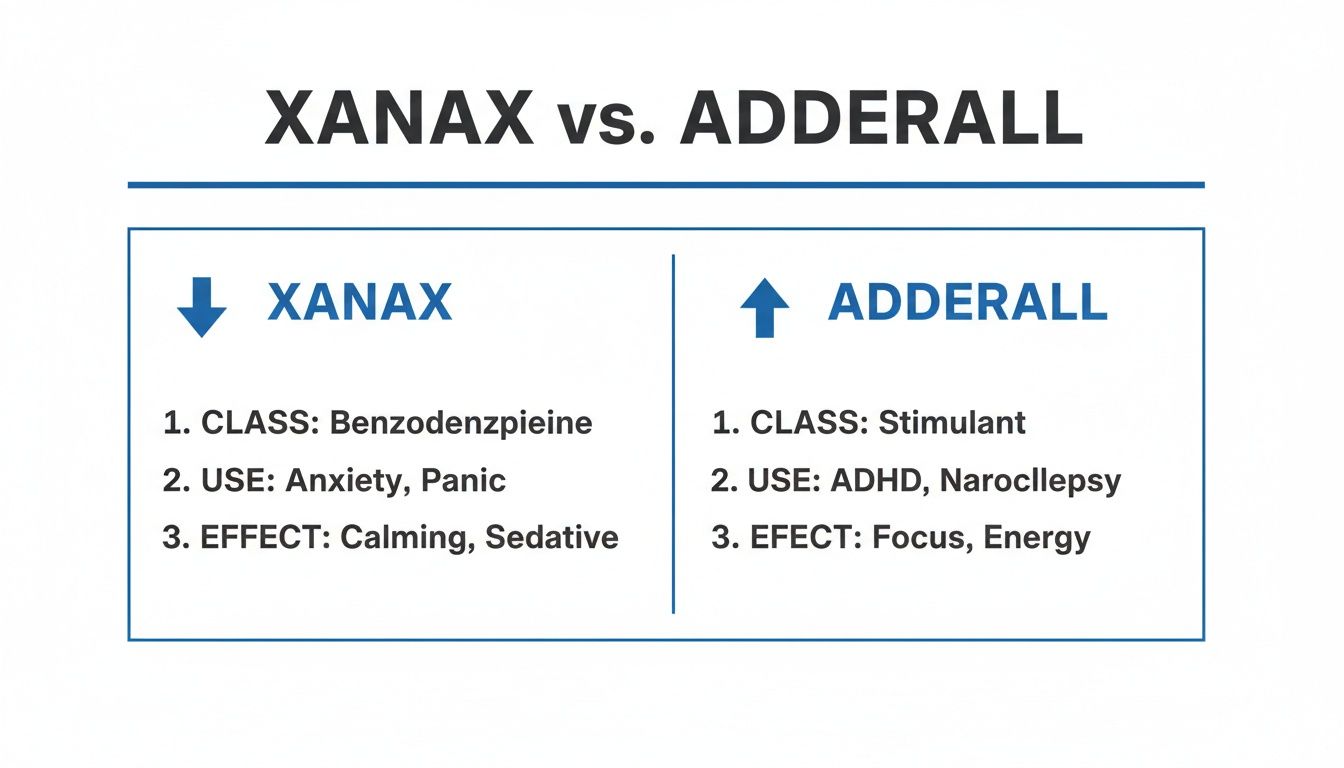
As you can see, one is a "downer" and the other is an "upper." Their effects aren't just different; they are diametrically opposed.
Pharmacological And Effects Profile Of Xanax vs Adderall
The different ways Xanax and Adderall work at a chemical level translate into vastly different experiences for the person taking them. This is true whether they are used for medical reasons or are being misused. One brings on sedation and calm, while the other produces stimulation and intense focus.
The table below breaks down the key distinctions in their pharmacological profiles and what that means in practical terms.
| Attribute | Xanax (Alprazolam) | Adderall (Amphetamine Salts) |
|---|---|---|
| Primary Neurotransmitter | Boosts GABA (Gamma-aminobutyric acid) | Increases Dopamine & Norepinephrine |
| Primary Drug Class | Benzodiazepine (Depressant) | Amphetamine (Stimulant) |
| Physical Effects | Slows heart rate and breathing; muscle relaxation; reduces anxiety. | Increases heart rate, blood pressure, and breathing; boosts alertness. |
| Mental Effects | Feelings of calm, relaxation, and drowsiness. Can impair memory and coordination. | Feelings of focus, high energy, confidence, and suppressed appetite. Can cause anxiety and paranoia. |
| Medical Use | Primarily for panic disorder and anxiety disorders. | Primarily for ADHD and narcolepsy. |
| Typical Onset & Duration | Rapid onset (within an hour), shorter duration (3-6 hours). | Slower onset, longer duration (4-12 hours, depending on the formula). |
Ultimately, their opposing mechanisms are why they are never prescribed together to be taken at the same time and why polydrug use involving both is so dangerous.
A Critical Warning: Mixing Xanax and Adderall is a game of Russian roulette. The stimulant effects of Adderall can easily hide the sedative effects of Xanax. This makes it possible to take a dangerously high, and even fatal, dose of the benzodiazepine without realizing it, leading to profound respiratory depression where breathing slows down or stops completely.
If you or someone you care about in the Dallas or Euless area is struggling with prescription drug misuse, understanding the "why" is the first step toward getting help. At Maverick Behavioral Health, we specialize in helping people untangle the complex reasons behind their substance use. Call our team at (888) 385-2051 for a completely confidential call to learn how our outpatient programs can put you on the path to recovery.
Approved Medical Use Versus High-Risk Misuse
When a doctor prescribes them, both Xanax and Adderall can be incredibly effective medications. But there's a fine line between legitimate medical treatment and high-risk misuse, and understanding that distinction is key to preventing a substance use disorder from taking root—a growing worry for families across Dallas and Euless.
The difference really comes down to intent, dosage, and context. A prescription is meant to provide a specific dose for a diagnosed condition under a doctor’s watch. Misuse is anything outside of that, whether it's taking the drug for recreation, in higher amounts than prescribed, or without a prescription altogether.
Adderall: From ADHD Treatment to a Dangerous Crutch
Adderall is federally approved to treat Attention-Deficit/Hyperactivity Disorder (ADHD) and narcolepsy. For someone with these conditions, the medication can be a game-changer. It helps balance brain chemistry to improve focus, dial down impulsivity, and promote wakefulness, allowing them to function more easily day-to-day.
The problem is its reputation as a "study drug" or performance enhancer. This has led to widespread misuse among students and professionals trying to pull all-nighters or get a competitive edge. They often see it as a harmless productivity tool, but this is exactly where the danger starts.
Its sheer availability makes it a prime candidate for being diverted and abused. In fact, Adderall remains the most frequently prescribed and misused prescription stimulant in the United States. As of 2026, amphetamine-based medications accounted for 49% of all stimulant prescriptions. This is especially true for young people and adults; one university study found that Adderall was involved in 42.9% of past-year prescription stimulant misuse. You can dig deeper into these numbers in the full report on stimulant statistics from the U.S. DEA.
Xanax: From Anxiety Relief to Self-Medication
On the other side, Xanax is approved for the short-term treatment of generalized anxiety disorder and for managing acute panic disorder. When someone is in the grip of a debilitating panic attack, Xanax works quickly to calm the central nervous system and provide powerful relief. It’s designed to be an emergency brake for overwhelming psychological distress.
The risk with Xanax appears when it becomes a go-to fix for everyday stress or a way to fall asleep. This kind of self-medication can rapidly spiral into dependence. Someone might take an unprescribed pill to handle work pressure, then find they "need" it to unwind every night. That's how the line between coping and craving gets blurred. Our guide to prescription medication rehab in the Dallas area offers more insight into this cycle.
A common scenario we see involves a person who was legitimately prescribed Xanax after a traumatic event. As life returns to normal, they continue using it to manage minor daily stressors. Soon, they feel anxious without it and start taking more than prescribed, convinced they can't function otherwise. This is the slippery slope from appropriate use to a serious substance use disorder.
This shift from a medical tool to a psychological crutch is often subtle. What began as a solution slowly becomes the problem itself, eventually requiring professional help to break free. Recognizing these warning signs is the first step.
If any of this sounds familiar, don't wait for a crisis. Call Maverick Behavioral Health at (888) 385-2051 for a confidential conversation about your options for treatment right here in the Dallas-Fort Worth area.
Dependence and Withdrawal: Two Very Different Dangers
While both Xanax and Adderall are notorious for their high addiction potential, the way a person becomes dependent and the experience of withdrawal are worlds apart. It's a critical distinction. We're talking about two completely different kinds of crises—one a physical battle that can be life-threatening, the other a psychological crash that can feel just as devastating.

This split comes down to how each drug works. Xanax, a benzodiazepine, is a powerful central nervous system depressant. People are drawn to its immediate, calming effect, a feeling that can quickly spiral into a dangerous physical need. In fact, 3.4 million people in the U.S. misused alprazolam in the last year alone, often chasing that tranquil state. You can read additional insights on the long-term effects of alprazolam to see just how serious this can become.
The Physical Peril of Xanax Withdrawal
Dependence on Xanax can sneak up on you with alarming speed, sometimes taking hold after just a few weeks of consistent use. It works by boosting GABA, the brain's main "braking" neurotransmitter. Your body, always trying to maintain balance, quickly adapts by producing less of its own GABA.
Take the Xanax away, and the brain suddenly has no brakes. The result is a state of severe over-excitation, leading to a withdrawal syndrome that is not just excruciating but can be medically life-threatening. Symptoms often start within hours and can include:
- Intense, rebounding anxiety and full-blown panic attacks
- Severe insomnia and an inability to rest
- Heart palpitations and dangerously high blood pressure
- Hallucinations or delirium
- Grand mal seizures, which can be fatal
Because the risks are so severe, no one should ever try to quit Xanax "cold turkey" or without a doctor's guidance. A medically supervised detox is absolutely essential to taper the dosage safely and manage these dangerous symptoms.
The Psychological Crash of Adderall Withdrawal
Adderall withdrawal, on the other hand, is primarily a psychological ordeal, though no less disruptive. Dependence forms as the brain gets used to the constant flood of dopamine and norepinephrine. Soon, a person doesn't just need the drug to focus—they need it to feel motivated, energetic, or even just okay.
When the drug is stopped, the user experiences a profound "crash." The brain, now starved of the stimulation it has come to rely on, struggles to function. While it's not typically life-threatening like benzo withdrawal, the symptoms are debilitating:
- Overwhelming fatigue and sleeping for long periods (hypersomnia)
- A total inability to feel pleasure (anhedonia)
- Crushing depression, sometimes with suicidal thoughts
- Powerful, all-consuming drug cravings
- Poor concentration and a persistent mental "fog"
This deep psychological low often becomes the very thing that drives a person right back to using, just to escape the misery and feel normal again. It's a powerful trap. If you recognize this cycle, understanding the available types of addictions we treat can be the first step toward breaking free.
Differentiating Overdose Signs: An Emergency Guide
Overdose is another area where the Xanax vs. Adderall comparison reveals stark, life-or-death differences. Knowing these signs is vital, especially for anyone in the Euless or Dallas area who may be around someone misusing these powerful medications.
Signs of a Xanax (Depressant) Overdose:
- Extreme drowsiness or being unable to stay awake
- Slow, shallow, or stopped breathing (respiratory depression)
- Slurred speech and severe confusion
- Loss of coordination, stumbling like they're drunk
- Bluish lips or fingernails from lack of oxygen
- Becoming unresponsive or slipping into a coma
Signs of an Adderall (Stimulant) Overdose:
- Extremely rapid heart rate, heart palpitations, or chest pain
- Dangerously high blood pressure and body temperature (hyperthermia)
- Severe agitation, aggression, or paranoia
- Hallucinations or seizures
- A major cardiovascular event, like a heart attack or stroke
Mixing these two is a recipe for disaster. The stimulant effects of Adderall can hide the signs of a depressant overdose, meaning a person could stop breathing without anyone realizing the immediate danger. If you or a loved one in Dallas-Fort Worth is caught in this cycle, professional help is the only safe way out. Call Maverick Behavioral Health at (888) 385-2051 for a completely confidential conversation.
Finding Specialized Addiction Treatment In Dallas-Fort Worth
Grasping the key differences between Xanax and Adderall, along with their distinct risks, is a huge first step. But the most important step is what comes next: getting help. For those living in Euless, Dallas, and the surrounding DFW area, specialized and compassionate care isn't far away—it's right here in your community.

It’s completely normal to feel overwhelmed when you’re thinking about getting help for a prescription drug problem. You don't have to figure it all out on your own. At Maverick Behavioral Health, we’ve created a supportive environment where your recovery comes first. We specialize in treating dependence on substances like Xanax and Adderall, offering expert care that gets to the root of the issue.
Outpatient Care Designed For Real Life
We know that many people put off treatment because they can't imagine putting their entire life on pause. That’s exactly why our outpatient programs are structured to fit into your daily life. You can get the high-quality treatment you need without stepping away from your job, classes, or family commitments.
Our programs offer different levels of support:
- Partial Hospitalization Program (PHP): This is our most structured outpatient option. It involves several hours of therapy and support on most days of the week, making it a great alternative to residential treatment or a solid step down for those who need a high level of care.
- Intensive Outpatient Program (IOP): Our IOP provides a more flexible schedule. With fewer required hours than PHP, it's perfect for people transitioning from a more intensive program or for those in the Dallas area who need consistent support while keeping up with their daily routines.
The real goal here is to build a foundation for recovery that genuinely works for your life. By delivering structured care in an outpatient setting, we give you the chance to practice new coping skills in real time, building your resilience right where it matters most—in your everyday environment.
Expertise In Dual Diagnosis Treatment
Addiction to a prescription medication like Xanax or Adderall rarely happens in a vacuum. Very often, it’s connected to an underlying mental health challenge. Someone might start misusing Xanax to self-medicate a panic disorder, for example, or their Adderall use might get tangled up with co-occurring depression.
Maverick Behavioral Health is a leader in dual diagnosis treatment. Our clinical team is specifically trained to identify and treat both the substance use disorder and any co-occurring mental health conditions at the same time. This integrated approach is absolutely critical for lasting healing. Trying to fix one problem while ignoring the other often just leads back to square one.
You can get a better sense of how we support our community by reading our guide to finding an addiction treatment center in Dallas County, Texas. We work with you to create a personalized plan that respects your individual story and gives you the tools to manage both conditions for good.
If you or someone you care about in Euless or the DFW metroplex is struggling with Xanax or Adderall, the path forward starts with one brave step. Our team at Maverick Behavioral Health is here to offer the confidential, professional, and supportive care you deserve.
Take the first step toward a healthier future. Call our compassionate care team today at (888) 385-2051 for a free, completely confidential consultation.
Frequently Asked Questions About Xanax And Adderall
When it comes to medications as potent as Xanax and Adderall, a lot of myths and questions bubble up. Getting straight, honest answers is the first step toward staying safe. Here, we tackle some of the most common questions we hear from people just like you, cutting through the noise to give you the facts.
Can You Take Xanax And Adderall Together?
The short answer? No. Unless a single, coordinating physician is overseeing your care for a specific reason, you should never mix these two drugs. People sometimes refer to this combination as a "speedball," and it sends your body completely contradictory signals. Adderall is revving up your heart and central nervous system, while Xanax is hitting the brakes on your breathing and other critical functions.
This creates an incredibly dangerous situation where one drug can mask the overdose signs of the other. You might not feel how sedated you are from the Xanax because the stimulant is keeping you awake, leading you to take a dose that could be lethal. This push-and-pull puts an immense strain on your heart and lungs, dramatically increasing the risk of a heart attack, respiratory failure, or stroke.
Which Is More Addictive, Xanax Or Adderall?
This is a common question, but it’s a bit of a trick one. Both Xanax and Adderall have a high potential for addiction, but they get you there through very different mechanisms. It’s not about which one is "more" addictive; it's about understanding their unique risks.
- Xanax: Physical dependence can set in alarmingly fast—sometimes within just a few weeks of daily use. The withdrawal from Xanax is known for being particularly brutal and can include life-threatening seizures. This is why a medically supervised detox is absolutely essential.
- Adderall: For many, addiction begins psychologically. You might start to feel like you can't be productive, confident, or even just energetic without it. This mental reliance is what drives the compulsive use. While the withdrawal isn't typically fatal, the "crash"—marked by severe depression and crushing fatigue—can feel unbearable and lead right back to using.
Ultimately, debating which is worse is a distraction. Both substances can lead to a substance use disorder that can completely derail your life, and both require professional support to overcome.
Does Having ADHD Prevent Adderall Addiction?
That’s a dangerous myth. Having a legitimate ADHD diagnosis does not make you immune to developing an addiction to Adderall. While the drug is a game-changer for managing ADHD symptoms when taken exactly as prescribed, it’s still a powerful amphetamine with a significant risk for misuse.
The danger zone begins when you stray from your prescription. Taking more than your prescribed dose, using it for non-medical reasons like studying all night, or starting to feel like you can’t function without it are all red flags. If you have ADHD and are starting to worry about your relationship with Adderall, please know that help is available. Our dual diagnosis program right here in Euless, TX, is specifically designed to treat both ADHD and a substance use disorder at the same time.
Where Can I Get Help For Addiction In The Dallas Area?
If you or someone you care about in the Dallas-Fort Worth area is struggling with prescription drug misuse, Maverick Behavioral Health is ready to help. Our facility in Euless offers specialized outpatient programs (PHP and IOP) that are built to treat Xanax and Adderall addiction effectively.
Our outpatient approach provides the structure and support you need for recovery while giving you the flexibility to keep up with your responsibilities at work, school, or home. We know the first step is the hardest, but it's also the most important one you'll ever take.
Don't let another day go by. You can reclaim your life from prescription drug dependence. Maverick Behavioral Health offers compassionate, evidence-based care for people across Euless, Dallas, and the entire DFW metroplex. Call our team today at (888) 385-2051 for a free, 100% confidential assessment and learn more about our outpatient treatment options.