



Some people search “sublocade doctor near me” after one more difficult morning with daily medication. The routine may already be helping, but it can still feel like recovery revolves around a pill strip, a pharmacy run, or the stress of keeping everything on schedule. For adults in Euless, Dallas, and the wider DFW area, that search usually means one thing: life needs to feel steadier, simpler, and less fragile.
That search also often comes with private questions. Is a monthly shot really easier? Is it safe? Will insurance cover it? What happens at the first appointment? Those questions deserve straight answers, especially when opioid use disorder treatment already feels overwhelming enough.
Table of Contents
- Tired of Daily Doses? A New Path for Opioid Recovery
- What Is Sublocade and How Does It Work?
- Is Sublocade the Right Choice for Your Recovery?
- Your Step-by-Step Path to Starting Sublocade Treatment
- Navigating Insurance and Cost for Sublocade in Texas
- Find Your Sublocade Doctor at Maverick Behavioral Health
- Answering Your Questions About Sublocade Treatment
Tired of Daily Doses? A New Path for Opioid Recovery
A common situation looks like this. Someone has started doing the hard work of recovery, but every day still begins with the same mental checklist: take medication, protect it, remember it, plan around it, and worry about what happens if a day gets chaotic. Even when treatment is working, daily dosing can keep opioid use disorder at the center of the day.
That’s why the search for a sublocade doctor near me is often really a search for breathing room. People want fewer moving parts. They want to focus on work, family, therapy, sleep, and rebuilding trust without feeling tethered to a daily medication routine.
Practical rule: The best medication plan isn’t the one that sounds simplest on paper. It’s the one a person can realistically follow during real life stress.
For some adults with opioid use disorder, a monthly option creates that stability. It doesn’t replace counseling, structure, or support. It can, however, remove one daily pressure point that often makes recovery feel harder than it needs to be.
In the Euless and Dallas area, that matters. Treatment works better when it fits a person’s actual life, not an ideal schedule.
What Is Sublocade and How Does It Work?
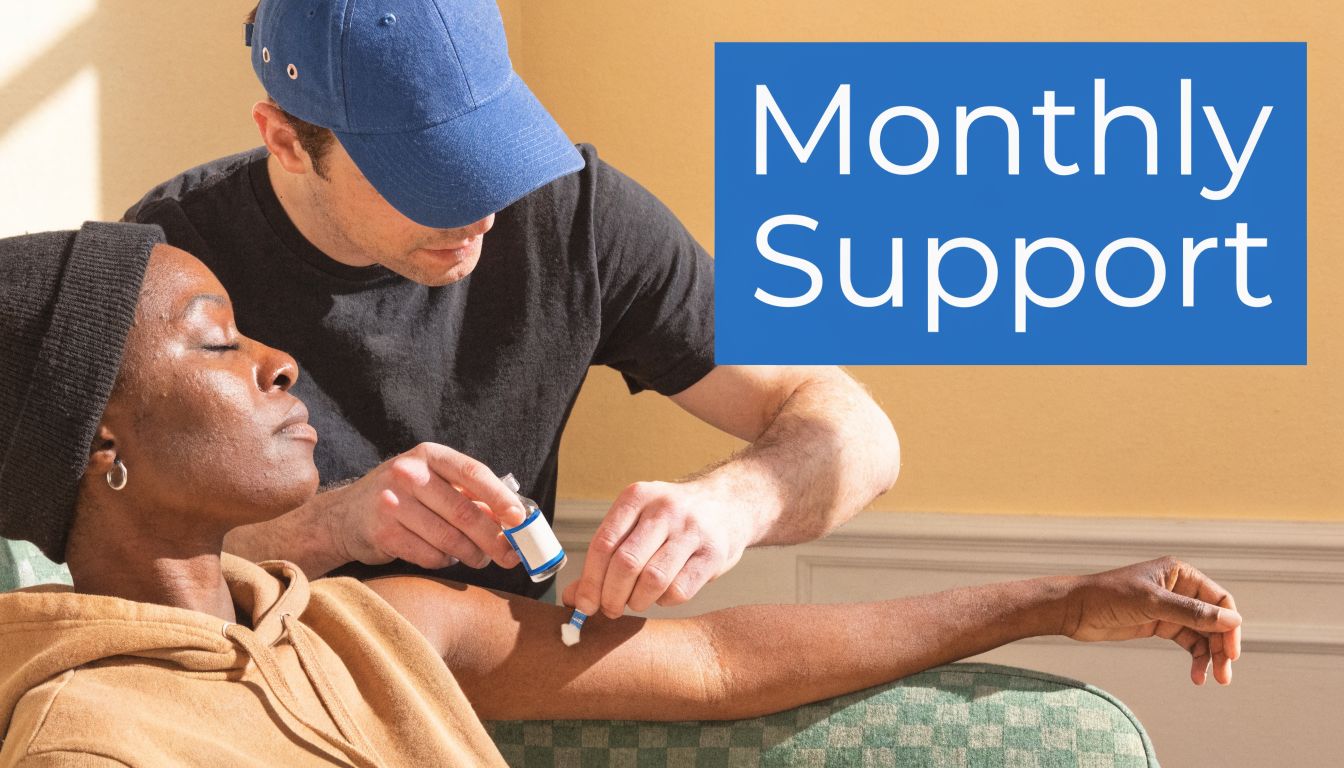
Sublocade is a once-monthly buprenorphine injection used for adults with moderate to severe opioid use disorder. A healthcare professional gives it as a subcutaneous injection, which means it’s placed just under the skin rather than taken as a daily pill or film.
A steady medication reservoir
The easiest way to think about Sublocade is as a steady medication reservoir. After the injection, it forms a depot under the skin and releases buprenorphine gradually for about a month. That long-acting design is why many patients see it as a practical alternative to daily dosing.
Sublocade’s subcutaneous depot formulation provides sustained-release buprenorphine for approximately 30 days, which helps reduce cravings while also blocking the euphoric effects of other opioids, according to this overview of Sublocade treatment.
That steady release matters because recovery often gets harder when medication levels rise and fall with missed doses, late doses, or day-to-day disruptions. A monthly injection doesn’t solve every problem, but it can create a more consistent treatment foundation.
Why monthly treatment can feel different
Buprenorphine is a partial opioid agonist. In plain language, that means it activates opioid receptors enough to reduce cravings and withdrawal, but not in the same way as full opioid agonists. That’s why it’s used in medication-assisted treatment for opioid use disorder.
What tends to work well with Sublocade is the combination of stability and reduced decision fatigue. Instead of managing medication every day, the person attends scheduled appointments and lets the medication do its work in the background.
A few practical advantages stand out:
- Less daily disruption: There’s no need to remember a dose every morning or carry medication through the day.
- More consistent support: The depot releases medication gradually instead of relying on daily adherence.
- Better fit for structured care: It can pair well with counseling and a broader medication-assisted treatment program when someone needs both medication and therapeutic support.
Monthly medication often works best for people who don’t want recovery to depend on getting every single day exactly right.
Is Sublocade the Right Choice for Your Recovery?
Sublocade can be an excellent fit for some adults, but it isn’t automatically the right fit for everyone. A careful doctor won’t treat that as bad news. It’s a sign that the decision is being made for safety, comfort, and long-term stability rather than speed alone.
Who it’s designed for
Clinically, Sublocade is used for adults with moderate to severe opioid use disorder. It can be especially appealing for people who are tired of daily dosing, have trouble staying consistent with oral medication, or want a long-acting treatment option that reduces day-to-day medication management.
A strong study supports its use. In a 24-week clinical trial, 28% of patients receiving Sublocade plus counseling were free of illicit opioids for at least 80% of the weeks, compared with 2% of patients receiving placebo plus counseling, according to the official provider information for Sublocade.
That doesn’t mean every patient has the same result. It does show that this medication can play a meaningful role in reducing illicit opioid use when it’s prescribed appropriately and combined with counseling.
Why the first week matters
One detail surprises many people. Before starting Sublocade, patients generally need to be stabilized on oral buprenorphine for at least seven days. That step isn’t a bureaucratic hurdle. It’s a clinical safety measure.
That first week helps answer practical questions:
| Question | Why it matters |
|---|---|
| Does the person tolerate buprenorphine well? | A doctor needs to confirm the medication is a safe fit before moving to a long-acting injection. |
| Are withdrawal and cravings responding? | Early stabilization shows whether buprenorphine is helping in the expected way. |
| Is the patient ready for monthly treatment? | The transition works best when the foundation is already steady. |
Some clinical settings may offer same-day start pathways for certain treatment-naive patients, but the decision has to be individualized and medically supervised. The right approach depends on the person’s opioid use, current withdrawal status, treatment history, and overall stability.
A thoughtful assessment protects the patient. In opioid treatment, “fast” only helps when it’s also clinically sound.
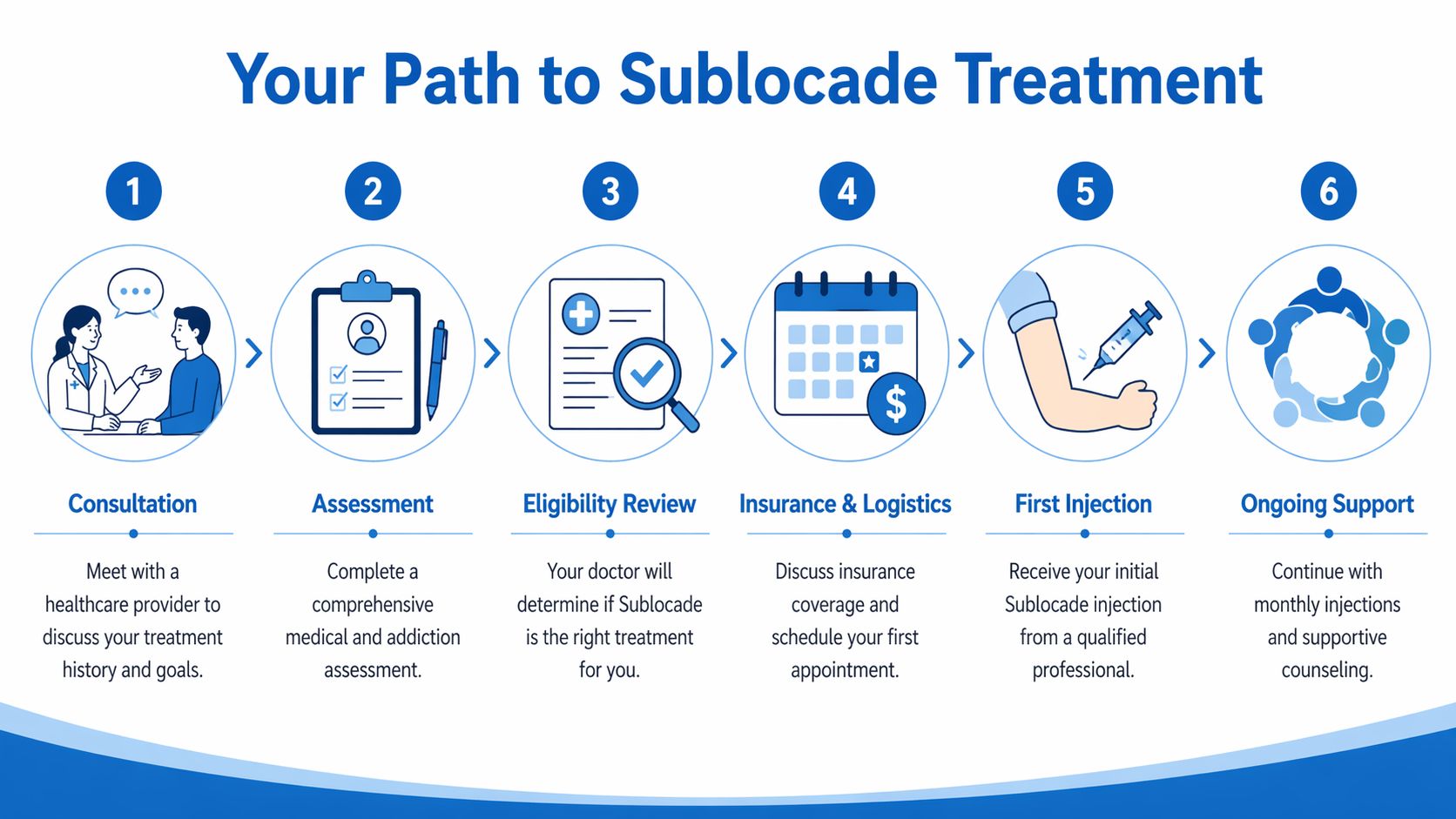
Your Step-by-Step Path to Starting Sublocade Treatment
Starting treatment usually feels less intimidating once the process is clear. The path to Sublocade is structured, but it isn’t complicated when a team handles it well.
Step 1 and step 2
The first step is a confidential assessment. This appointment usually covers opioid use history, current symptoms, prior treatment, medical factors, mental health concerns, and practical goals. The goal isn’t to judge. It’s to match the person with the safest and most workable plan.
Next comes oral buprenorphine stabilization. For many patients, that means spending at least seven days on oral buprenorphine before moving to the injection. During that period, the clinician watches for tolerance, symptom relief, and whether the medication is a good fit.
These early appointments often answer the questions people are most afraid to ask out loud:
- Will this medication make daily life easier? The induction period helps show whether buprenorphine improves stability.
- What if treatment needs to be adjusted? That’s normal. Early treatment often involves small clinical adjustments.
- Can this stay private? Yes. Confidentiality should be part of care from the first call forward.
Step 3 and step 4
Once a patient is clinically ready, the provider schedules the first Sublocade injection. Because it must be administered by an authorized healthcare professional, this isn’t a self-managed medication. That’s part of what makes it feel more structured and, for many people, more dependable.
After the first injection, care shouldn’t stop at medication. The strongest outpatient plans include ongoing monitoring, counseling, and real recovery support between visits.
A practical monthly pattern often looks like this:
- Medical follow-up: The clinician checks how cravings, withdrawal symptoms, and daily functioning are going.
- Therapy participation: Many patients do better when medication is paired with counseling or a structured outpatient program.
- Scheduling the next injection: Consistency matters. The next appointment is usually planned before the patient leaves.
- Problem-solving early: If work, transportation, or family demands could affect attendance, the team addresses that before it becomes a treatment gap.
Recovery tends to hold when the plan accounts for ordinary life problems, not just the medical ones.
In the Dallas-Fort Worth area, some specialized providers report new patient intake availability within 24 hours, which can help reduce dangerous delays in treatment access, according to Texas Sublocade access information. That kind of responsiveness matters because waiting too long can derail momentum at exactly the wrong time.
Navigating Insurance and Cost for Sublocade in Texas
Cost is one of the main reasons people postpone care. It’s also one of the biggest sources of confusion, because the question usually isn’t just “Is this covered?” It’s “What will insurance approve, how long will it take, and what will be left for the patient to pay?”
What usually creates delays
Sublocade can be expensive without coverage. Many patients hit friction around prior authorization, pharmacy benefit rules, and figuring out whether the medication is billed under medical or pharmacy coverage. The paperwork can feel almost impossible when someone is already trying to stay stable.
While out-of-pocket costs for Sublocade can be high, many PPO insurance plans do provide coverage, and treatment centers may offer insurance verification support to help manage pre-authorization requirements and reduce patient costs, according to this guide on checking rehab insurance before treatment.
What helps most
The most effective approach is simple. Let the admissions or insurance team verify benefits before treatment starts, explain what the plan appears to cover, and flag any likely delays early.
Patients should expect help with:
- Insurance verification: Confirming active benefits and reviewing likely coverage for medication and outpatient care.
- Authorization support: Identifying whether prior approval is needed before the first injection.
- Clear next steps: Explaining what documents, prescriptions, or appointments need to happen first.
A financial question should never become the reason someone gives up on treatment before even speaking to a clinician. In most cases, the fastest path is to ask for verification help right away and let the treatment team sort through the details.
Find Your Sublocade Doctor at Maverick Behavioral Health
For someone typing sublocade doctor near me in Euless or Dallas, local care should mean more than a name in a directory. It should mean access to a real treatment setting, a confidential assessment, help with insurance, and a plan that connects medication with therapy and follow-through.
What local treatment should include
A monthly injection works best when it sits inside broader recovery care. That may include individual therapy, group therapy, dual diagnosis support, intensive outpatient treatment, or step-down outpatient services depending on the person’s needs.
People in DFW often need practical flexibility too. Work schedules, parenting responsibilities, transportation limits, and privacy concerns all affect whether treatment remains consistent.
For readers who also want to understand broader options for opioid addiction treatment near them, local outpatient care can offer a path that’s structured without requiring full residential treatment.
A practical next step in Euless
Maverick Behavioral Health serves Euless and the greater Dallas-Fort Worth area with outpatient substance use and mental health treatment, including medication-assisted care as part of a more complete recovery plan. In the DFW area, specialized providers offering integrated Sublocade services may have new patient intake availability within 24 hours, which can help reduce treatment delays, as noted in the earlier Texas access source.
A person doesn’t need to have every answer before calling. It’s enough to say that opioid use has become hard to manage, daily dosing feels burdensome, or there’s interest in learning whether Sublocade is clinically appropriate.
The most useful next step is a private conversation about symptoms, treatment history, schedule needs, and insurance. From there, the team can explain whether Sublocade makes sense and what the path forward would look like.
Answering Your Questions About Sublocade Treatment
Private concerns tend to keep people stuck longer than medical ones. Direct answers help.
Is treatment confidential
Yes. Addiction treatment should be handled confidentially, and patients can ask how records, scheduling, and communication are managed before the first appointment. That matters for professionals, parents, and anyone worried about privacy in a close community.
What about side effects therapy and scheduling
Side effects: A prescribing clinician should review possible side effects in detail before treatment starts and tell the patient what to watch for after an injection. The important point is not to guess or self-manage concerns in isolation. Patients should contact the treatment team if something feels off.
Therapy participation: Yes, people can participate in therapy while receiving Sublocade, and many do better when medication and therapy are combined. Medication can reduce cravings and create stability. Therapy helps with triggers, stress, relationships, trauma, routines, and relapse prevention.
Missed or rescheduled injection visits: Life happens. Work emergencies, illness, transportation problems, and family needs can interfere with appointments. The safest response is to contact the clinic as soon as the conflict is known so the team can advise on timing and rescheduling rather than letting the gap stretch.
Getting help quickly matters. The United States has lost over 1 million lives to drug overdoses, with more than 100,000 deaths in the last reported year, making timely access to effective treatment more urgent than ever, according to national overdose figures summarized here.
Questions about confidentiality, logistics, and fit are normal. They shouldn’t stop someone from reaching out.
Maverick Behavioral Health helps adults in Euless, Dallas, and across DFW find a practical path into opioid recovery with outpatient care that’s private, compassionate, and built around real life. If daily dosing has become exhausting and it’s time to ask whether Sublocade is the right fit, call (888) 385-2051 to speak confidentially with the admissions team. They can help with insurance verification, explain the next steps, and schedule an appointment to get treatment moving.