



Everything feels too loud. Thoughts are racing, the body is tense, and simple tasks suddenly feel impossible. Some people describe it as hitting a wall. Others feel numb, panicked, tearful, angry, or completely disconnected. In that state, the first question usually isn't philosophical. It's practical: how to stop a mental breakdown right now.
The most useful starting point is this. A “mental breakdown” isn't a formal diagnosis. It's a common way people describe a period of severe stress symptoms, emotional overload, or a mental health crisis. Modern guidance treats that moment as something that needs early support, immediate stabilization, and clear safety decisions, not shame or guessing. That shift matters because when someone is overwhelmed, long explanations don't help much. Short, simple actions do.
This guide is written for that exact moment. It focuses on what to do first, how to tell when it has moved into a true emergency, what changes if alcohol or drugs are involved, and what to do when self-help isn't enough. For readers in Euless, Dallas, and the wider Fort Worth area, it also explains how outpatient support can become the next step after the immediate crisis settles.
Table of Contents
- Understanding What a Mental Breakdown Feels Like
- Your First Five Minutes Grounding and Safety
- When to Seek Immediate Emergency Help
- Creating a Simple Safety Plan for the Future
- Building Long-Term Resilience and Prevention
- Professional Support for Mental Health in Dallas-Fort Worth
Understanding What a Mental Breakdown Feels Like
For many adults, the experience doesn't begin with one dramatic moment. It builds. Sleep gets worse. Stress piles up. Concentration slips. Small problems start feeling impossible. Then one more argument, deadline, craving, loss, or panic surge pushes the system past its limit.
A person in that state may feel trapped inside their own mind. They might cry uncontrollably, freeze, pace, shake, shut down, or feel like they can't keep functioning. That doesn't mean they're weak. It usually means the mind and body have been under more strain than they can manage with the tools currently in place.
Modern guidance also treats the phrase “nervous breakdown” differently than people once did. It isn't viewed as a diagnosis on its own. It's treated as a cluster of severe stress symptoms that calls for structured self-care, support, and sometimes urgent intervention. Healthdirect's guidance on nervous breakdowns also recommends routine protections such as 7 to 8 hours of sleep nightly, regular exercise, social support, and professional counseling, and notes that crisis lines should be used when suicidal warning signs appear. The same broader concern shows up in national mental health data. NAMI reports that suicide was the 11th leading cause of death in the United States in 2022, which is why a breakdown should be taken seriously instead of brushed off.
A breakdown often feels sudden to the person living it. The overload usually started much earlier.
Some people are really experiencing burnout, not an acute crisis. That distinction matters because burnout may call for workload changes, rest, and treatment support, while a crisis may require same-day escalation. A helpful plain-language comparison appears in Baz Porter on burnout, especially for readers trying to sort out whether they're depleted, panicked, or in danger.
For readers who want a broader mental health foundation beyond this crisis-focused guide, Maverick's mental health resource center can help frame common symptoms and treatment paths.
Your First Five Minutes Grounding and Safety
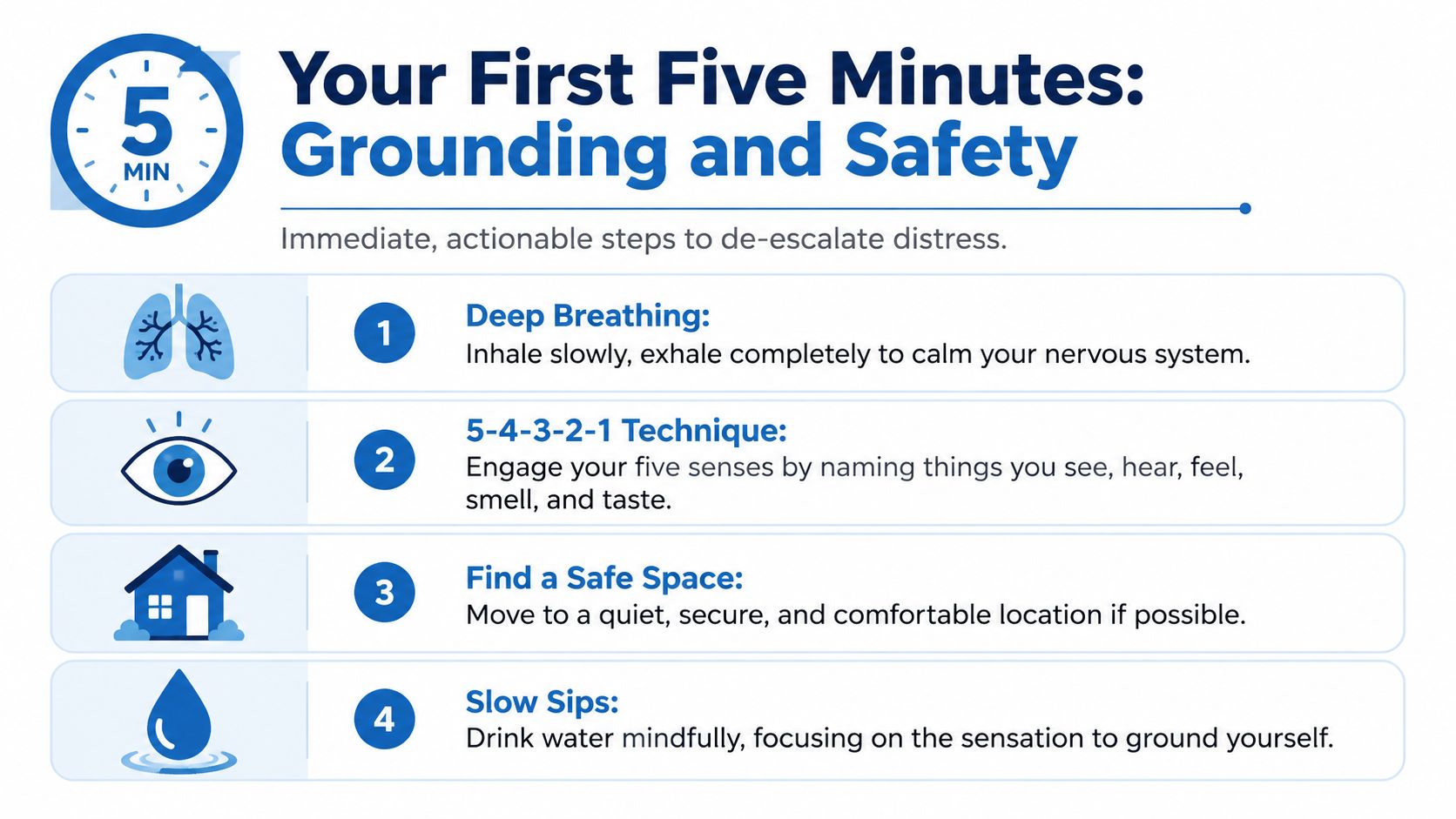
The first goal isn't deep insight. It's to lower the immediate intensity enough to make the next safe decision. That means reducing stimulation, slowing the body, and cutting off anything that's actively escalating the moment.
Move first, think second
A practical crisis-stabilization sequence used across mental health guidance is straightforward: remove the person from triggers, reduce sensory load, use short nonjudgmental phrases, and escalate immediately if there is risk of self-harm or harm to others. That safety-first approach is reflected in this crisis guidance from PMHC.
That looks like this in real life:
- Go somewhere quieter. Step out of the crowded room, leave the argument, mute the phone, turn off the television, or sit in the parked car with the engine off if that's safer than staying inside.
- Sit down if the body feels shaky. The goal is containment. A chair, couch, or floor against a wall is better than pacing aimlessly.
- Use one sentence only. “I am overwhelmed, but I am safe right now.” Or: “The next step is to slow my breathing.” Short phrases work better than trying to reason through everything at once.
- Take slow sips of water. Not because water fixes the crisis, but because deliberate physical actions help interrupt spiraling.
Use one grounding method, not five
When distress spikes, people often start stacking techniques too fast. They try breathing, then scrolling, then texting five people, then pacing, then arguing with themselves. That usually adds more stimulation.
Pick one method and stay with it for a few minutes.
Practical rule: During the acute wave, simple and repetitive beats clever and complicated.
Two options work well:
- Deep breathing. Cleveland Clinic recommends deep breathing as part of reducing the risk of a mental health crisis or breakdown, along with mini-breaks and exercise. A very simple version is to inhale slowly, then exhale completely and let the exhale be unhurried. Cleveland Clinic's breakdown guidance also notes that alcohol, recreational drugs, and excessive caffeine can worsen stress on the body.
- The 5-4-3-2-1 method. Name five things that can be seen, four that can be felt, three that can be heard, two that can be smelled, and one that can be tasted. This works because it forces attention back into the present environment instead of the internal alarm loop.
Some people also settle faster with slow movement instead of stillness. Gentle stretching, simple postures, or breath-led movement can help if they don't become another pressure point. For readers interested in body-based calming practices, this overview of qi gong and yoga gives a useful starting point.
Know what makes it worse
Certain responses reliably backfire in the moment.
| What helps | What usually worsens it |
|---|---|
| Short, calm phrases | Rapid-fire questions |
| Quiet and reduced stimulation | Bright screens, loud rooms, conflict |
| Sitting, breathing, grounding | Trying to “snap out of it” |
| Asking for help early | Waiting until the person is completely overwhelmed |
Blame also makes crises worse. So does interrogation. If another person is helping, they should avoid asking for a full explanation while the person is still highly activated. “Tell me exactly why this is happening” is too much. “Sit here with me and breathe” is more useful.
When to Seek Immediate Emergency Help
Some situations are beyond self-soothing. That isn't failure. It's a triage issue.
Recent public guidance has become clearer on this point. A major gap in consumer content has been helping people tell a true mental health crisis from severe stress, panic, burnout, or intoxication and withdrawal. GoodRx's crisis guidance reflects the broader shift toward immediate safety and escalation, rather than relying on the vague phrase “mental breakdown.”
Signs this is no longer a self-help moment
Emergency help is needed now if any of these are happening:
- Self-harm risk. The person is talking about suicide, preparing to hurt themselves, or can't commit to staying safe.
- Threat to others. They may harm another person, are making violent threats, or can't be redirected.
- Psychosis signs. They appear to be hearing or seeing things others don't, seem severely detached from reality, or hold fixed beliefs that make safety impossible.
- Basic functioning has collapsed. They can't care for themselves, can't remain safe, or are so disorganized that supervision is needed.
- Calming attempts fail and distress keeps rising. If grounding hasn't reduced intensity and the person is getting more unsafe, waiting longer doesn't help.
If there is immediate danger, the right move is emergency services or the nearest emergency room.
Chest tightness, pounding heart, and shortness of breath can happen with panic, but they can also overlap with medical problems. For readers struggling to tell the difference, this guidance on anxiety heart concerns can help frame why physical symptoms shouldn't be dismissed automatically.
Substance use changes the response
Alcohol and drugs can blur the picture fast. A person may look panicked but be intoxicated, withdrawing, or reacting to a dangerous mix of substances and mental health symptoms. That changes the urgency because judgment, impulse control, breathing, hydration, and orientation may all be affected.
A simple rule helps. If substance use is in the picture and the person becomes confused, unsafe, hard to wake, highly agitated, or impossible to calm, this should be treated as a crisis that needs prompt professional evaluation. Waiting to see if it passes can waste critical time.
Creating a Simple Safety Plan for the Future
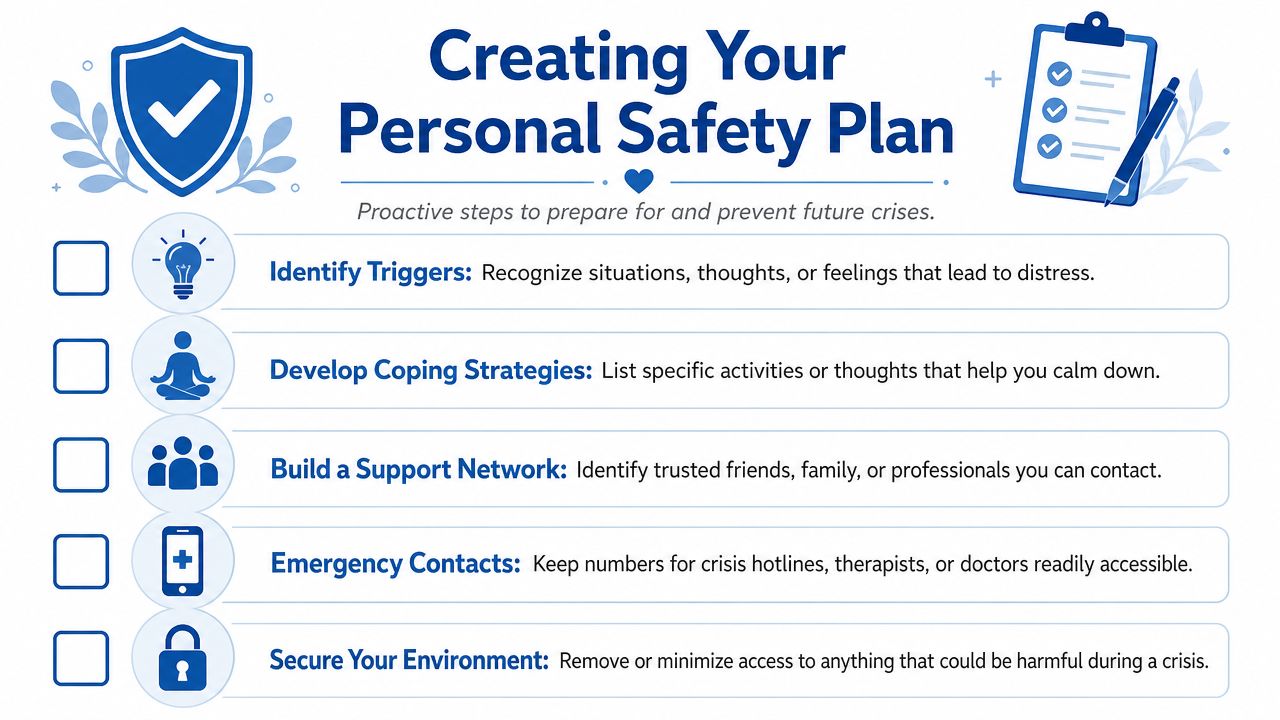
After the worst of the moment has passed, do one more thing before life gets busy again. Write down what you will do the next time your mind starts spiraling. A plan matters because distress shrinks judgment. People forget what usually helps, delay calling support, or tell themselves they should be able to handle it alone.
A one-page plan works better than a detailed one
Keep it brief enough to use while stressed, tired, ashamed, or overwhelmed. If it takes ten minutes to read, it will not get used during a real crisis. The best plans fit on one page or one phone screen and answer a few direct questions fast.
They should tell you:
- How do I know I'm starting to slide?
- What helps me settle in the first ten minutes?
- Who do I contact before this gets worse?
- What signs mean I need same-day professional help or emergency care?
That last question needs a clear answer. Do not leave it vague. If substance use is part of the pattern, include that plainly. Alcohol, pills, stimulants, cannabis, or other drugs can turn a hard night into a medical or psychiatric crisis much faster than people expect.
Build the plan around decisions, not hopes
A usable safety plan is specific. “Calm down” is not a step. “Put both feet on the floor, drink water, hand my car keys to my sister, and sit in the living room with the lights on” is a step.
Write your plan in the notes app, on an index card, or on paper by the bed. Use language you would still understand when your concentration is poor.
| Section | What to write |
|---|---|
| My early signs | “I stop sleeping, cancel plans, feel trapped, start using more substances, skip meals, or can't stop crying.” |
| What helps fast | “Quiet room, cold water, one support person, slow breathing, stepping outside, phone on do not disturb, no social media.” |
| Who to contact | “Trusted family member, friend, therapist, doctor, recovery sponsor, crisis line.” |
| Same-day help threshold | “If I cannot function, keep escalating, start using heavily, or feel close to losing control, I ask for professional help today.” |
| Emergency threshold | “If I might hurt myself or someone else, become confused, cannot stay safe, cannot stop using, or seem detached from reality, someone takes me to the ER or calls emergency services.” |
| Home safety steps | “Remove access to anything dangerous, do not stay alone, leave triggering settings, stop driving, and give medications or car keys to a safe person if needed.” |
Put the plan where stress can't hide it. Phone favorites, fridge door, wallet, bedside table, or with the person most likely to help.
Include one support person in the planning before you need them. Show them the plan. Tell them what you look like when things are getting bad and what you want them to do if you start minimizing it. I have seen this prevent hours of confusion because the helper is not guessing.
Review the plan after any serious episode. Cross out what did not help. Add what did. A safety plan is not a promise that you will never hit a breaking point again. It is a shorter path back to safety, and a faster handoff to professional care when self-help is no longer enough.
Building Long-Term Resilience and Prevention
A breakdown rarely comes out of nowhere. In practice, it usually builds through missed sleep, too much stress, too little recovery, growing isolation, and sometimes alcohol or drugs getting folded into the coping plan.

Restore stability before you chase insight
People in overload often want to figure everything out first. The nervous system usually responds better to boring, repeatable repairs.
Start with sleep, food, movement, and a daily rhythm your body can predict. As noted earlier, public health guidance supports regular sleep and consistent physical activity because both help steady mood, stress response, and thinking. If your life is chaotic, aim for regularity before intensity. A short walk done five days a week helps more than one hard workout followed by three wiped-out days.
Substance use needs plain talk here. Alcohol, recreational drugs, misused prescriptions, and even heavy caffeine can all push an already strained system further off balance. What feels calming at night can turn into worse anxiety, shakier sleep, irritability, or a harder crash the next day. If substance use is part of the pattern, prevention has to include reducing it, stopping it, or getting treatment for it. Otherwise, the same cycle keeps rebuilding.
A simple prevention checklist:
- Protect sleep timing. Get up and go to bed at about the same time, even after a bad night.
- Eat on a schedule. Long gaps without food can make anxiety, irritability, and dizziness feel worse.
- Move your body often. Walk, stretch, lift, or do anything you can repeat consistently.
- Limit chemical triggers. Cut back on alcohol, drugs, and excess caffeine, especially during high-stress periods.
- Stay in contact with at least one safe person. Isolation makes warning signs easier to miss.
Build routines that still work on bad days
Motivation drops fast when someone is exhausted, depressed, panicked, or using substances to get through the day. Routines hold up better because they do not require a strong mood to start.
Keep the plan small enough that you can do it when your brain is noisy. A fixed bedtime. One decent meal at a predictable time. Ten minutes outside. No alcohol during stressful stretches. A Sunday check-in with the person who can tell when you are slipping. Small routines are not impressive. They work.
I often tell people to measure prevention by function, not by inspiration. If your routine helps you sleep a little better, miss fewer warning signs, and ask for help sooner, it is doing its job.
Watch the pattern, not just the meltdown
Long-term prevention gets better when you track what happens in the days before things fall apart. Look for the repeat sequence. You stop sleeping well. You cancel plans. You get more agitated or numb. You start using more. Work gets harder. Then one more stressor hits and everything spills over.
That pattern matters because it tells you when self-help is still likely to work and when it probably will not. If your early steps consistently fail, or if substance use turns a rough week into a dangerous one, treat that as a signal to bring in professional help earlier next time.
Get treatment before the next crisis forces the decision
Some people need weekly therapy. Others need more structure because daily life is still going, but just barely. If you keep cycling through near-breakdowns, miss work, withdraw from people, or use substances to control your state, it may be time for care that does more than teach coping skills once a week.
Options like counseling, group support, medication management, and structured programs can interrupt the cycle before it becomes an emergency. If substance use and mental health symptoms are feeding each other, dual-diagnosis care is usually the safer route because treating only one side often leaves the other strong enough to trigger another collapse. This overview of outpatient mental health treatment options explains how structured support can help when self-help keeps falling short.
Long-term resilience is not about becoming impossible to overwhelm. It is about spotting the slide earlier, lowering the load, and knowing when the situation has crossed from stress into a real crisis that needs outside help.
Professional Support for Mental Health in Dallas-Fort Worth
For adults in Euless, Dallas, Fort Worth, and nearby communities, the most realistic form of help often isn't dropping everything for long-term inpatient care. It's structured outpatient treatment that fits around real life while still providing enough support to interrupt the cycle.
That can include individual therapy, group therapy, medication support when appropriate, and a more intensive schedule through PHP or IOP when someone needs more than weekly counseling. For people dealing with both emotional collapse and substance use, dual-diagnosis treatment matters because treating only one side of the problem usually leaves the other side strong enough to trigger another crisis.
Maverick's outpatient mental health treatment overview explains how that kind of care can help adults build coping skills, improve routine, and stay connected to treatment while managing work, family, or school responsibilities. Maverick Behavioral Health provides outpatient mental health and substance use treatment in Euless for the broader Dallas-Fort Worth area, including support for co-occurring disorders and medication-assisted treatment for certain substance use needs.
Some people need same-day urgent evaluation. Others need a clear admission path into outpatient care before the next breakdown happens. Both are valid. The key is not waiting until the person is back at the edge.
If life has started to feel unmanageable, support is available. Maverick Behavioral Health helps adults in Euless and across the Dallas-Fort Worth area access outpatient mental health and substance use care with practical next steps, not judgment. You don't have to manage this alone. If you're ready to build a stronger foundation for your mental health, call the team today at (888) 385-2051.