



Some people in Dallas-Fort Worth know they need help, but still hesitate because the next step feels blurry. They may be managing anxiety, depression, trauma, mood swings, substance use, or all of those at once. They may be trying to keep a job, stay in school, care for children, or to get through the day without everything falling apart.
That’s where outpatient mental health treatment often makes sense. It gives people structured support without requiring them to leave home full time. It can offer enough clinical depth to create real change while still allowing daily life to continue in Euless, Dallas, and nearby communities.
People also need to know they aren’t the only ones reaching out. Between 2019 and 2021, the percentage of adults ages 18 to 44 who received any mental health treatment in the past year increased from 18.5% to 23.2%, and by 2022 about 23% of all U.S. adults reported receiving mental health treatment in the past year, up from 19% in 2019, according to the CDC mental health treatment data brief.
Table of Contents
- Understanding Outpatient Mental Health Treatment
- Choosing Your Level of Care PHP vs IOP in Dallas
- Evidence-Based Therapies for Lasting Recovery
- What to Expect A Week in a DFW Outpatient Program
- Navigating Insurance Costs and Access to Care
- Your First Steps How to Begin Treatment
- Building a Life in Recovery After Treatment
Understanding Outpatient Mental Health Treatment
Outpatient care is easiest to understand through a simple comparison. It works a lot like attending a specialized academic program while still living at home. A person goes to treatment several times a week, learns skills in a structured setting, practices those skills in real life, and returns for support, feedback, and adjustment.
Inpatient care is different. That model is closer to moving away for school because treatment happens in a fully immersive environment with overnight stays. Outpatient mental health treatment keeps a person connected to home, work, school, and family while still providing organized clinical care.
What outpatient really means
The word outpatient doesn’t mean casual or minimal. It means treatment happens without living overnight at the facility. Depending on the level of care, that treatment can still be highly structured and clinically intensive.
A strong outpatient program often includes a mix of individual therapy, group therapy, psychiatric support when needed, and practical planning for daily life. Some people enter outpatient care as their first step. Others begin after hospital care or residential treatment and need steady support as they transition back into the community.
Practical rule: Outpatient treatment works best when a person needs more support than occasional therapy, but doesn’t need overnight monitoring.
Families often get confused by the word “flexible.” Flexible doesn’t mean unstructured. It means care is built around real life. A client may attend programming during the day or evening, then go home and use those coping tools in the exact places where stress shows up.
Who this model fits
Outpatient care can fit adults who are still functioning in some parts of life but know something isn’t working. That might include a college student whose panic attacks keep disrupting class attendance, a parent who can’t get through the week without alcohol, or a working professional who’s keeping up appearances but privately unraveling.
It also fits people dealing with both mental health symptoms and substance use. In those cases, treating only one issue usually leaves the other one active in the background.
For readers who want a broader look at available mental health treatment options in an outpatient setting, it helps to think in one question: does this person need consistent, structured help while continuing to live at home? If the answer is yes, outpatient mental health treatment may be the right path.
Choosing Your Level of Care PHP vs IOP in Dallas
The biggest practical question usually isn’t whether treatment is needed. It’s how much treatment is needed right now. That’s where levels of care matter.
How the levels differ
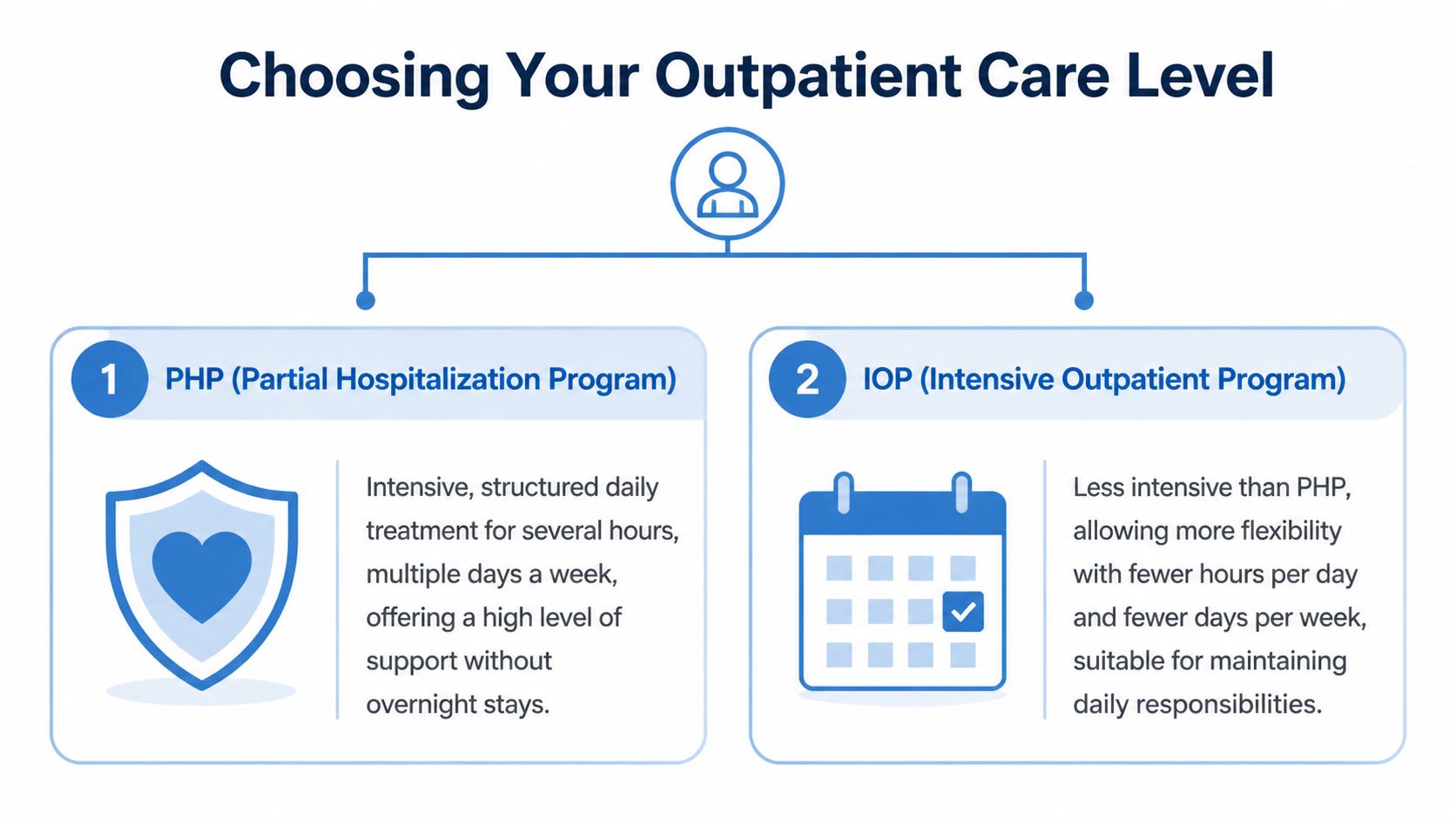
PHP, or Partial Hospitalization Program, is the more intensive outpatient option. It gives people a strong clinical structure during the day while still allowing them to return home at night. This level often fits people whose symptoms are disruptive enough that standard therapy wouldn’t be enough support.
IOP, or Intensive Outpatient Program, offers a step down in intensity while staying more structured than weekly counseling. For adults, research-backed IOP protocols establish a minimum of 9 hours per week, according to guidance on outpatient mental health treatment and IOP dosage. That level of care is often a practical fit for adults trying to maintain work, school, or family responsibilities in the Dallas-Fort Worth area.
Standard outpatient care is the least intensive of the three. It may involve weekly or periodic appointments and often works best for people who are stable enough to need support, but not a high level of structure.
A useful question is not “Which program sounds stronger?” It’s “Which level matches the amount of support needed this week?”
Outpatient care levels compared
| Level of Care | Time Commitment | Best For Individuals Who… | Maverick Behavioral Health Service |
|---|---|---|---|
| PHP | Several hours a day, multiple days a week | Need substantial structure and frequent clinical contact, but don’t need overnight care | PHP |
| IOP | At least 9 hours per week for adults | Need meaningful support while continuing work, school, or family routines | IOP |
| Standard Outpatient | Usually fewer sessions and less total weekly time | Need ongoing therapy or follow-up support with more independence between sessions | Standard outpatient |
A person in Euless might start in PHP if daily symptoms are making it hard to function safely or consistently. Someone in Dallas who’s stable enough to work but keeps slipping into the same patterns may be better suited for IOP. Someone who has already built momentum may continue in standard outpatient care.
For readers comparing schedules and structure, this overview of what IOP therapy involves can help clarify what daily life in that level of care often looks like.
Evidence-Based Therapies for Lasting Recovery
Treatment starts to feel less intimidating when the language becomes concrete. Many individuals don’t need a list of acronyms. They need to know what happens in the room and why it helps.

What happens inside therapy
CBT, or Cognitive Behavioral Therapy, helps a person notice the link between thoughts, emotions, and actions. A client might learn that one automatic thought, such as “nothing will get better,” quickly drives withdrawal, hopelessness, or substance use. In CBT, the therapist helps test that thought, challenge it, and replace it with something more accurate and workable.
DBT, or Dialectical Behavior Therapy, teaches skills for people whose emotions feel intense, fast, or hard to manage. That may include distress tolerance, mindfulness, emotion regulation, and relationship skills. A person who normally spirals after conflict may learn how to pause, ground the body, and choose a response instead of reacting on impulse.
For clients with co-occurring conditions, these approaches aren’t interchangeable labels. CBT is highly effective for anxiety and depression, while DBT combines cognitive techniques with mindfulness to regulate emotions and improve distress tolerance, which is especially important for high-risk populations, as described in the NCBI overview of evidence-based treatment approaches.
Dual diagnosis and medication support
Many adults don’t have a mental health issue on one side and a substance use issue on the other. They have both, woven together. Anxiety may fuel alcohol use. Trauma may drive opioid misuse. Depression may deepen after stimulant crashes. When that happens, treatment needs to address both conditions at the same time.
A complete outpatient plan may include:
- Individual therapy that addresses private concerns, trauma history, motivation, and symptom patterns.
- Group therapy where clients practice communication, accountability, and coping skills with peers who understand the same struggles.
- Family involvement when appropriate, so the home environment becomes more informed and supportive.
- Medication support for clients who need psychiatric medication or medication-assisted treatment for substance use, including opioid recovery support when clinically appropriate.
Maverick Behavioral Health provides outpatient mental health and dual diagnosis care across PHP, IOP, and standard outpatient levels, with individual therapy, group sessions, wellness activities, and medication-assisted treatment options including Suboxone when clinically indicated.
Some people need insight. Others need structure. Many need both.
What to Expect A Week in a DFW Outpatient Program
A weekly schedule often looks more manageable once it’s placed next to real life. That’s especially true for adults balancing school, commuting, parenting, or a job in Dallas-Fort Worth.

A sample weekly rhythm
A typical IOP week may include several treatment days, each built around a clear focus. One evening could center on group therapy for stress management and relapse prevention. Another might include individual counseling and skills practice for anxiety, depression, or cravings. A third session may involve family work, medication follow-up, or goal review.
Outside sessions, the client doesn’t just “wait until next time.” The person practices what was learned during the week. That might mean using a grounding exercise before work, setting a boundary with a family member, attending a support meeting, improving sleep habits, or following a medication plan carefully.
A sample week might look like this:
- Monday evening: Group therapy focused on triggers, coping skills, and check-ins
- Wednesday evening: Individual session plus treatment planning
- Thursday evening: Group session with emotion regulation or communication practice
- Weekend or scheduled slot: Family session, psychiatric follow-up, or recovery planning
What the week is designed to build
This kind of schedule gives clients repeated contact with treatment while leaving space for normal responsibilities. It also gives the clinical team a chance to spot patterns quickly. If someone reports worsening depression, stronger cravings, or conflict at home, the plan can be adjusted before things escalate.
One of the strengths of outpatient mental health treatment is that progress gets tested in real time. The client learns a skill in session, uses it in daily life, then returns with honest feedback about what worked and what didn’t.
Navigating Insurance Costs and Access to Care
Cost anxiety stops many people before treatment even starts. Sometimes the concern is money itself. Sometimes it’s the maze around insurance benefits, authorizations, covered levels of care, and what happens if a claim is denied or delayed.
Why insurance feels so hard
Insurance can be one of the biggest barriers to getting help. The challenge isn’t only whether a person has coverage. It’s whether someone can figure out what that coverage means in practice.
The need for clarity is real. A verified summary of behavioral health access barriers notes that insurance complexity is a critical barrier to care, and transparent guidance on insurance verification is essential for removing it, as discussed in this behavioral health care access resource.
That matters because people seeking help are often already overwhelmed. They may be trying to compare PHP to IOP, estimate time off work, arrange childcare, and deal with symptoms at the same time. Adding unclear benefit language on top of that can push treatment further away.
What families should ask early
A more useful approach is to ask direct, concrete questions as early as possible:
- Which level of care is covered: Some plans handle standard outpatient differently than IOP or PHP.
- Whether pre-authorization is required: Delays can happen if this step isn’t handled early.
- What out-of-pocket responsibility may look like: Deductibles, copays, and coinsurance can affect planning.
- How quickly treatment can begin once benefits are checked: Timing matters when symptoms are worsening.
For families trying to sort through both mental health and substance use benefits, this guide on insurance coverage for mental health treatment and addiction rehab can help frame the right questions.
A confidential call to (888) 385-2051 can help a potential client understand benefits verification, likely next steps, and whether outpatient mental health treatment is logistically possible right now. No one should have to decode an insurance policy alone while in crisis.
Your First Steps How to Begin Treatment
Getting started feels easier when the process is predictable. Individuals don’t need pressure. They need a calm explanation of what will happen first, second, and third.

What happens on the first call
The first step is usually a confidential phone conversation. The caller may be the person seeking treatment, a spouse, a parent, or another family member. The purpose is simple: understand what’s happening now and whether outpatient care matches the situation.
During that call, the intake team often asks about current symptoms, substance use if relevant, safety concerns, past treatment, schedule needs, and insurance information. The conversation should feel practical and nonjudgmental. The goal isn’t to trap anyone into treatment. It’s to identify the safest and most appropriate next step.
The first call doesn’t need to contain the whole life story. It only needs enough information to begin.
What the assessment looks for
If outpatient care appears appropriate, the next step is a clinical assessment. That assessment helps determine the right level of care and what should be included in the treatment plan.
The clinician may look at several areas:
Current symptoms and daily functioning
Are anxiety, depression, trauma symptoms, mood shifts, or substance use interfering with work, school, sleep, eating, or relationships?Safety and stability
Does the person have enough support and stability to participate in treatment while living at home?Treatment history
What has helped before, what hasn’t helped, and where did prior care fall short?Practical needs
Can sessions be scheduled around job hours, classes, parenting duties, or transportation needs in the DFW area?
Once that assessment is complete, the team can recommend a starting point, explain the schedule, and help the person prepare for day one. To begin that process, the clearest next step is a confidential call to (888) 385-2051.
Building a Life in Recovery After Treatment
The end of a program isn’t the end of recovery. It’s the point where support shifts from intensive structure to a more independent, sustainable routine.
What good aftercare includes
A thoughtful discharge plan should never feel like a sudden drop-off. Strong outpatient providers build relapse prevention into treatment before the final day arrives. They also help coordinate what comes next.
That matters because the transition period can be vulnerable. Verified guidance on outpatient continuity of care notes that effective providers structure relapse prevention protocols and coordinate with follow-up services after discharge, with transparent planning around aftercare follow-ups and medication monitoring being critical during transition, as outlined by guidance on discharge planning and aftercare in outpatient treatment.
A practical aftercare plan may include:
- Step-down care: Moving from PHP to IOP, or from IOP to standard outpatient, without losing clinical continuity.
- Ongoing therapy: Keeping regular individual or group support in place after the more intensive phase ends.
- Medication monitoring: Making sure psychiatric medications or MAT plans continue safely and consistently.
- Relapse response planning: Defining what the client and family should do if warning signs return.
Recovery after discharge
The strongest recovery plans are specific. They identify triggers, early warning signs, safe people to call, routines that support stability, and what type of help should be reactivated if symptoms return.
Families also need guidance. They often want to support recovery but don’t know whether to step in, step back, or change the way they communicate. Good aftercare planning gives them a role without making them responsible for someone else’s recovery.
Outpatient mental health treatment works best when it’s treated as part of a longer arc. The program builds stabilization, skill use, accountability, and insight. Aftercare helps protect those gains in daily life across Dallas, Euless, and the rest of the DFW area.
For adults and families who are ready to take the next step, Maverick Behavioral Health offers outpatient mental health and dual diagnosis treatment in the Dallas-Fort Worth area. A confidential call to (888) 385-2051 can help clarify the right level of care, answer insurance questions, and begin the admissions process without pressure or obligation.