



A lot of people in Dallas-Fort Worth end up in the same exhausting pattern with a friend who drinks too much. They answer late-night calls, cover for missed plans, replay the same worrying conversations, and keep hoping the next scare will be the one that changes something. Instead, the drinking keeps shaping the friendship.
That kind of stress confuses good people. Loyalty says stay close. Reality says the situation is getting worse. Friends with an alcoholic often feel guilty for being angry, then ashamed for feeling relieved when they step back for a day.
Clear help starts by accepting two facts at the same time. The friend may need support, and the person trying to help also needs protection. Without that second part, concern turns into burnout, resentment, and enabling.
Table of Contents
- Your Friend is Struggling and So Are You
- Recognizing the Warning Signs of Alcoholism
- How to Talk to Your Friend About Their Drinking
- Setting Boundaries to Protect Your Own Wellbeing
- Considering a Formal Intervention
- Finding Local Treatment in Dallas and Euless
Your Friend is Struggling and So Are You
A friendship can change slowly under alcohol. At first, it looks like more partying, more excuses, more chaos after the weekend. Then the pattern gets personal. A friend starts canceling plans, showing up irritated, asking for favors that feel off, or acting like every concern is a betrayal.
That leaves the other person carrying a strange mix of fear and responsibility. They may wonder whether they're overreacting because their friend still works, still laughs, or still promises things will calm down soon. They may also feel trapped by the belief that a good friend should always be available.
What concerned friends usually get wrong
The biggest mistake isn't caring too much. It's confusing support with management. Concerned friends start trying to monitor drinking, soften consequences, explain behavior to others, and keep the peace at any cost. That approach usually drains the helper and protects the addiction.
A healthier position is simpler. Notice the pattern. Name what is happening. Stop doing the jobs alcohol has pushed onto the friendship.
Practical rule: If a choice protects the friend from the natural consequences of drinking more than it protects health or safety, it's probably enabling.
What a better path looks like
Friends with an alcoholic need a plan that is both compassionate and firm:
- Get clear on the behavior: Focus on what has happened, not on labels.
- Protect day-to-day stability: Sleep, work, family life, and emotional safety need to stay intact.
- Respond consistently: Mixed messages create room for denial.
- Use outside support: Private guidance often helps more than repeated arguments.
Some people also need help understanding how support works across the whole family and friend system. This overview of how family support helps in addiction recovery in Dallas can give useful context for what healthy involvement looks like.
There isn't a perfect script for every friendship. There is, however, a reliable standard. If helping the friend is costing peace, safety, sleep, or mental health, the current approach isn't working.
Recognizing the Warning Signs of Alcoholism
A serious alcohol problem isn't typically spotted because of one dramatic moment. Instead, it's recognized because the same problems keep showing up under different names. Stress. Bad luck. A rough week. Another apology. Another promise.

A friend in trouble may not fit the stereotype people expect. They may still hold a job in Dallas, keep up appearances in Euless, and look functional from the outside. The issue is the pattern of impairment, not whether life has fully collapsed.
Behavioral signs that show up first
Many warning signs appear in ordinary social situations:
- Plans become unreliable: They cancel at the last minute, arrive intoxicated, or disappear for hours.
- Every event bends toward alcohol: Brunch, a game, a birthday, a weeknight dinner. Drinking becomes the center of the plan.
- Defensiveness spikes fast: A mild question gets an angry response or a joke meant to shut the conversation down.
- Responsibilities slip: They miss work, ignore family obligations, or leave practical problems for other people to solve.
These signs matter more when they repeat. One rough weekend isn't the same as a lifestyle built around recovery from the last drinking episode and planning for the next one.
Emotional and physical changes people overlook
Friends often notice a personality shift before they name a drinking problem. Someone who used to be steady becomes moody, withdrawn, suspicious, or sharply reactive. Anxiety and low mood can become more visible. So can shame.
Physical changes may be subtle. Looking worn down, neglecting appearance, smelling of alcohol at odd times, shaking, sweating, or seeming sick for stretches longer than a typical hangover can all point to a deeper issue.
Sometimes the clearest sign isn't how much they drink. It's how much of the friendship now revolves around the fallout.
One reason this matters is the power of social influence. A study of U.S. adolescents found that perceiving more friends use alcohol was associated with a 10.17 times greater likelihood of past-year alcohol use, which highlights how friendship circles can amplify risk and why early action matters (adolescent friendship and alcohol use study).
For readers trying to decide whether the situation has crossed from concerning to serious, this guide on signs you need rehab for drug or alcohol addiction helps connect those behaviors to treatment-level warning signs.
A simple test that helps
Instead of asking, "Is my friend an alcoholic?" ask three better questions:
- Is alcohol changing who they are in relationships?
- Are problems repeating despite promises to cut back?
- Is the friendship now organized around managing drinking and damage control?
If the answer is yes to all three, the concern is probably not an overreaction. It's pattern recognition.
How to Talk to Your Friend About Their Drinking
The conversation usually goes badly when it starts in the heat of anger. It also goes badly when the concerned friend waits until months of resentment have piled up. A useful talk is calm, specific, private, and grounded in behavior the friend can't easily dismiss.
Timing matters. Don't start the conversation when the friend is drunk, hungover, rushing out the door, or already in a fight. Pick a neutral place. Keep the tone steady. The goal isn't to win. It's to break through denial without blowing up the relationship.
What to say first
A good opening sounds direct but not prosecutorial. It centers concern and specific observations.
Examples that work better:
- "I'm worried because I've noticed you drinking is affecting your mood and your plans."
- "I've seen a pattern lately. You cancel, disappear, and then tell me everything is fine."
- "I care about you, and I don't think this is just stress anymore."
Examples that usually fail:
- "You need to admit you're an alcoholic."
- "Everyone thinks you have a problem."
- "If you cared about me, you'd stop."
Helpful vs. Harmful Communication
| What to Do (Helpful) | What to Avoid (Harmful) |
|---|---|
| Use specific examples from recent weeks | Dump a long list of every past mistake |
| Speak when they're sober and relatively calm | Confront them during or right after drinking |
| Say how the behavior affects safety, trust, and the friendship | Attack their character or call them selfish |
| Listen for a minute before responding | Turn it into a debate about whether they drink "that much" |
| Offer a concrete next step, such as a screening or treatment call | End with vague warnings and no action plan |
How to keep the talk from derailing
Many friends with an alcoholic expect one good conversation to produce instant insight. Usually it doesn't. Denial often sounds polished. The friend may minimize, compare themselves to heavier drinkers, or promise a short-term fix.
That doesn't mean the conversation failed. It means the concern landed.
"Calm, specific, repeated concern usually works better than one dramatic confrontation."
A few communication rules help:
- Stick to observable facts: "You missed dinner twice and asked for money after drinking."
- Don't argue over labels: The friend may reject "alcoholic" and still hear concern about consequences.
- Refuse side battles: If they switch topics, return to the drinking-related pattern.
- Keep the ask concrete: Suggest a professional assessment, not a vague promise to "do better."
Some people need more help preparing for that moment. This article on how to convince someone to go to rehab without pushing them away offers a useful framework for getting through resistance without turning the talk into a power struggle.
What not to expect
A productive conversation doesn't always end with gratitude. It may end with silence, irritation, or distance for a while. That's painful, but it is still better than colluding with a problem that is already reshaping the friendship.
The standard for success should be realistic:
- Truth was spoken clearly
- Concern stayed respectful
- A next step was offered
- The friend heard that support exists, but enabling doesn't
That combination protects dignity on both sides.
Setting Boundaries to Protect Your Own Wellbeing
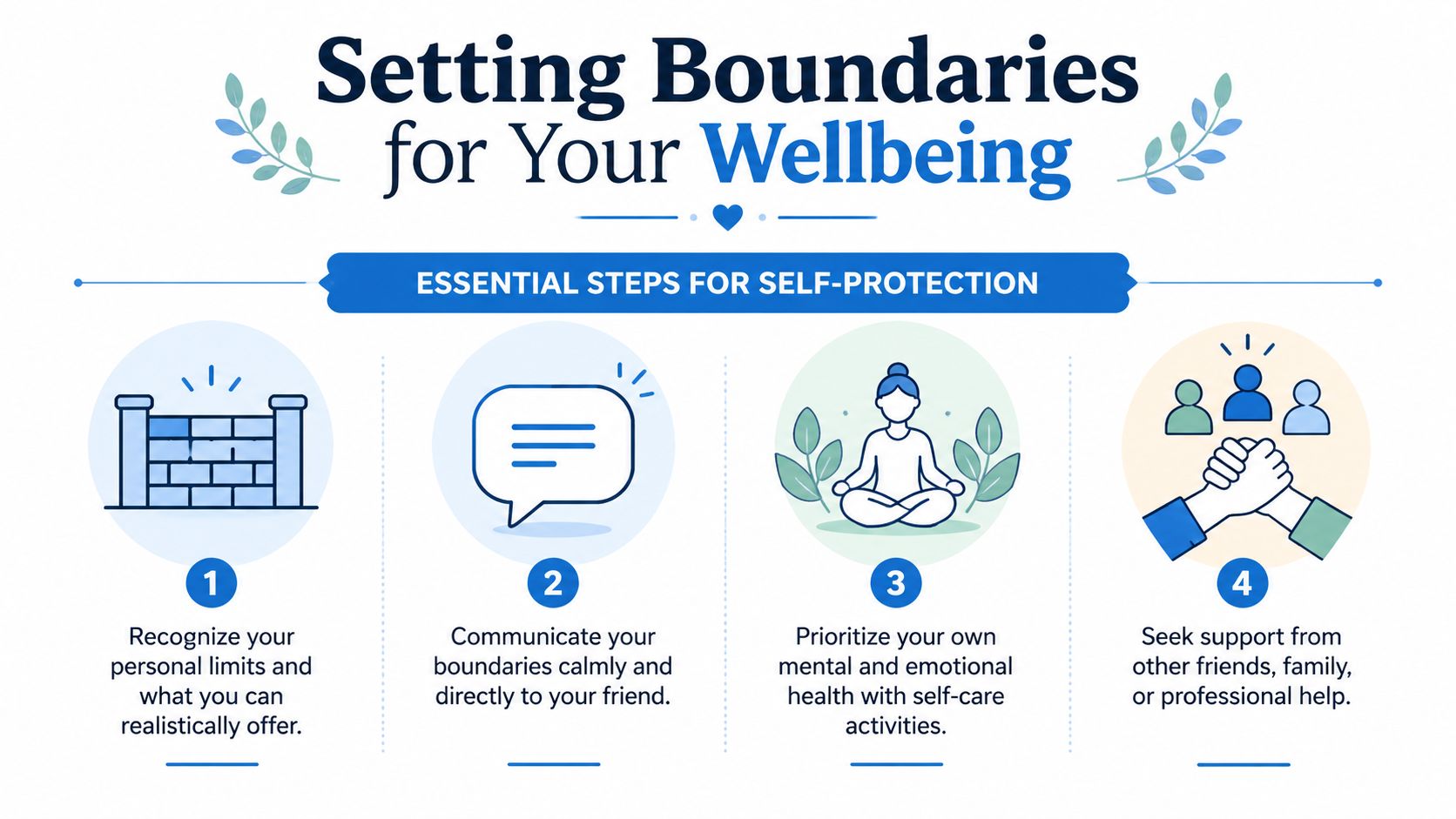
For many people, this is the hardest part. Boundaries can feel cold when the friend is suffering. They can also trigger guilt, especially if the friend says nobody else understands them. But friends with an alcoholic need to hear this plainly. Boundaries are not abandonment. They are protection.
Without limits, the friendship starts revolving around crisis control. The concerned friend lies to cover absences, sends money that disappears into drinking, answers calls at all hours, and keeps showing up to conversations that go nowhere. That pattern doesn't preserve the friendship. It corrodes it.
Why self-protection isn't optional
Friends of alcoholics often carry real emotional strain. One source reports that 20-30% develop co-occurring mental health issues, and 65% reported persistent insomnia and social withdrawal, which is a strong reminder that the helper's wellbeing can deteriorate too (emotional distress among friends of alcoholics).
That matters in practical terms. A sleep-deprived, anxious, overextended friend is less able to respond calmly, think clearly, or make safe decisions. The first person who needs stabilizing may be the one trying hardest to help.
What healthy boundaries look like in real life
Boundaries need to be concrete. Vague intentions collapse under pressure.
- Money boundary: No lending cash that could support drinking or rescue repeated fallout.
- Transportation boundary: No riding with them if they've been drinking, and no covering up unsafe choices.
- Communication boundary: No late-night arguments when they're intoxicated.
- Social boundary: No joining plans that are obviously built around heavy drinking.
- Truth boundary: No lying to employers, partners, or family to protect their image.
A boundary is only real if it includes an action. "I can't talk when you've been drinking. If you call in that state, I'll speak with you tomorrow." That is clear. "Please don't put me in this position" usually isn't enough.
Support says, "I'll help you get treatment." Enabling says, "I'll help you avoid the consequences."
How to hold the line when they push back
People with serious drinking problems often test limits. They may accuse the other person of being disloyal, dramatic, selfish, or judgmental. That reaction hurts, but it doesn't mean the boundary is wrong. It usually means the old arrangement was serving the addiction.
Three responses work better than long explanations:
- Repeat the boundary calmly
- Keep the consequence small and consistent
- Leave the conversation if it turns abusive or manipulative
In Dallas-Fort Worth, many concerned friends try to stay available because the area moves fast and people don't want to abandon someone who seems one bad night away from disaster. That instinct is understandable. It still doesn't justify sacrificing safety, finances, sleep, or mental health. The friendship has a better chance when one person stops letting alcohol set the rules.
Considering a Formal Intervention
Sometimes private talks and personal boundaries still don't move the situation. The friend keeps drinking, keeps denying the impact, and keeps pulling the same people back into the same cycle. That is when a formal intervention may become the next reasonable step.
A well-run intervention isn't a group ambush. It's a structured meeting with preparation, clear messaging, and a treatment plan ready before the conversation begins.

When this level of action makes sense
A formal intervention is worth considering when the pattern includes repeated harm, persistent denial, unsafe behavior, or total refusal to discuss treatment in any serious way. It also makes sense when the whole social circle has become part of the problem.
One reason structure matters is that social ties can reinforce drinking. Data reported on adult friendships found that frequent friendships were associated with a 48% increased likelihood of heavy drinking, showing the darker side of social connection when a group normalizes unhealthy behavior (friendship and heavy drinking findings).
Who should be in the room
The right group is small and stable. It should include people who matter to the friend and can stay composed. It should not include anyone likely to explode, moralize, settle old scores, or derail the purpose.
A strong intervention team usually does four things well:
- Speaks from direct experience: Each person describes what they have seen.
- Stays consistent: Everyone agrees on the message before the meeting.
- Offers a treatment path: Assessment and admission options are arranged in advance.
- States consequences clearly: If treatment is refused, boundaries will remain in place.
A formal intervention works best when love and limits are presented together, not as competing messages.
What preparation should include
Preparation matters more than emotion. Each person should write a short statement focused on behavior, impact, and hope for treatment. The group should also decide what each member will stop doing if the friend refuses help. Empty threats damage credibility.
Professional guidance can be especially valuable when alcohol misuse is mixed with depression, trauma, or volatile family dynamics. The more chaotic the relationships, the more important structure becomes.
The point of intervention isn't to force insight in one hour. It's to stop letting denial run the system and to put treatment within immediate reach.
Finding Local Treatment in Dallas and Euless
When a friend finally says, "Maybe I need help," the next few hours matter. Confusion can kill momentum. Concerned friends do better when they already understand the basic treatment options and know what kind of care fits real life in Dallas-Fort Worth.
Outpatient treatment is often the practical middle ground for adults who need substantial help but still have work, school, parenting, or housing responsibilities. The right level depends on safety, severity, mental health needs, and how stable the person's day-to-day life is.
What the common outpatient levels mean
PHP is a high-touch outpatient option. It gives the person intensive clinical support during the day while allowing them to return home or to supportive housing afterward. This can help when drinking has become disruptive enough that standard weekly counseling isn't enough.
IOP offers a step down in intensity while still providing regular therapy and accountability. It's often a good fit for people who need structured care but must keep working or handling family duties in the Dallas or Euless area.
Standard outpatient can work for milder situations or as ongoing support after a higher level of care. It usually focuses on therapy, relapse prevention, and maintenance.
Some people also need dual diagnosis care because alcohol misuse and anxiety, depression, trauma, or another mental health condition are feeding each other. In those cases, treatment works better when both are addressed together instead of treating drinking as the only problem.
Why the friend group still matters after treatment
Treatment doesn't happen in a vacuum. Recovery is easier to sustain when the person's social world changes too. Research on young adults after residential substance use treatment found that those with low-risk friend networks achieved 60-75% days abstinent at 12 months, compared with 25-40% for those with high-risk networks, which is one reason structured outpatient care often focuses on building healthier connections (recovery outcomes and low-risk friend networks).
That has a direct lesson for friends with an alcoholic. If the friendship is going to continue, it may need new rules, new activities, and less contact in settings where alcohol drives everything. Treatment can help the person build those skills, but friends often need to change their part too.
What to do today if the situation feels urgent
If the friend is open to help, don't turn the moment into a long debate about labels or blame. Keep the next step small and immediate.
- Call a treatment provider the same day: Momentum matters.
- Ask about level of care: PHP, IOP, outpatient, and dual diagnosis are not the same.
- Clarify logistics: Schedule, insurance, transportation, and start date affect follow-through.
- Stay in a support role: Encourage action, but don't take over the entire recovery process.
- Keep boundaries active: Treatment interest doesn't erase the need for limits.
For people across Euless, Dallas, and the surrounding DFW area, local outpatient care can make the difference between repeated crisis management and a real recovery plan. The best option is the one the person can start, sustain, and stay engaged with.
Maverick Behavioral Health provides outpatient addiction and mental health treatment for adults in Euless, Dallas, and the wider DFW area, including PHP, IOP, standard outpatient care, dual diagnosis services, and medication-assisted treatment when appropriate. If a friend is struggling with alcohol and the situation has moved beyond what private conversations can fix, a confidential call can help clarify the right next step. To speak with the team, call (888) 385-2051.