



A resident in Euless gets home late, sits in the car for a minute, and feels that familiar pull toward drinking. The house is quiet. Friends may be asleep. Driving across Dallas-Fort Worth for support feels impossible in that moment.
That’s where a virtual aa meeting can matter.
Instead of waiting until morning, a person can often find a meeting from a phone, tablet, or laptop and connect with other people in recovery without leaving home. For many people, that small drop in effort makes a big difference. It removes traffic, distance, and the pressure of walking into an unfamiliar room.
Support also feels more realistic when it fits real life. Someone in Dallas may need a meeting before work. Someone in Arlington may need one after an evening outpatient group. Someone in Euless may need a late-night option after cravings hit unexpectedly. Online recovery support can help fill those gaps.
This guide is built for people in the Dallas-Fort Worth area who want clear answers, not jargon. It explains what a virtual aa meeting is, what happens during one, how it compares with in-person meetings, and how to use it alongside structured care such as outpatient treatment and medication support. The goal is simple. Make the first step feel less confusing and more doable.
Table of Contents
- Introduction Finding Support When You Need It Most
- What Is a Virtual AA Meeting and How Does It Work
- Key Differences Between Virtual and In-Person AA Meetings
- A Step-by-Step Guide to Joining Your First Meeting
- Integrating Virtual AA with Professional Treatment in Dallas
- Local Virtual AA Meeting Resources for Dallas-Fort Worth
- Frequently Asked Questions About Online AA
- Your Next Step Towards Recovery in Texas
Introduction Finding Support When You Need It Most
Recovery rarely follows a neat schedule. Cravings can hit after an argument, after a stressful drive on Highway 183, or during a quiet weekend when too much empty time starts to feel dangerous. Many people in Dallas-Fort Worth know the feeling of needing support right now, not after the next appointment opens up.
A virtual aa meeting gives people another doorway into recovery. It can help a parent who can’t leave the house at night. It can help a professional who wants privacy. It can help someone early in sobriety who feels too anxious to walk into a room full of strangers. For some, online meetings become the first safe step back into connection.
There’s also relief in knowing that online support doesn’t have to replace everything else. It can work as a bridge. A person might attend outpatient treatment during the week, use medication support as prescribed, and still need peer connection on evenings or weekends. That’s where virtual meetings often fit best.
Practical rule: The best meeting is often the one a person can actually attend when support is needed, not the ideal one that feels too hard to reach.
People often get stuck because they assume they need to know all the rules first. They don’t. Most meetings are designed for people who are nervous, unsure, or brand new. A person doesn’t have to speak. A person doesn’t have to turn on a camera in many meetings. A person usually only needs a first name and a willingness to show up.
For Dallas, Euless, and the broader DFW area, that flexibility matters. Commuting is real. Work schedules are real. Family responsibilities are real. Recovery support has to fit inside ordinary life if it’s going to last.
What Is a Virtual AA Meeting and How Does It Work
A virtual aa meeting is an Alcoholics Anonymous meeting held online instead of in a physical room. The format is different, but the core purpose stays the same. People gather to support sobriety, share experience, and stay connected to recovery.
For many newcomers, it helps to think of it as a group recovery meeting held through the same kind of video call people already use for work, school, or family conversations. A host lets people in, members join from different places, and the group follows a meeting format. Some people appear on camera. Some join by audio only.

During the pandemic, virtual Twelve Step participation grew quickly. In one study, 64.9% of participants agreed that virtual meetings were as good or better than face-to-face meetings for maintaining their own abstinence, which shows how important online access became for many people in recovery (research on virtual Twelve Step meeting experiences).
People exploring online recovery sometimes also want to understand how similar formats work in other fellowships. This overview of Narcotics Anonymous meetings on Zoom can help clarify what the online experience often feels like across peer support settings.
The basic idea
A virtual meeting usually starts with a chairperson or host opening the room. That person may welcome newcomers, read a few standard recovery readings, and explain basic ground rules. The meeting may be open to anyone interested in learning, or it may be limited to people who want help with alcohol use.
The structure often feels more familiar than expected. There may be a topic for the day, a speaker sharing a story, or a reading followed by discussion. Members take turns speaking if they want to. Others listen.
Some confusion comes from the word “virtual,” as if it means less real. It doesn’t. The conversation is real. The accountability can be real. The emotional relief of hearing, “someone else understands this,” is often very real.
What usually happens during the meeting
Most online meetings follow a predictable rhythm, which can lower anxiety for first-time attendees.
- Arrival and check-in. A person clicks a meeting link or dials in by phone, waits briefly, and enters the meeting room.
- Opening readings. The host may read AA materials or ask volunteers to read.
- Introductions. Some meetings invite brief introductions. Sharing is usually optional.
- Main discussion. The group may hear a speaker, discuss a recovery topic, or reflect on a reading.
- Closing. The meeting wraps up with brief announcements or closing words.
A newcomer doesn’t need to have the right words ready. Listening counts as participation.
There are also small differences between meetings. One group may be very structured and quiet. Another may feel conversational. One may encourage cameras on, while another welcomes audio-only attendance. That variety is normal. If one meeting doesn’t feel like a fit, another one may.
Key Differences Between Virtual and In-Person AA Meetings
Choosing between online and in-person support isn’t really about which format is “better” in every situation. It’s about what helps a person show up consistently and build real connection over time. In Dallas-Fort Worth, that choice often depends on schedule, transportation, privacy, energy level, and stage of recovery.
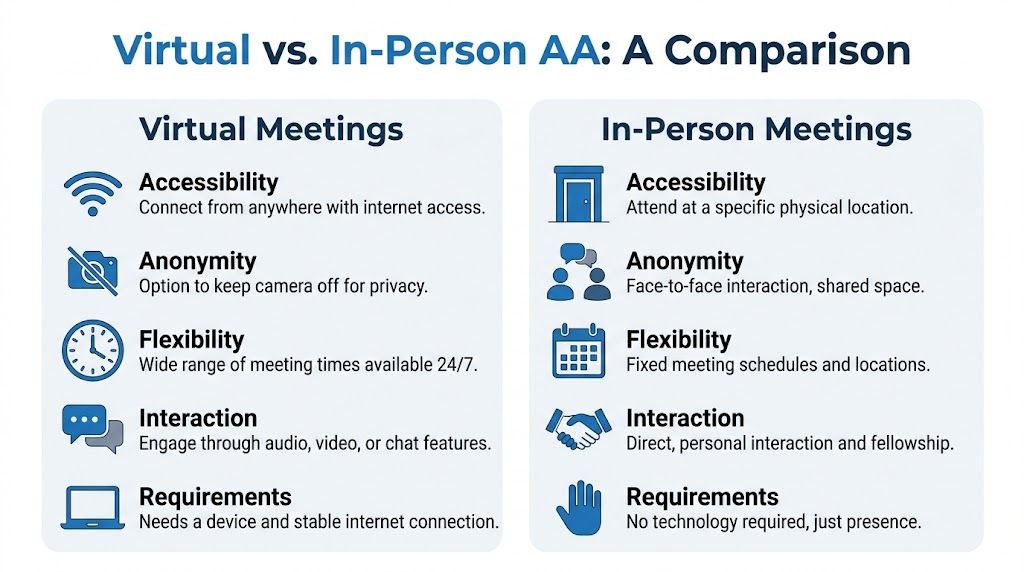
Research on attendance patterns shows a useful tradeoff. People who attended both in-person and online meetings were over 4 times more likely to attend 8 or more meetings in the prior 30 days compared with people attending only in person. Online-only attendees were also more likely to reach that level of attendance than in-person-only attendees. At the same time, online-only participants reported less involvement in group infrastructure, including lower rates of having a sponsor or close friend in the group (Recovery Research Institute summary of in-person versus online meetings).
Where virtual meetings help most
Virtual meetings lower practical barriers. A person can join from an apartment in Dallas, a house in Euless, or a hotel room during travel. That convenience matters for people with tight work schedules, limited transportation, social anxiety, or caregiving responsibilities.
Online meetings can also offer a softer entry point. Keeping a camera off may feel less intimidating than walking into a crowded room. Joining without speaking for the first few meetings gives some people enough comfort to keep coming back.
A quick side-by-side view helps:
| Feature | Virtual Meetings | In-Person Meetings |
|---|---|---|
| Accessibility | Join from home or anywhere with a phone or device | Requires travel to a set location |
| Privacy | May allow camera-off or audio-only participation | Involves being physically present with others |
| Scheduling | Often easier to fit around work, school, or family duties | Fixed times and travel can make attendance harder |
| Connection style | Sharing happens through audio, video, or chat | Face-to-face contact can feel more personal |
| Practical needs | Requires internet or phone access and basic tech comfort | Requires getting to the meeting site |
Where in-person meetings still have an edge
Many people build stronger personal bonds in the room than on the screen. The informal conversations before and after a meeting often matter. That’s where sponsorship relationships, friendships, and a sense of belonging may grow more naturally.
That doesn’t mean virtual meetings are weak. It means they may need backup strategies. Someone who mainly attends online might need to be more intentional about asking for phone numbers, following up after meetings, or discussing sponsorship directly. A hybrid approach often works well because it keeps attendance high while creating room for deeper ties.
A balanced approach often works best: use online meetings to protect consistency, and use in-person contact when possible to strengthen accountability and fellowship.
For a person in DFW, the right answer may change over time. Early on, virtual support may be the only manageable option. Later, adding one local in-person meeting a week may help recovery feel more rooted. Recovery doesn’t have to be all one format.
A Step-by-Step Guide to Joining Your First Meeting
The first meeting usually feels hardest before it starts. Once a person gets through the door, or in this case the login screen, the process is often much simpler than expected. The key is to reduce friction before the meeting begins.
Finding a meeting that fits
Start by looking for a meeting that matches the person’s immediate need, not an ideal future routine. Someone anxious about sharing may prefer a beginner-friendly or discussion-based meeting. Someone with a packed workday may need an early morning, lunch-hour, or late-night option.
A few filters can make the search easier:
- Meeting type. Newcomer, open, closed, men’s, women’s, or discussion meetings may all feel different.
- Time of day. Pick a time that’s realistic enough to repeat.
- Format. Video may feel engaging for some people. Audio-only may feel safer for others.
- Local feel. Some people do better when the group includes others from nearby neighborhoods or the broader DFW area.
If sponsorship feels confusing, this guide on what a sponsor does can make that part of recovery feel less mysterious before a person starts attending regularly.
Getting ready before joining
The technology side doesn’t need to be complicated. A phone is often enough. A laptop or tablet may feel easier if the person wants to see faces on screen. The most important step is choosing a space that feels private enough to listen without tension.
A simple pre-meeting setup works well:
- Choose a quiet spot. A parked car, bedroom, office, or patio can work if it feels reasonably private.
- Use headphones if needed. They help with privacy and make it easier to hear.
- Log in a few minutes early. That leaves room for password entry, app updates, or audio checks.
- Keep the first goal small. For a first meeting, the goal can be staying through the full session.
Online meeting hosts also take safety seriously. The primary platform used by many groups places a 40-minute limit on free group meetings, and many groups use security measures such as waiting rooms, passcodes, and mute-on-entry. Some meetings also assign a Tech Stepper to help manage access and reduce disruption after early incidents of unwanted intrusion (AA guidance for setting up temporary online meetings).
What to do once the meeting starts
Etiquette is usually straightforward. Keep the microphone muted unless speaking. Follow the host’s directions. Use the raise-hand feature if the group asks people to wait their turn. If the camera stays off, that’s often acceptable, though some groups may have their own preferences.
People also worry about anonymity, and that concern makes sense. A few practical habits help:
- Use a first name only if that feels safer.
- Check the background before turning on video.
- Avoid recording or screenshots. Meetings depend on trust.
- Stay focused. Multitasking can make the experience feel flat and disconnected.
If a person feels shaky, embarrassed, or emotional during a first meeting, that doesn’t mean the meeting went badly. It often means the person showed up honestly.
If one meeting feels awkward, that’s not a verdict on AA. It’s just one room. The next meeting may feel more welcoming, more organized, or more relatable.
Integrating Virtual AA with Professional Treatment in Dallas
Peer support and professional treatment do different jobs. Both matter. A virtual aa meeting offers shared experience, accountability, and a place to hear from others living through similar struggles. Clinical treatment addresses the medical, psychological, and behavioral side of addiction in a structured way.
That distinction is especially important for people in Dallas-Fort Worth who are juggling work, family, legal stress, anxiety, depression, trauma symptoms, or opioid cravings. A person may need peer support at night and therapy during the day. A person taking medication for opioid use disorder may still need a recovery community. One form of help doesn’t cancel out the other.

Why the combination matters
A major gap in online recovery content is that it often lists meetings without explaining how those meetings fit with outpatient care, day treatment, or medication support. That gap matters because 65% of outpatient clients relapse within 6 months without peer support integration, according to the source provided in the brief (discussion of virtual AA and treatment integration).
A meeting can’t assess withdrawal risk. It can’t diagnose depression. It can’t adjust medication. But it can support daily accountability, reduce isolation, and help a person stay connected between clinical appointments. That’s why combining both forms of care often makes practical sense.
For people unfamiliar with structured outpatient services, this explanation of what IOP therapy is can help clarify how treatment schedules and peer support can work together instead of competing for time.
How this looks in daily life
In real life, integration usually looks simple rather than dramatic. A person in a Dallas outpatient program might attend therapy groups on weekdays, meet with a clinician, follow a medication plan if prescribed, and use virtual meetings on evenings or weekends when cravings or loneliness spike. Someone in PHP may use online meetings after program hours to maintain momentum. A working professional in Euless may rely on early morning online meetings before commuting.
A combined plan may include:
- Clinical structure. Therapy, relapse prevention work, and mental health care.
- Medication support when appropriate. Some people benefit from MAT as part of a broader recovery plan.
- Peer connection. Online meetings provide regular contact with others in recovery.
- Aftercare rhythm. Meetings can continue even when treatment intensity changes.
Clinical care treats the condition. Peer support helps carry the person through ordinary hours when no appointment is scheduled.
This matters for dual diagnosis too. If alcohol use is tied to panic, depression, trauma, or sleep problems, a meeting alone may not be enough. But a meeting can still be one of the strongest supports around that treatment. It helps fill the empty spaces where relapse often begins.
Local Virtual AA Meeting Resources for Dallas-Fort Worth
Finding a local meeting can feel easier when the search starts close to home. Many people prefer a group connected to the part of DFW they already know. Even if the meeting is online, hearing familiar city names can make the room feel more grounded and less anonymous.
Dallas area options
People on the Dallas side of the metroplex can start with the Dallas AA Intergroup online meeting directory. The most useful approach is to search by format first, then narrow by time and meeting type. Virtual, newcomer-focused, and special-interest meetings can usually be identified in the listing details.
A person living in Dallas proper may want a city-based group for local familiarity. Someone in Irving or Grand Prairie may still prefer Dallas listings if the schedule fits better. Online access makes those boundaries less important than they once were.
Helpful ways to search include:
- Filter for virtual or online listings when available.
- Look for newcomer-friendly language if the first meeting feels intimidating.
- Check meeting notes carefully for access instructions, passwords, or attendance expectations.
Fort Worth side and mid-cities options
People west of the metroplex can use the Fort Worth AA Central Office meeting finder. This can be useful for residents in Fort Worth, Arlington, Hurst, Bedford, and nearby communities who want options connected to their side of the region.
Euless residents often sit in the middle of several workable choices. That can help. A person may try a Dallas-area online meeting one day and a Fort Worth-area meeting the next, then stay with the groups that feel most welcoming and consistent.
Many meetings connected to Euless, Arlington, Irving, and other mid-cities communities now offer online or hybrid access. A person doesn’t need to wait for the “perfect” local fit to begin. Starting with the nearest workable option is usually enough.
Frequently Asked Questions About Online AA
What if someone is not religious
This concern stops many people before they ever attend. AA includes spiritual language, and that can feel uncomfortable at first. But many members interpret that language in broad, personal ways rather than in a narrow religious sense.
In practice, people attend for many reasons. Some connect with the spiritual side. Others focus more on honesty, accountability, routine, and community. If one meeting’s tone feels too heavy in a way that doesn’t fit, another meeting may feel more grounded and practical.
What if internet or technology is a problem
That’s a real barrier, especially for people who feel stressed by apps, passwords, or unstable connections. The good news is that many online meetings don’t require perfect video. According to the source provided, many virtual meeting platforms offer an audio-only dial-in option, allowing people to join by phone and mitigating up to 80% of common connectivity issues (overview of virtual meeting pros and cons).
A few practical adjustments often help:
- Use phone audio only if video keeps freezing.
- Join early so there’s time to fix sound or login issues.
- Choose a simple setup instead of trying to learn every feature.
- Keep expectations low for the first try. The goal is connection, not technical perfection.
A rough first login doesn’t mean a person failed. It usually means the person is learning a new routine under stress.
Can online AA replace treatment
Sometimes people hope meetings alone will be enough because treatment feels intimidating, expensive, or time-consuming. Meetings can be powerful, but they don’t replace professional care when someone needs medical support, mental health treatment, detox planning, or a structured relapse prevention plan.
A useful way to think about it is this. AA offers fellowship and lived experience. Treatment offers assessment, therapy, care planning, and support for co-occurring conditions. For some people, meetings may be the starting point. For others, they work best as part of a larger recovery plan.
If alcohol or drug use is getting dangerous, if withdrawal is a concern, or if depression, anxiety, or trauma are tied into the substance use, a professional assessment is a safer next step than trying to manage everything through peer support alone.
Your Next Step Towards Recovery in Texas
A virtual aa meeting can make recovery feel reachable on a hard day. It can help someone stay connected after work, during travel, after outpatient sessions, or in the middle of a difficult evening at home. For many people in Dallas-Fort Worth, that kind of access removes enough friction to keep recovery moving.
At the same time, online meetings work best when they’re part of a larger support system. Recovery often gets stronger when peer connection, therapy, structured outpatient care, and medication support are working together instead of separately. That combination gives people help in the meeting room and help in daily life.
For anyone in Dallas, Euless, or the surrounding DFW area who’s trying to decide what kind of support is needed, the next step doesn’t have to be dramatic. It just has to be honest. If drinking or drug use keeps disrupting work, relationships, health, or emotional stability, reaching out for professional guidance is a strong move.
There is help in Texas that can meet a person where they are, whether the need is flexible outpatient care, support for co-occurring mental health concerns, or a plan that includes both treatment and recovery meetings.
Maverick Behavioral Health provides outpatient addiction and mental health treatment for adults in Euless and across the Dallas-Fort Worth area. If someone needs a structured plan that can work alongside virtual AA, IOP, PHP, dual diagnosis care, or MAT, a confidential conversation can help clarify the next step. To speak with the team, call (888) 385-2051.