


Some people in Dallas-Fort Worth are reading about medication assisted treatment for opioid addiction after another hard night. They may have promised themselves they’d stop tomorrow, then spent the day fighting withdrawal, cravings, shame, and fear of overdosing. Family members may be watching someone they love disappear into a daily cycle that feels impossible to break.
That’s where clear information matters. Opioid addiction isn’t a moral failure. It’s a medical condition that affects the brain, the body, decision-making, and survival. Medication assisted treatment for opioid addiction can help stabilize that crisis so a person can think clearly, function safely, and participate in recovery. In the United States, 81,806 opioid-involved overdose deaths were reported in 2022, and only 25.1% of the 9.37 million adults who needed opioid use disorder treatment accessed medications like buprenorphine or methadone according to Pew’s review of medication-assisted treatment and opioid use disorder.
Table of Contents
- What Medication-Assisted Treatment Really Means
- Understanding Your MAT Medication Options
- Is MAT Right for You? Screening and Dual Diagnosis
- Starting MAT at a Dallas-Area Outpatient Center
- Building a Life in Recovery During and After MAT
- Navigating Insurance and Costs for MAT in Texas
- Take the First Step to Recovery in Dallas-Fort Worth
- Frequently Asked Questions About MAT
What Medication-Assisted Treatment Really Means

Medication-assisted treatment, often shortened to MAT, means using an FDA-approved medication for opioid use disorder together with counseling and other forms of support. The core medications are methadone, buprenorphine, and naltrexone. The medication part matters because opioid addiction isn’t just about bad habits. It changes how the brain responds to pain, reward, stress, and survival.
A person caught in opioid use disorder often isn’t chasing euphoria in the way families sometimes imagine. Many are trying to avoid getting sick. They wake up in withdrawal, spend the day trying to feel normal, and go to sleep afraid of what happens next. MAT helps interrupt that pattern.
Why MAT is medical treatment, not a shortcut
The most common misunderstanding is that MAT is “trading one drug for another.” That idea keeps many people from getting care that could save their life.
A better comparison is insulin for diabetes or an inhaler for asthma. The medication doesn’t erase the whole condition. It helps stabilize the body so the person can function, stay safe, and do the work that recovery requires.
MAT doesn’t create recovery by itself. It creates enough stability for recovery to become possible.
That stability can mean fewer cravings, less withdrawal, fewer desperate decisions, and more ability to show up for therapy, work, parenting, or school. Instead of spending every hour trying not to get sick, the person can focus on repairing life.
What MAT is designed to do day to day
In practical terms, medication assisted treatment for opioid addiction aims to help with several things at once:
- Reduce withdrawal: It helps the body stop cycling through repeated sickness.
- Lower cravings: It gives the brain time to settle instead of constantly demanding opioids.
- Protect against relapse danger: Some MAT medications help reduce overdose risk and blunt the effects of other opioids.
- Support participation in therapy: A stable person can talk, reflect, and practice coping skills.
This approach matters because opioid addiction can turn daily life into chaos very quickly. A parent may miss work, a student may stop attending class, or a professional may seem functional on the outside while privately unraveling. MAT helps restore a basic level of steadiness.
For many families in Euless, Dallas, and nearby communities, the first relief comes from understanding one simple truth. Needing medication doesn’t mean recovery has failed. For opioid use disorder, medication is often part of proper treatment.
Understanding Your MAT Medication Options
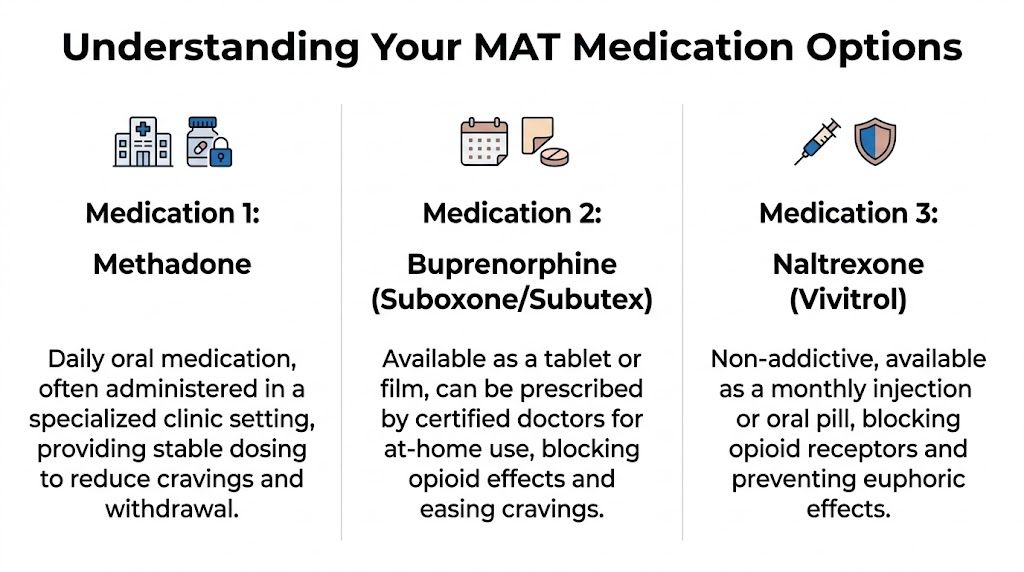
The three FDA-approved medications for opioid use disorder work differently. That’s why a careful conversation with a clinician matters. The right choice depends on opioid use history, withdrawal pattern, treatment setting, medical needs, and what daily life looks like in Dallas-Fort Worth.
Buprenorphine
Buprenorphine is a partial opioid agonist. In plain language, it activates opioid receptors, but not as strongly as drugs like heroin, fentanyl, or many prescription opioids. That makes it useful for reducing cravings and withdrawal while producing much less euphoria.
It also binds very tightly to opioid receptors. This is one reason it can help block other opioids from having the effect a person expects. For some patients, that makes it easier to step out of the cycle of constant use and relief-seeking.
As of late 2022, federal rules changed so any practitioner with a DEA registration for Schedule III drugs may prescribe buprenorphine, which expanded access in outpatient settings, as explained in SAFE Project’s overview of medication assisted treatment.
Common forms include:
- Daily tablet or film: Often taken at home as prescribed.
- Cheek film: Another prescribed form that can fit routine daily use.
- Six-month implant: A longer-acting option for some patients.
For many people, buprenorphine feels less like a “high” and more like relief from the constant physical and mental pressure of withdrawal.
Methadone
Methadone is a full opioid agonist. It works by activating opioid receptors in a steady, controlled way to reduce cravings and withdrawal. Because of how it’s regulated, methadone is typically provided through specialized treatment settings rather than standard office prescribing.
For the right patient, methadone can offer strong, consistent symptom control. This can be especially important for someone with a long history of heavy opioid use or repeated relapse after trying to stop on their own.
What patients often want to know is simple: will it help them stop feeling sick and desperate all day? Methadone can do that when it’s properly monitored and dosed.
Naltrexone
Naltrexone is different. It’s an opioid antagonist, which means it blocks opioid receptors instead of activating them. If someone uses opioids while on naltrexone, the expected euphoric effect is blocked.
This can be helpful for some patients, especially those who have already completed detox and want a medication that doesn’t act like an opioid at all. It may be available as an oral medication or a longer-acting injection, depending on the treatment plan.
The main practical issue is timing. A person must already be off opioids before starting naltrexone, or the medication can trigger sudden withdrawal. That’s why it isn’t the easiest starting point for everyone.
Comparing MAT Medications for Opioid Addiction
| Medication | How It Works | How It's Taken | Best For |
|---|---|---|---|
| Buprenorphine | Partial opioid agonist that reduces cravings and withdrawal with a lower risk of misuse | Tablet, film, cheek film, or longer-acting implant | People who want flexible outpatient treatment and a medication that can fit work, school, or family life |
| Methadone | Full opioid agonist that provides steady symptom control | Daily oral medication in a structured treatment setting | People who need a highly structured approach or stronger stabilization |
| Naltrexone | Opioid antagonist that blocks opioid effects | Oral medication or injection depending on plan | People who have already stopped opioids and want a blocking medication |
Practical rule: The “best” MAT medication is the one a patient can start safely, stay on consistently, and combine with real treatment.
Some programs in the Dallas area, including Maverick Behavioral Health, offer outpatient MAT with therapy so medication decisions happen alongside ongoing clinical support rather than in isolation.
Is MAT Right for You? Screening and Dual Diagnosis

Not everyone starts treatment in the same place. One person may be using opioids every day and afraid of withdrawal. Another may already have stopped but can’t stop thinking about using again. A third may also be dealing with panic attacks, depression, trauma, or insomnia. That’s why MAT should begin with a real assessment, not a quick prescription and a handshake.
What a good screening looks like
A strong intake process asks direct questions about opioid use, past overdoses, withdrawal symptoms, other substances, current medications, medical history, and daily responsibilities. It also looks at safety. Can the person make it through early treatment as an outpatient? Do they need detox first? Are there risks tied to alcohol or sedative use?
Honesty matters here. If a patient minimizes fentanyl use, leaves out benzodiazepines, or hides mental health symptoms, the treatment plan can miss the mark. The goal isn’t judgment. The goal is building the safest and most effective path forward.
Useful screening often includes attention to:
- Substance pattern: What opioids are being used, how often, and by what route.
- Withdrawal experience: Whether symptoms start quickly, feel severe, or trigger immediate relapse.
- Recovery environment: Housing, transportation, family support, and work demands.
- Mental health needs: Anxiety, depression, trauma symptoms, mood swings, or suicidal thoughts.
Why mental health treatment matters at the same time
Many people with opioid addiction aren’t only treating withdrawal. They’re also trying to quiet grief, trauma, chronic stress, depression, or fear. If those conditions go untreated, medication alone may not carry recovery very far.
Integrated care is critical but often lacking. Only 35% of U.S. adults with OUD received any treatment in 2019, and even fewer accessed integrated MAT for co-occurring mental health disorders because care is often fragmented. Combining MAT with therapies like CBT improves outcomes, according to NCBI’s overview of medications for opioid use disorder and integrated care.
That’s why patients with both substance use and mental health concerns often need coordinated treatment instead of separate systems. A reader looking for that kind of combined support can learn more about dual diagnosis rehab options.
When anxiety, depression, or trauma drives opioid use, treating only the opioid use leaves part of the problem untouched.
Starting MAT at a Dallas-Area Outpatient Center
Starting outpatient MAT often feels less dramatic than people expect. It usually begins with paperwork, a medical review, questions about recent use, and a discussion of what the first week may look like. For someone in Euless or Dallas trying to keep a job or stay in school, that can be good news. Treatment doesn’t always require stepping away from life completely.
The first appointment
The first visit usually focuses on safety and fit. Staff review what opioids have been used, when the last use happened, what withdrawal feels like, and whether the person has other mental health or medical concerns. If buprenorphine is being considered, timing matters because starting it too soon after recent opioid use can make withdrawal worse.
That part confuses many patients. The reason is pharmacology. Buprenorphine binds tightly to opioid receptors, so if a stronger opioid is still occupying those receptors, the switch can trigger sudden discomfort. That’s why clinicians often ask patients to arrive in mild withdrawal before the first dose.
A local reader trying to understand the broader range of treatment options can also review opioid addiction treatment near Dallas-Fort Worth.
The first week of treatment
The opening days are often called induction and stabilization. During this phase, the clinical team watches how the person responds to the medication and adjusts the plan as needed. The early goal is straightforward: reduce withdrawal, lower cravings, and help the patient function more normally.
Patients often want to know what it feels like. In many cases, the first meaningful change is that the constant mental noise starts to quiet down. The person may still feel tired, uneasy, or emotionally raw, but they’re no longer spending every hour trying to avoid getting sick.
A common early rhythm looks like this:
- Assessment and medication decision: The team confirms which medication fits the patient’s current situation.
- Careful first dosing: The patient starts under guidance, with close attention to how symptoms change.
- Dose adjustment: The team fine-tunes the amount based on cravings, withdrawal, sedation, and daily functioning.
- Therapy begins alongside medication: Individual and group sessions start addressing triggers, shame, stress, and relapse patterns.
Early MAT isn’t about feeling perfect. It’s about becoming stable enough to stop living minute to minute.
How outpatient care fits daily life
Outpatient MAT is often a practical option for adults who need treatment without completely leaving work, classes, parenting, or household responsibilities. Scheduling may be built around daytime or evening hours depending on the level of care. Someone may attend therapy several times a week while continuing to sleep at home and stay connected to family.
That flexibility matters in DFW, where long commutes, job demands, and family obligations can make treatment feel impossible. A good outpatient plan takes real life seriously. It helps the patient build a schedule they can keep.
The first week doesn’t solve everything. It does something just as important. It proves that the cycle can be interrupted.
Building a Life in Recovery During and After MAT
Recovery doesn’t stop once cravings ease up. That’s when deeper work starts. MAT can create a steadier physical and emotional baseline, but the person still has to learn how to live without using opioids as the main way to cope, numb out, or escape.

Medication creates room for recovery work
Once the body is more stable, therapy becomes more useful. Patients can start identifying what tends to happen before use. Some notice conflict at home is a trigger. Others relapse when they feel lonely, exhausted, ashamed, or physically uncomfortable. Group sessions help people hear patterns they thought were unique to them. Individual therapy helps turn those insights into a plan.
Recovery during MAT often includes:
- Learning coping skills: Managing stress, cravings, anger, grief, and boredom without reaching for opioids.
- Repairing routines: Sleeping more regularly, eating consistently, showing up on time, and handling responsibilities.
- Working on relationships: Rebuilding trust with partners, parents, children, or friends through honesty and consistency.
- Addressing relapse patterns: Planning for high-risk moments before they happen.
For some people, this also means learning how to sit with feelings that opioids used to bury. That part can be uncomfortable. It’s also where real change often begins.
Aftercare protects progress
A common mistake is thinking treatment is over the moment someone feels better. Opioid addiction doesn’t work that way. Stopping medication too soon, drifting away from therapy, or losing structure after initial improvement can leave a person vulnerable.
Patients on methadone and buprenorphine are 50% less likely to die from overdose than people receiving no treatment or naltrexone, and strong retention in treatment is linked to lower mortality, especially because the period after stopping treatment carries heightened risk, as described in the National Association of Counties overview of MAT and overdose mortality.
That’s why aftercare planning matters so much. It may include ongoing therapy, medication follow-up, recovery meetings, relapse planning, family work, or step-down outpatient services.
A solid aftercare plan often answers questions like these:
- What happens if cravings return
- Who notices early warning signs
- How medication follow-up will continue
- What to do after a lapse so it doesn’t become a full return to use
Recovery gets stronger when support continues after the first crisis passes.
Some patients stay on MAT for an extended period. Others taper later under medical supervision when life is more stable. The key is clinical timing, not pressure or stigma.
Navigating Insurance and Costs for MAT in Texas
Cost worries stop many people before treatment even begins. Families may assume outpatient MAT in Texas is automatically out of reach, or they may feel embarrassed asking what insurance will cover. That hesitation is common, but it can also delay care that shouldn’t wait.
What to ask before starting
The easiest first move is insurance verification. That means giving an admissions team the policy information and letting them check what the plan may cover for evaluation, therapy, medication-related visits, and outpatient levels of care. A simple explanation of whether outpatient rehab services are covered by insurance can help families understand the process before they call.
Important questions include:
- Which level of care is covered: Standard outpatient, intensive outpatient, or partial hospitalization.
- Whether prior authorization is needed: Some plans ask for approval before treatment starts.
- What out-of-pocket costs may apply: Deductibles, copays, or coinsurance can affect planning.
- How medication visits are billed: This can differ from therapy billing.
How to move forward if cost feels overwhelming
If someone doesn’t have insurance, private pay may still be possible depending on the program and treatment needs. Admissions staff can usually explain options in plain language. That matters because people in crisis often shut down when the financial side sounds too complicated.
A practical next step is to gather the insurance card, a photo ID, a list of current medications, and a rough summary of recent opioid use before making the call. That keeps the conversation focused and useful.
The financial side of treatment can feel intimidating. It shouldn’t keep someone from asking questions. A confidential benefits check is often the fastest way to replace guesswork with real answers.
Take the First Step to Recovery in Dallas-Fort Worth
Opioid addiction can make people believe they’ve run out of options. They haven’t. Medication assisted treatment for opioid addiction gives many people a way to step out of withdrawal, reduce cravings, and begin real recovery with structure and support.
For adults in Euless, Dallas, and the surrounding DFW area, outpatient care can offer a practical path forward. It can fit around work, school, and family responsibilities while addressing both substance use and mental health needs. That combination matters because recovery usually becomes more durable when treatment matches real life.
A first phone call doesn’t lock anyone into treatment. It opens the door to accurate information, a confidential screening, and a plan based on what’s happening. Anyone ready to ask what MAT could look like for a loved one or for themselves can call the admissions team now at (888) 385-2051 for a free, confidential conversation.
Frequently Asked Questions About MAT
How long will someone need MAT medication
There isn’t one standard timeline. Some people need medication for a longer period, while others may taper later under medical supervision. The safer question isn’t “How fast can someone get off it?” but “When is life stable enough that reducing medication won’t increase risk?” The answer depends on cravings, relapse history, mental health, housing, daily stress, and treatment progress.
Can someone still work and see family while in MAT
Often, yes. Outpatient MAT is commonly structured so people can continue living at home and keep up with many daily responsibilities. The exact schedule depends on clinical needs, but treatment is often built to support real-world functioning rather than remove a person from it entirely.
What are common side effects of Suboxone
Side effects can vary from person to person, and a prescribing clinician should review them in detail before treatment starts. Patients often ask about headache, nausea, constipation, sleep changes, or feeling off during early adjustment. The important point is that side effects should be monitored closely and discussed openly so the plan can be adjusted if needed.
Is MAT just replacing one addiction with another
No. Addiction involves compulsive, harmful use despite consequences. MAT uses prescribed medication in a structured treatment plan to reduce withdrawal and cravings, support stability, and lower risk. A person taking medication as prescribed while engaging in treatment is doing medical recovery work, not “cheating.”
Families often need time to absorb that difference. It helps to look at what’s changing in real life. Is the person safer, more stable, more honest, more present, and more able to function? Those changes usually say more than the stigma does.
Maverick Behavioral Health offers outpatient substance use and mental health treatment in the Dallas-Fort Worth area, including support for people exploring MAT as part of recovery from opioid addiction. Anyone who wants clear next steps can contact Maverick Behavioral Health or call (888) 385-2051 for a free, confidential conversation about treatment options, insurance verification, and what starting care may look like in Euless or Dallas.