



The search usually starts the same way. A person in Euless, Dallas, or somewhere else in DFW types “suboxone doctors that accept insurance” into a phone, opens five tabs, and quickly runs into the same problems. One site says a doctor is taking new patients. Another says to call. A third lists treatment options without saying whether insurance covers the visit, the medication, or the counseling that may go with it.
That confusion stops a lot of people right when they’re trying to do something hard and important. The process feels bigger than it is. It becomes manageable when it’s broken into the right steps, in the right order, with the right questions.
Table of Contents
- The Path to Recovery Starts Here
- Finding Potential Suboxone Doctors in the DFW Area
- How to Verify Insurance Coverage and Costs
- Preparing for Your First Suboxone Appointment
- Understanding Your Treatment and Financial Options
- How Maverick Behavioral Health Serves the DFW Area
The Path to Recovery Starts Here
Individuals looking for Suboxone care aren’t starting from a calm place. They’re trying to solve a real problem while dealing with withdrawal, cravings, fear about cost, or pressure from work and family. A simple search for suboxone doctors that accept insurance can feel like it should solve that problem, but search results rarely tell the full story.
A listing might be current, or it might not. A clinic might accept an insurance brand in general, but not a specific plan. A prescriber might offer medication, but not the counseling support that often helps people stay engaged in treatment. That’s where people get stuck.
The good news is that the process becomes much clearer when it’s handled in sequence. First, build a short list of possible providers. Then verify the insurance details directly. Then confirm what the first appointment includes and what the treatment model looks like.
Getting informed is not a small step. It’s the step that removes panic from the process and replaces it with choices.
For someone in the Dallas-Fort Worth area, local details matter. Driving distance matters. Appointment times matter. Whether a program can support work, school, parenting, or dual diagnosis care matters. So does whether someone on the phone can answer plain questions without making the caller feel judged.
People usually do best when they stop trying to solve everything at once. The immediate goal isn’t to pick the perfect provider from memory. It’s to identify a few real options, ask the right questions, and keep moving.
This is how the search evolves from "Where do people even start?" to "Which option can get treatment started without creating a billing mess or a treatment gap?"
Finding Potential Suboxone Doctors in the DFW Area

Start with a broad list, then narrow it fast
The first step is simple. Build a short working list of providers in Euless, Dallas, and nearby DFW communities. Don’t try to decide from one listing alone. A list of three to five options is usually enough to compare availability, insurance fit, and treatment style.
One reason this search looks different than it did a few years ago is that the prescribing rules changed. Since the Consolidated Appropriations Act of 2023 eliminated the special X-waiver requirement, any DEA-registered practitioner can prescribe buprenorphine. That expanded access, but in Texas it has also led to uneven distribution, with many newer prescribers not offering the integrated therapy that’s often important for dual-diagnosis MAT, according to the SAMHSA buprenorphine practitioner locator guidance.
That means a longer provider list doesn’t automatically mean a better one.
A practical local search usually includes these methods:
Official treatment directories
These help identify prescribers and treatment programs in the DFW area. They’re useful for building a first-pass list, especially for people who don’t already know where to call. The downside is that directory entries may not tell a person whether the provider is in-network, how quickly appointments are available, or whether counseling is offered on site.Insurance portal searches
The member portal often shows in-network behavioral health, psychiatry, addiction medicine, or outpatient treatment options. This is a strong filter because network status affects cost. The weakness is that insurer directories may give limited detail about whether the clinic provides medication-assisted treatment in a coordinated way.Local search terms with city modifiers
Search phrases like “suboxone doctors that accept insurance Euless” or “Suboxone treatment Dallas PPO” can surface nearby options that people might miss in larger databases. This works well for finding local pages, maps, and office details. It works less well for confirming whether the office still takes a certain plan.Treatment-specific local pages
People looking for broader care, not just a prescription, often benefit from reading local outpatient information before calling. A page about opioid addiction treatment near DFW can help clarify whether a program provides medication, therapy, and ongoing support together.
What matters more than the prescription
Not every prescriber offers the same kind of care. Some focus almost entirely on medication visits. Others build treatment around medication plus individual therapy, group support, mental health care, and accountability over time.
That distinction matters because opioid use disorder rarely shows up alone. A person may also be dealing with anxiety, depression, trauma, relationship strain, job instability, or legal stress. A prescription can reduce withdrawal and cravings, but it doesn’t automatically address the patterns that make recovery harder to sustain.
Practical rule: When calling a provider, ask two questions early. “Do you prescribe Suboxone?” and “What other services come with treatment?”
A short list becomes more useful when each office is screened for these local decision points:
- Distance and schedule fit. A clinic can look good online and still be unrealistic if the drive, office hours, or follow-up schedule won’t fit work or family demands.
- Level of support. Some people need a straightforward medication visit. Others need outpatient structure, mental health treatment, or a higher level of accountability.
- Admissions responsiveness. The tone of the first phone call matters. Clear answers, insurance help, and respectful communication usually signal a more organized intake process.
The aim here isn’t to find the flashiest option. It’s to find the provider who will indeed get treatment started and support it properly.
How to Verify Insurance Coverage and Costs
A Dallas patient finally finds a Suboxone doctor with an open appointment this week. Then the next question hits. Will insurance cover the visit, the medication, and any counseling the doctor recommends, or is there going to be a bill no one mentioned on the first call?
That confusion is common, especially in DFW where one clinic may be in-network with a plan in Dallas but a nearby location or affiliated program is billed differently. “Accepts insurance” only means the office will bill a plan. It does not confirm what the plan will pay.
A careful insurance check answers four practical questions: Is the provider in-network? Is buprenorphine/naloxone covered? Is prior authorization required? Are related services, such as therapy or outpatient substance use treatment, also covered?
The call that prevents surprise bills
Before calling, gather the insurance card, a pen, and the exact name of the doctor, clinic, or program you may use. If two DFW options are on the list, keep both names in front of you. Comparing them during the same call often saves time.
Ask the insurance representative to verify these parts of care separately:
- Provider network status
Confirm whether the specific doctor, clinic, or program is in-network under the exact plan. - Medication coverage
Ask whether buprenorphine/naloxone is covered through the pharmacy benefit. - Prior authorization requirements
Ask whether the medication, office visits, or both need preapproval. - Related services
Ask whether counseling, therapy, urine drug screening, and outpatient substance use treatment are covered if the prescriber includes them in the treatment plan.
Prior authorization is one of the biggest trouble spots. Coverage may exist, but payment can still be delayed until the provider submits the right documentation. That is why it helps to choose a clinic that will verify benefits and handle authorization requests instead of leaving the patient to sort it out alone.
This visual can help organize the sequence before the first phone call.
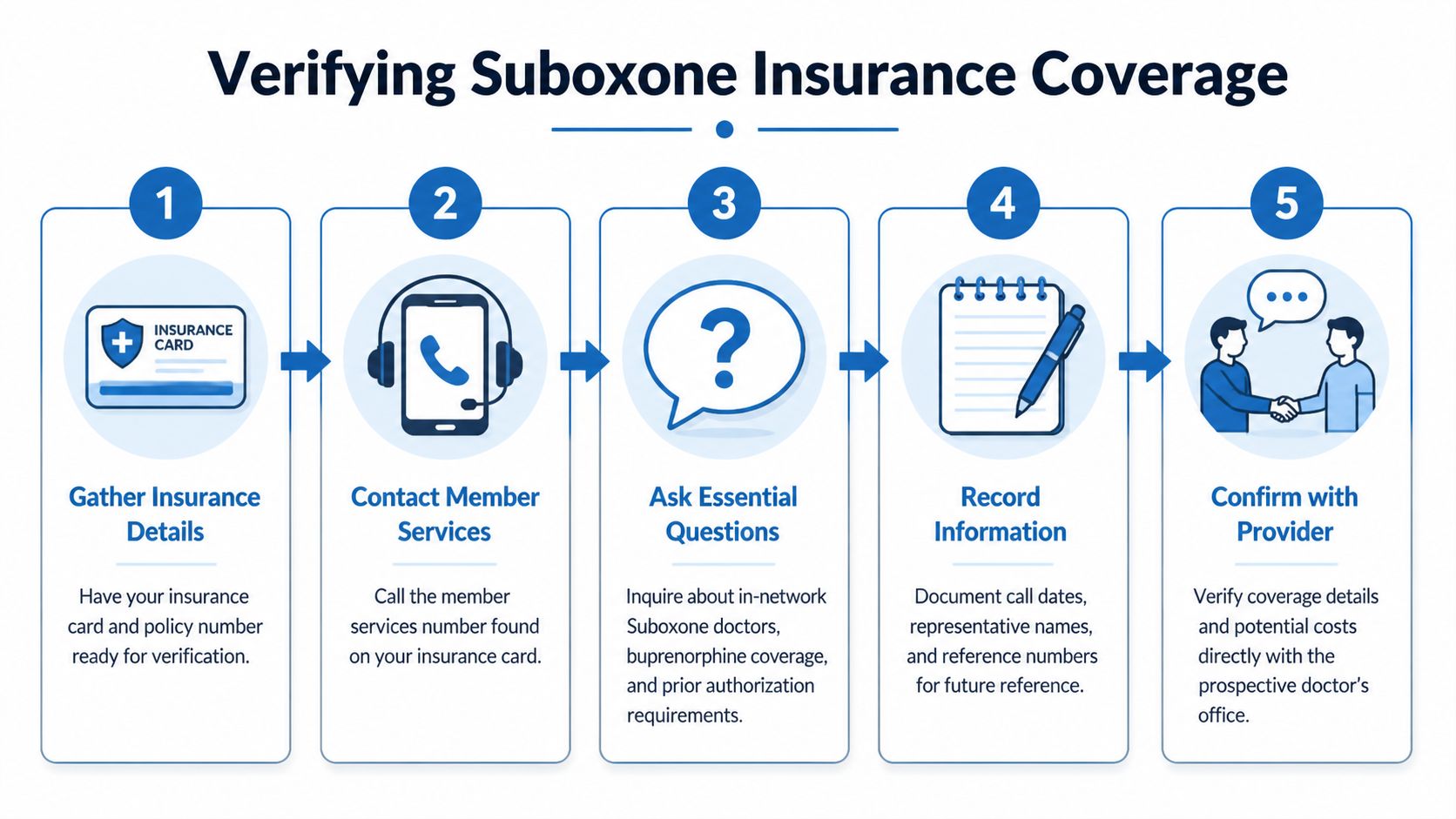
For a closer look at what an admissions team usually confirms, this guide on verifying insurance coverage for rehab explains the process in more detail.
A word for word insurance script
People often know what they need. They just do not know how to ask it clearly. A script lowers that pressure and gives the representative fewer chances to answer only part of the question.
Use this exact language:
“Hello. I’m calling to verify benefits for treatment for opioid use disorder in the Dallas-Fort Worth area. Please check my plan’s coverage for Suboxone treatment. First, is buprenorphine/naloxone covered under my pharmacy benefit? Second, does my plan require prior authorization for the medication? Third, are office visits for opioid use disorder treatment covered, and what would my copay, deductible, or coinsurance be for in-network care? Fourth, if the provider recommends counseling, drug screening, or outpatient substance use treatment along with medication, is that also covered? Fifth, can you confirm whether this specific provider or clinic is in-network under my exact plan? Please also give me your name, a reference number for this call, and any authorization requirements you see on the account.”
That wording matters because insurance companies often split addiction treatment into separate buckets. Medication may fall under pharmacy benefits. Office visits may fall under medical benefits. Counseling may be processed through behavioral health.
Call the provider’s office next. Ask them to confirm that they still take the plan, whether they are accepting new patients, how soon an intake can be scheduled, and whether they submit prior authorizations if the plan asks for one. In DFW, that last point can make a real difference because some offices verify benefits thoroughly while others give only general estimates.
What to write down during every call
A short set of notes can settle an argument later if the bill does not match what was explained on the phone.
Write down:
- Who you spoke with. Get the representative’s full name and reference number if one is available.
- What was confirmed. Note network status, medication coverage, visit costs, and related service coverage.
- What still needs action. Record any prior authorization, referral, deductible, or document request.
- What the provider’s office said. Write down intake timing, whether new patients are being accepted, and any estimated out-of-pocket cost they were willing to discuss.
If the answer sounds vague, call again. Insurance language can be inconsistent, and different representatives sometimes explain the same benefit differently. Clear notes from a ten-minute call can spare a patient in Fort Worth, Dallas, Arlington, or another DFW community from driving to an appointment they cannot afford.
Preparing for Your First Suboxone Appointment
Once an appointment is scheduled, anxiety usually shifts. The search part is over, but now the person wonders what the actual visit will feel like. That uncertainty can trigger second-guessing. Knowing the flow ahead of time makes it easier to walk through the door or log into the visit.
What the first visit usually feels like
The first appointment is usually more conversational and clinical than people expect. Staff generally start with paperwork, identity and insurance verification, and basic health questions. After that, the clinician reviews substance use history, current opioid use, past treatment, current medications, mental health concerns, and immediate recovery goals.
The tone should be direct and nonjudgmental. A solid intake isn’t trying to catch someone saying the wrong thing. It’s trying to build a safe treatment plan based on accurate information.
In many settings, the visit also includes a physical check-in and urine screening. That helps the clinical team understand what’s in the system and how to start medication safely. If Suboxone induction is part of the plan, the provider explains timing carefully because starting too early can create problems.
The first appointment is not only about getting a prescription. It’s about making sure the medication, timing, and follow-up plan fit the person in front of the clinician.
Some people expect a quick visit with one decision. In reality, good care usually looks more deliberate than that. The provider is assessing safety, readiness, support needs, and whether additional therapy or outpatient structure should be part of treatment from day one.
Your first appointment checklist
Bringing the right items makes intake smoother and keeps the visit focused on care instead of paperwork.
| Item | Why It's Needed |
|---|---|
| Photo ID | Confirms identity for intake, prescribing, and medical records |
| Insurance card | Allows staff to verify active benefits and billing details |
| Current medication list | Helps the clinician review safety and possible interactions |
| Pharmacy information | Makes prescription coordination faster if medication is prescribed |
| Basic medical history | Gives the provider context on health conditions and prior treatment |
| Substance use history | Helps determine the safest and most appropriate treatment plan |
| Emergency contact | Provides a backup contact if the clinic requires one for intake |
| Questions written down | Makes it easier to ask about dosing, visits, counseling, and follow-up |
A few questions are worth bringing on paper, especially for nervous patients:
- How often are follow-up visits at the beginning
- Is counseling recommended or required in this program
- What happens if prior authorization delays the prescription
- What should be done if cravings or withdrawal return between visits
A person doesn’t need perfect paperwork or a polished story to show up. They do need honesty, identification, and a willingness to answer the clinician’s questions as clearly as possible.
Understanding Your Treatment and Financial Options

A common DFW call sounds like this: “My insurance says Suboxone is covered, but the doctor’s office says they’re out of network, and I still don’t know what I’ll owe.” That confusion keeps people stuck far too often.
The next decision is usually not whether treatment matters. It is which type of treatment fits the person’s life, symptoms, support system, and budget well enough that they can stay with it.
Prescription-only care versus integrated outpatient treatment
Some patients do well with a prescription-focused model. They keep appointments, take medication as directed, have stable housing, and have enough support outside the clinic to manage stress, cravings, and setbacks without much clinical contact.
Other patients need more than a short medication visit.
An integrated outpatient approach combines medication with therapy, group support, treatment planning, and follow-up that changes as the patient’s needs change. In practice, that often fits people who are also dealing with anxiety, depression, trauma, family conflict, repeated relapse, or a recent step-down from detox, residential care, or a hospital setting.
The trade-off is straightforward. Prescription-only care may offer more flexibility and fewer weekly time demands. Integrated care asks for more participation, but it also gives patients more support when life gets messy.
A simple way to sort the options:
Prescription-focused care
Often a reasonable fit for patients who are stable, organized, and looking for medication management with limited structure.Outpatient treatment with therapy and groups
Often a better fit for patients who need help with cravings, routines, triggers, mental health symptoms, and accountability.Hybrid arrangements
Sometimes the best answer is a middle ground. Medication visits stay efficient, while therapy or group support fills the gaps that medication alone does not address.
Patients in North Texas often ask which option is “best.” The better question is which option they can realistically attend, afford, and continue for more than a few weeks. The strongest plan on paper will not help if it falls apart after the first bill, the first missed ride, or the first stressful weekend. Patients looking for care close to home can also review Maverick Behavioral Health’s DFW service areas while comparing what level of support makes sense.
Paying for care when money feels tight
Cost worries stop a lot of people before treatment even starts. I see this all the time. Patients assume the visit, medication, lab work, and follow-up appointments will be out of reach, so they postpone the call instead of getting exact numbers.
That is usually a mistake.
Insurance may cover part of treatment, but the patient still needs to know the practical details. Key questions are whether the provider is in network, whether prior authorization is required, whether the deductible applies, what the office visit copay is, and whether the pharmacy benefit treats buprenorphine-naloxone differently from the medical visit. Coverage without those details is not enough.
When money is tight, the options usually look like this:
- Use active insurance benefits carefully. Confirm both the clinic visit and the prescription benefit, not just one or the other.
- Ask for exact self-pay rates if insurance is unclear. A transparent cash rate is sometimes easier to plan for than vague benefit language.
- Choose the level of care that matches actual clinical need. More frequent visits can help some patients. For others, that schedule creates a financial strain that makes staying in treatment harder.
- Ask whether the program can explain billing before intake. Good admissions teams can often flag likely costs early, including evaluation fees, follow-ups, drug screens, and pharmacy issues.
For anxious callers, scripts help. Instead of asking, “Do you take my insurance?” ask, “Can you tell me whether you are in network with my specific plan, what my first visit may cost, and whether Suboxone treatment requires prior authorization through your office or through the pharmacy benefit?” That wording gets clearer answers.
A workable financial plan is not the cheapest option in every case. It is the option that lets the patient start care, return for follow-up, fill the prescription, and keep going without constant fear of the next charge.
How Maverick Behavioral Health Serves the DFW Area
People in Euless, Dallas, and the wider DFW area often don’t need more search results. They need a team that can help sort through insurance confusion, explain treatment clearly, and move quickly when someone is ready for help.
Maverick Behavioral Health serves the Dallas-Fort Worth area with outpatient substance use and mental health care designed for real life. That includes individualized treatment planning, support for co-occurring conditions, and medication-assisted treatment with Suboxone as part of a broader clinical approach instead of a prescription-only model. People who need more than a short medication visit can receive care that also includes therapy, group work, and ongoing adjustment as progress changes.
Insurance navigation is a major part of that support. Maverick accepts most PPO insurance plans and helps patients understand verification, benefits, and next-step logistics before treatment starts. That matters when prior authorizations, deductibles, or conflicting insurer answers have already made the process feel hard.
The setting also matters. Outpatient care works best when it can fit around jobs, families, school, and other responsibilities while still giving enough structure to support recovery. Maverick provides multiple levels of outpatient treatment so care can match the person, not force the person into a one-size-fits-all schedule.
People looking for local care can also explore the communities served across the metroplex on Maverick’s DFW areas served page. For many families, knowing there’s a program close enough to attend consistently is the detail that turns interest into action.
The larger point is simple. Recovery gets easier to begin when someone else can help carry the administrative weight. Insurance calls, intake questions, treatment planning, and outpatient scheduling all become more manageable when handled by a team that does this every day.
Maverick Behavioral Health helps people in Euless, Dallas, and across DFW find practical, insurance-friendly paths into Suboxone treatment and outpatient care. If the search for suboxone doctors that accept insurance has become frustrating, a compassionate admissions team can help verify benefits, explain options, and schedule the next step. Contact Maverick Behavioral Health or call (888) 385-2051 for a free, confidential consultation.