



A lot of people start this search at the same moment. A spouse is worried. A parent is trying to help without making things worse. A working adult in Dallas-Fort Worth knows treatment is needed, but one question keeps blocking action: how to pay for drug rehab without wrecking the household budget.
That question gets even more complicated with outpatient care. PHP and IOP often make the most sense for adults in Euless, Dallas, and nearby communities who need treatment but still have jobs, children, classes, or other responsibilities. The care may fit daily life better than residential treatment, but the billing can feel less straightforward. Instead of one large stay, there may be recurring visits, changing insurance rules, medication costs, and out-of-pocket expenses that show up in pieces.
There is a workable path through that maze. Most families have more options than they think, and the first step is usually much simpler than it feels.
Table of Contents
- Verifying and Maximizing Your Insurance Benefits
- Navigating Costs for Medication-Assisted Treatment (MAT)
- Exploring Self-Pay Options and Payment Plans
- Tapping into Employer, Grant, and Loan Resources
- Using Community and Creative Funding for Support
- Your Next Step to Affordable Care in Dallas
Verifying and Maximizing Your Insurance Benefits
A working adult in Dallas can do everything right. Pick an evening IOP schedule, clear childcare, line up transportation, and still get stuck on one question. What will this cost week to week?

Insurance verification answers that question before admission, not after the first bill arrives. For outpatient care, that matters because PHP and IOP charges often hit in stages across multiple weeks, and the financial picture can look very different from a single hospital bill.
Start with the insurance card
The fastest starting point is the member ID card and a recent explanation of benefits if one is available. The goal is to confirm more than whether a plan covers substance use treatment. Families need to know whether the policy covers outpatient behavioral health, which level of care is included, whether the facility is in network, and what the patient will owe before insurance starts paying more of the claim.
For Dallas-Fort Worth adults trying to keep a job while getting help, I usually tell families to focus on the actual monthly impact. A plan may technically cover PHP or IOP and still leave a large deductible, coinsurance, or visit-based cost that needs to be planned for ahead of time.
A treatment program can often verify benefits for you. If you want to see what that review usually includes, Maverick’s guide to the process of verifying insurance coverage for rehab explains what gets checked before care starts.
Practical rule: Ask for the expected patient responsibility for outpatient treatment, not just whether treatment is covered.
Questions to ask before treatment starts
A short call to the insurer can prevent billing surprises later. Ask direct questions and write down the reference number for the call.
- Deductible: "What deductible applies to outpatient behavioral health, and how much has already been met?"
- Copay or coinsurance: "What will I owe for each PHP or IOP visit, day, or session?"
- Prior authorization: "Does outpatient substance use treatment require approval before the first visit?"
- Network status: "Is this provider in network for outpatient behavioral health or substance use treatment?"
- Out-of-pocket maximum: "What is my out-of-pocket maximum, and how close am I to it?"
- Claims process: "Will the treatment center bill insurance directly, or do I need to submit anything myself?"
- Telehealth rules: "Are virtual IOP services covered the same way as in-person care?"
One detail families often miss is how the insurer classifies the program. Some plans process PHP differently from IOP. Some apply behavioral health benefits one way and office-based medical visits another way. That distinction matters for working adults because the schedule may fit, but the billing category determines the true out-of-pocket cost.
What these terms mean in real life
Insurance language gets clearer once it is tied to a real outpatient schedule.
| Term | What it means for outpatient rehab |
|---|---|
| Deductible | The amount you pay before the plan starts sharing more of the covered cost |
| Copay | A fixed dollar amount due for a visit or service |
| Coinsurance | A percentage of the allowed charge that you owe after the deductible rules apply |
| Out-of-pocket maximum | The yearly cap on covered medical spending before the plan pays more fully |
| Prior authorization | Approval the insurer may require before it will cover treatment |
Here is the trade-off I want families to see early. Outpatient treatment usually protects work, parenting, and daily responsibilities better than residential care. It also creates a rolling bill instead of one obvious price tag. If a person attends several sessions each week, even a modest copay or coinsurance amount can add up fast unless the benefits are mapped out before admission.
That is why careful verification helps. It gives families a usable estimate, catches authorization problems early, and makes it easier to choose a level of care that is clinically appropriate and financially realistic.
Navigating Costs for Medication-Assisted Treatment (MAT)
Medication-assisted treatment often creates confusion because it usually doesn't sit under one clean bill. The counseling and medical visits may run through a behavioral health or medical benefit, while the prescription itself may run through a separate pharmacy benefit. For someone seeking outpatient opioid treatment in Dallas-Fort Worth, that split can be the difference between a smooth admission and a frustrating delay.

Why MAT billing feels different
Many payment guides miss this problem entirely. As noted in this discussion of getting into rehab with limited funds, many guides fail to address that MAT medications such as Suboxone often require separate pharmacy coverage and prior authorization, and Texas Medicaid has its own reimbursement structure. For DFW residents, that complexity can become a serious barrier if nobody maps it out clearly.
That means a family may hear "treatment is covered" and still get blindsided by medication questions. The visits may be approved while the pharmacy claim is pending. The counseling may move forward while the prescription needs authorization. Or the medication may be covered only after a pharmacy review.
A plain-language overview of medication-assisted treatment can help families understand why the clinical side and the medication side often move on different tracks.
MAT financing works better when people treat it as two benefits to verify, not one.
How to check both sides of MAT coverage
The clearest approach is to verify the program and the prescription separately.
For the treatment side, ask whether the plan covers outpatient substance use treatment, medication management visits, and counseling. For the pharmacy side, ask whether the medication is covered, whether prior authorization is required, and whether any restrictions apply to dose, refill timing, or pharmacy location.
A simple checklist helps:
- Clinical coverage: Confirm coverage for doctor visits, therapy, group sessions, and the outpatient level of care being recommended.
- Pharmacy coverage: Confirm whether the medication is on the formulary and whether it needs prior approval.
- Authorization status: Ask who submits the authorization and how updates are communicated.
- Coordination: Make sure the prescribing provider, therapist, and pharmacy are all working from the same insurance information.
When medication is not fully covered, families often need to build a bridge rather than abandon treatment. That can include asking about self-pay rates for visits, discussing flexible scheduling, or using pharmacy discount options when appropriate. The key is not assuming that one denial ends the process. In MAT, payment problems are often administrative before they are final.
Exploring Self-Pay Options and Payment Plans
Not everyone has strong insurance coverage. Some people are uninsured. Others have coverage on paper but face a deductible so high that it feels like no coverage at all. In outpatient rehab, that doesn't always mean treatment is out of reach. It usually means the conversation needs to shift from "Can this be paid?" to "What payment structure fits this household?"
When sliding scale makes the most sense
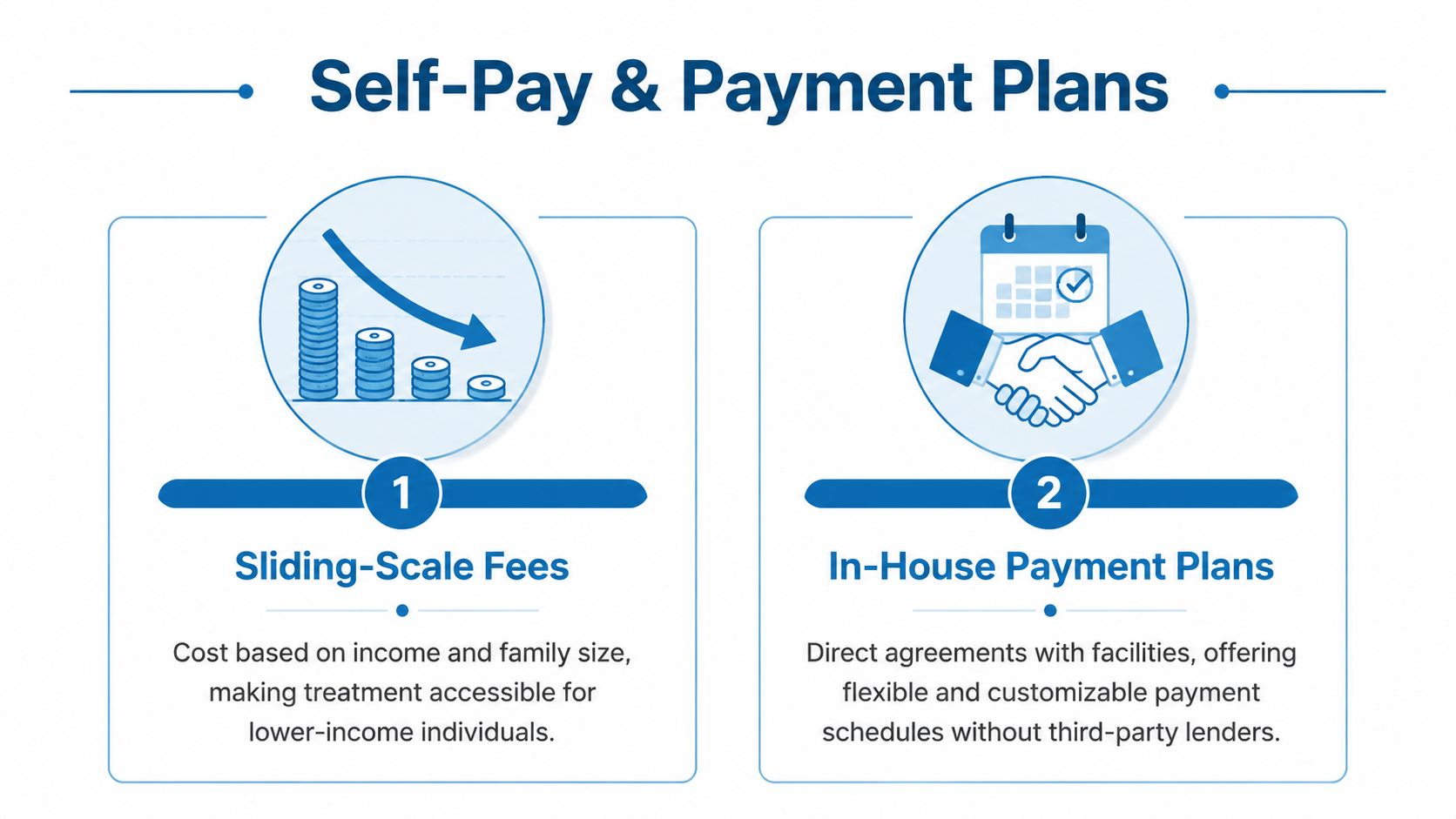
A sliding scale is a structured discount system, not a vague favor. It adjusts treatment cost based on income and household factors. According to this overview of rehab cost flexibility, sliding scale fees are based on a patient's percentage of the federal poverty level, and customized payment plans can turn a $5,000 to $10,000 cost into $150 to $400 monthly payments.
That matters for outpatient care because many working adults can handle a monthly obligation more easily than a large upfront bill. It also matters for families with uneven income, recent job loss, or high unavoidable expenses like rent, childcare, and transportation.
A sliding scale often fits best when:
- Income is limited: The household can't absorb standard self-pay rates without cutting essentials.
- Family size changes the picture: A salary that looks manageable on paper may still be stretched thin across a larger household.
- Insurance is absent or unusable: The plan may not be active, or the deductible may be too high to help in the near term.
When a payment plan works better
A payment plan is different. The base cost may remain the same, but the treatment center spreads payments out over time. For many adults in Euless and across Dallas-Fort Worth, this is the practical answer because it turns treatment into a planned budget item instead of a crisis expense.
In-house arrangements are often easier to manage than outside borrowing because the schedule can align more closely with treatment attendance and expected household cash flow. The point isn't just affordability. It is predictability.
A good payment plan removes the pressure to solve the entire bill before the first clinical appointment.
Maverick Behavioral Health is one outpatient option in the area that provides guidance on partial coverage, remaining balances, and payment pathways for people who need structure around self-pay costs. Families comparing options can review this explanation of paying the remaining balance when insurance only partially covers rehab.
A simple way to choose between them
Some families need a discount. Others need time. Some need both.
| Situation | Usually the better starting point |
|---|---|
| Income is low and documentation is available | Sliding scale |
| Income is steady but cash flow is tight | Payment plan |
| Insurance leaves a manageable remaining balance | Payment plan |
| Insurance leaves a large unaffordable gap | Sliding scale first, then payment plan if needed |
The wrong move is waiting for a perfect financial answer before seeking help. Outpatient treatment is often most workable when the financial plan is built the same way recovery is built. One realistic step at a time.
Tapping into Employer, Grant, and Loan Resources
Working adults often overlook the funding sources closest to them. That is especially true in outpatient rehab, where treatment can fit around work and family obligations well enough that employer-connected benefits may still be available.

Employer benefits people often overlook
Some employees focus only on major medical coverage and forget about other workplace resources. An Employee Assistance Program, when available, can help with assessment, referral, and early navigation. It isn't the full answer to paying for care, but it can open the door and shorten the time spent searching in circles.
Another overlooked route is using health-related workplace funds when they are available through an employer plan. For many families, those dollars are easier to justify because they are already set aside for healthcare use.
A practical order of operations often looks like this:
- Check with HR or benefits materials for any EAP support and healthcare spending options.
- Ask whether behavioral health and substance use treatment are included in the same benefit framework.
- Clarify privacy procedures so the employee knows what stays confidential and what gets documented for benefits use.
Grants and backup funding paths
Alternative funding sources can fill the gap when insurance and self-pay do not fully solve the problem. According to this rehab financing overview, financial help beyond standard insurance can include SAMHSA grants, employer assistance programs, and even early withdrawal from 401(k) plans for qualified medical expenses, up to $50,000 or half the account balance, whichever is less.
That doesn't mean every option is wise for every family. Grants are worth pursuing when eligibility is a possibility. Retirement withdrawals may be considered when treatment is urgent and other funds are exhausted. Loans can help, but they should be reviewed carefully, with close attention to repayment terms and whether the monthly obligation will create pressure during early recovery.
- Grants: Best for people who meet eligibility rules and need substantial help.
- EAP support: Best as an entry point for employed adults who want a confidential starting place.
- Retirement funds: Better treated as a serious fallback, not an automatic first move.
- Loans: Most useful when the terms are clear and the payment won't destabilize the household.
The best funding plan is often a mix. Insurance covers part, an employer benefit reduces friction, and a structured payment arrangement handles the rest.
Using Community and Creative Funding for Support
A familiar DFW situation looks like this. Someone is ready to start PHP or IOP, they need to keep working, insurance will cover part of care, and the remaining balance still feels out of reach. If MAT is part of the plan, the pressure can rise fast because program fees, prescriber visits, lab work, and pharmacy costs do not always land on one simple bill.
That is when families often assume they have run out of options. In practice, this stage is usually about combining smaller funding sources in a realistic way.
How families patch the gap together
For outpatient care, the gap is often more manageable than families expect because treatment does not always need to be paid from one source at one time. A spouse may cover the intake. A parent may help with the first two weeks. A church, recovery community, or close group of friends may contribute toward gas, childcare, copays, or medication pickup. Those smaller pieces can keep a working adult engaged in treatment long enough to stabilize, keep earning income, and avoid a more expensive crisis later.
Privacy matters here.
A family can ask for support without sharing every clinical detail. The request can stay simple and honest: a medical issue, an outpatient treatment plan, a need for short-term help, and a clear purpose for the funds. That approach often feels more comfortable for professionals, parents, and anyone trying to protect their job or reputation while getting care.
I also encourage families to separate one-time costs from recurring costs. For example, community support may be best used for intake fees, the first week of PHP, a MAT follow-up visit, or transportation during the first month. Ongoing weekly obligations, such as IOP sessions or prescription refills, are usually better handled through a payment plan, paycheck budgeting, or family contributions that are clearly defined in advance.
Clear boundaries help. If a relative wants to help, decide whether they are paying the provider directly, covering a pharmacy expense, or helping with practical costs like gas or childcare. Specific commitments reduce confusion and resentment.
What tends to delay care is waiting for one perfect solution. What helps more often is building a workable plan from several smaller sources and starting while the person is still willing to accept treatment.
Your Next Step to Affordable Care in Dallas
The biggest mistake families make is assuming they need every answer before making the first call. They don't. What they need is a clear financial review of the options available for their situation, including insurance, outpatient scheduling, medication costs if MAT is involved, and any realistic backup plan if coverage falls short.
That matters in Dallas-Fort Worth because outpatient rehab for working adults is rarely a one-size-fits-all billing problem. A person in Euless may need PHP while keeping a job protected. Another may need IOP plus medication support. Another may have insurance but still need help understanding coinsurance, pharmacy approvals, or whether a payment plan makes more sense than delaying care.
A confidential conversation can sort through those questions much faster than trying to decode them alone. Families who need help figuring out how to pay for drug rehab can call (888) 385-2051 to talk through insurance verification, self-pay concerns, outpatient treatment costs, and practical next steps for care in the Dallas area.
The call doesn't commit anyone to treatment. It replaces guessing with actual information, which is often the step that gets people unstuck.
Maverick Behavioral Health helps adults in Euless and the Dallas-Fort Worth area explore outpatient rehab options with practical guidance around insurance, self-pay, and treatment planning. A confidential call to (888) 385-2051 can help identify a realistic path forward.