



A family in Euless or Dallas often reaches the same moment. Someone hasn't slept well for days, a doctor prescribes Ambien, and everyone assumes it's a sleep medicine. Then a new question shows up fast: is Ambien a controlled substance, and if so, how serious is that?
The short answer is yes. Ambien is a controlled substance. That doesn't mean it has no medical use, and it doesn't mean a person who takes it as prescribed has done anything wrong. It means federal law treats it as a medication that needs tighter oversight because it can cause misuse, dependence, dangerous behavior, and legal trouble when it's used outside a valid prescription.
That distinction matters in real life. A pill given for insomnia can also affect judgment, memory, and safety. In Texas, the legal consequences of possessing Ambien without a prescription can be far more severe than many families expect. For people already dealing with anxiety, substance use, or chronic sleep problems, the risks can rise quickly.
Table of Contents
- The Common Story of an Ambien Prescription
- What It Means for Ambien to Be a Controlled Substance
- The Brain Science Why Ambien Carries Risk
- How Use Becomes Misuse The Path to Dependence
- Understanding the Risks of Ambien Withdrawal
- Legal Dangers of Ambien Misuse in the Dallas Area
- How to Get Help for Sedative Misuse in Euless and Dallas
The Common Story of an Ambien Prescription
A father in Dallas has not slept well for weeks. He is dragging through work, snapping at people he loves, and dreading bedtime because he already knows he will lie awake. His doctor prescribes Ambien, and the prescription can feel like a simple answer to a very real problem.
That moment is familiar in DFW households. The medication is legal. It is prescribed by a doctor. It is meant to help. So families often assume the risk is low and the rules are ordinary.
The confusion starts there.
Ambien is the brand name for zolpidem tartrate. It is a prescription sleep medication, but it is also a federally regulated drug. According to the U.S. Food and Drug Administration labeling for Ambien, the drug is intended for short-term treatment of insomnia. That short-term detail matters more than many families realize. A tool meant for brief use can become much riskier when someone begins to depend on it night after night, changes the dose without medical advice, or mixes it with alcohol or other sedating drugs.
For many families, the phrase Ambien a controlled substance sounds technical and distant. In real life, it means the medication sits in a category that carries both medical safeguards and legal consequences. Federally, Ambien is placed in Schedule IV. In Texas, that classification can affect how the medication must be prescribed, possessed, and handled. In clinics and emergency settings across the Dallas-Fort Worth area, the same label also points to something more personal. Some people start with a valid prescription and still develop patterns of misuse, dependence, or dangerous withdrawal.
Why this surprises families
Sleep medicine does not look threatening. A small tablet taken at bedtime does not carry the same emotional warning signs people associate with opioids or street drugs. But the brain does not judge a medication by its appearance or purpose. It responds to how the drug acts.
That is why a spouse, parent, or adult child may notice trouble before the person taking Ambien does. Maybe the prescription runs out early. Maybe the person says they cannot sleep at all without it. Maybe they seem groggy, confused, or unusually irritable. Those are not small observations. They are often the first signs that a legitimate prescription is becoming something harder to control.
A helpful rule is simple. A prescribed medication can still become dangerous if it is used longer than intended, taken in a different way than prescribed, or relied on so heavily that stopping feels frightening.
Asking questions early is a responsible response. It can protect someone you love from a medical crisis, a legal problem in Texas, or both.
What It Means for Ambien to Be a Controlled Substance
A family in Dallas may hear that Ambien is a “controlled substance” and assume that means something extreme. In practice, it means the medication is legal for medical use, but it is regulated because it can be misused, create dependence, and cause harm if it is taken outside a doctor's directions.
That federal label matters in real life. Ambien, which contains zolpidem, is classified by the Drug Enforcement Administration as a Schedule IV controlled substance. The DEA explains that Schedule IV drugs have accepted medical use and a lower potential for abuse than Schedule I, II, or III drugs, while still carrying enough risk to require tighter rules around prescribing and possession, according to the DEA's drug scheduling overview.
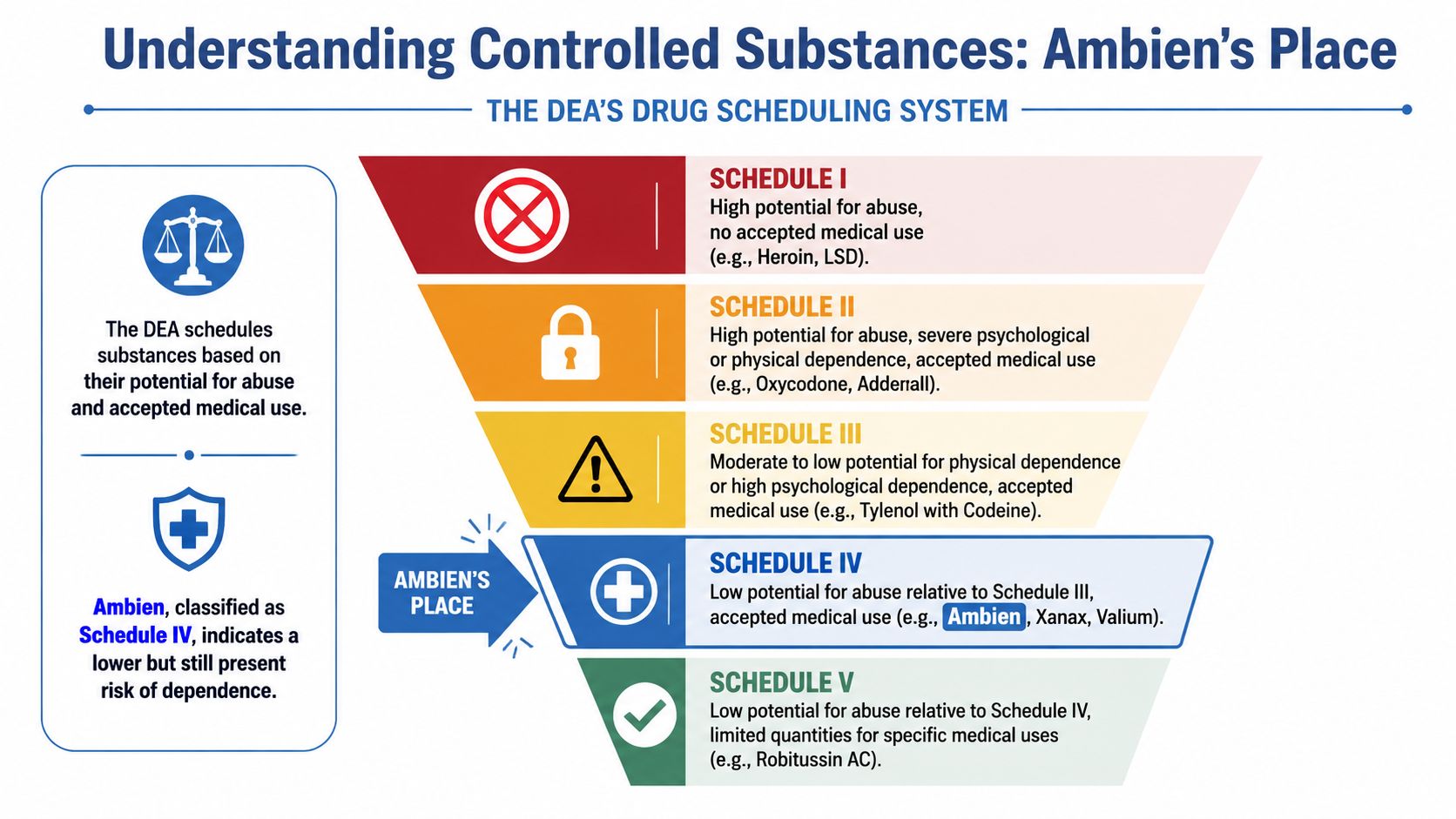
For many families, the confusing part is the phrase lower potential for abuse. Lower does not mean minor. It means Ambien is considered less dangerous than some other controlled drugs, but dangerous enough that federal law and Texas law both treat it as a medication that needs oversight.
Here is the plain-language version:
| Term | What it means in plain English |
|---|---|
| Controlled substance | A medication the government regulates because it has medical use but also misuse risk |
| Schedule IV | A lower abuse risk than some other controlled drugs, but still enough risk to require legal limits |
| Valid prescription | The drug may be used only as directed, by the person it was prescribed for |
Those rules affect everyday decisions. A person cannot legally share Ambien with a spouse, college student, or friend who “just needs help sleeping for a few nights.” In Texas, possessing zolpidem without a valid prescription or using it outside lawful medical directions can create criminal consequences, even if the pills originally came from a real prescription bottle. The federal classification is the starting point. State law is where that label can turn into an arrest, charges, or problems with employment and professional licensing.
The medical side matters just as much. In DFW communities, clinicians often see a pattern that starts in a subtle manner. Someone uses Ambien for sleep, begins relying on it more often than planned, then feels unable to rest without it. A controlled substance label is meant to warn about that possibility early, before the person reaches the point of compulsive use, risky behaviors at night, or withdrawal symptoms when trying to stop.
A helpful way to read the label is this. Controlled substance is a safety signal. It tells patients, prescribers, pharmacies, and families that this medication needs careful handling, close follow-up, and respect for both the law and the drug's effect on the brain.
That does not make someone “bad” for taking it. It means the medication deserves caution from the first dose, especially when a family in North Texas is trying to tell the difference between short-term sleep treatment and the beginning of a bigger problem.
The Brain Science Why Ambien Carries Risk
A family may see the risk before the person taking Ambien does. Someone starts it for sleep, seems calmer at night, and then becomes harder to wake, foggier in the morning, or oddly active after taking a pill they thought would help them rest.

How Ambien helps a person fall asleep
Ambien works by changing how the brain responds to GABA, one of the main chemical signals involved in slowing brain activity. More specifically, zolpidem acts at GABA_A receptors, with strong activity at the alpha-1 subunit, which is closely tied to sedation and sleep onset. The FDA labeling for zolpidem describes it as a positive allosteric modulator at these receptors.
In plain language, the medication strengthens the brain's “quiet down” signal.
That can feel like a gift to a person who has been lying awake for hours. Thoughts slow. Muscle tension eases. The mind stops pushing so hard against sleep. For many patients, that quick relief is part of what makes the drug appealing and part of what can make it risky.
Why the same mechanism can create dependence
The brain is built to adapt. If the same sedating signal is pushed over and over, the nervous system can begin adjusting around the drug's presence. A person may then notice that sleep feels harder without the pill, even if the medicine was first prescribed for short-term help.
This is the part many families in Dallas-Fort Worth find confusing. A medication can be legally prescribed, used for a real symptom, and still train the brain toward dependence. That is one reason Ambien is in DEA Schedule IV federally. The classification reflects abuse and dependence potential. In Texas, that federal label does not stay abstract. It can connect to serious legal consequences if the drug is possessed or used outside a valid prescription, while the same brain changes can leave the person dealing with cravings, rebound insomnia, or withdrawal when they try to stop.
A few distinctions help:
- Tolerance means the same dose may feel less effective over time.
- Dependence means the brain has adapted enough that stopping can trigger symptoms.
- Addiction involves compulsive use despite harm.
Those terms overlap, but they are not interchangeable. This breakdown of the difference between a habit and an addiction can help families put those changes into words.
No one has to misuse a medication on purpose for dependence to begin. That is why clinicians take sedative medications seriously, especially when a person starts needing them to feel “normal” at bedtime or becomes distressed at the idea of sleeping without them.
When a person struggles after stopping Ambien, the brain is reacting to the loss of a drug it had adapted to. Understanding that biology helps families respond with urgency, compassion, and less blame.
How Use Becomes Misuse The Path to Dependence
A common family story in Dallas-Fort Worth starts without fanfare. Someone is prescribed Ambien for real insomnia, uses it as directed, and feels relieved that sleep finally comes. Then the medication stops feeling as dependable, bedtime becomes tense, and the person starts bending the rules a little to get the same effect.

A pattern families often recognize too late
This change rarely begins with a plan to misuse a drug. It often begins with exhaustion. A person takes Ambien after several bad nights, then starts using it on more nights than intended, stays awake after taking it, or asks for refills sooner because sleep feels impossible without it.
That pattern matters because Ambien can affect memory, coordination, and judgment, especially when it is taken in ways that do not match the prescription. Families may notice the shift before the patient does. A spouse may describe late-night conversations, eating, driving, or other odd behavior that the person does not remember the next morning.
The warning sign is not only “taking too much.” It is the growing sense that the medication is running the evening.
In Texas, that change can carry more than one kind of risk. Federally, zolpidem is a DEA Schedule IV controlled substance because it has abuse and dependence potential. In real life around DFW, that means a pattern that starts in the bedroom can lead to clinical dependence, unsafe behavior, and legal trouble if the medication is used outside a valid prescription.
What the slide into misuse often looks like
Dependence usually builds through repeated small choices that feel temporary at the time:
- Taking more than prescribed: A person tells themselves one extra tablet will fix a bad night.
- Using it outside bedtime: Taking Ambien without planning to go straight to bed increases the chance of confusion and poor decisions.
- Staying awake after taking it: This is when people may act in ways they do not fully remember later.
- Using it for reassurance, not just sleep: The medication starts to feel like the only way to stay calm at night.
- Becoming secretive about it: Hiding pills, protecting the bottle, or getting defensive when someone asks about use can signal loss of control.
A simple comparison helps here. Habit is repeating a behavior because it feels familiar. Dependence is the brain adapting so strongly that stopping brings distress. Addiction adds compulsive use despite harm. For families trying to sort out those differences, this explanation of habit versus addiction can help put the behavior into words.
Some families first notice the problem when insomnia is no longer the main issue. The bigger issue is secrecy, risky behavior, or panic at the thought of going without the medication.
That is the point where concern should become action. Early help can prevent a pattern of misuse from turning into a deeper medical and legal crisis.
Understanding the Risks of Ambien Withdrawal
A family in Dallas may see this happen fast. Someone decides to stop taking Ambien on their own because they are worried about dependence or embarrassed to ask for help. By the second or third night, they are not just tired. They are anxious, shaky, wide awake, and acting unlike themselves.
That pattern is why withdrawal deserves serious attention.
Ambien affects the same calming systems in the brain that many sedative medications act on. After regular use, the brain can adjust to having that nightly signal. When the drug is stopped suddenly, the brain can swing in the other direction and become overactive. A simple way to picture it is a car that has been riding with the brake pressed down. If that pressure disappears all at once, the movement can feel abrupt and hard to control.
For many people, the first problem is rebound insomnia. Sleep can come back worse for a period of time, which often leads families to assume the person just needs another pill. Sometimes the picture is broader than poor sleep. Anxiety, irritability, sweating, trembling, panic, and agitation can appear too. In more severe cases, confusion and seizures are possible, as noted earlier in the article.
Families often ask a fair question. If Ambien is a Schedule IV controlled substance, does that really matter once someone is trying to quit? It does. The federal classification reflects a recognized risk of misuse and dependence. On the ground in DFW, that risk becomes personal very quickly. A person may keep taking extra doses to avoid withdrawal, borrow pills from someone else, or carry tablets without a valid prescription. What started as a medical problem can then turn into a legal one under Texas law.
Watch for signs that stopping has become unsafe:
- Sleep suddenly gets much worse: little to no sleep, repeated waking, intense restlessness at night
- Mood and nerves change sharply: anxiety, irritability, panic, feeling constantly on edge
- The body looks overstimulated: shaking, sweating, pacing, trouble sitting still
- Thinking becomes less clear: confusion, unusual behavior, poor awareness of surroundings
- Emergency warning signs appear: seizure-like activity or severe disorientation
A person does not have to fit anyone's stereotype of addiction to have withdrawal. Some people took the medication exactly as prescribed for longer than intended. Others began misusing it only after sleep problems and stress piled up. In both cases, the brain may still react strongly when the medication is removed.
Medical guidance helps sort out what level of care is needed. A clinician looks at how long Ambien was used, how much was taken, whether alcohol or other sedatives are involved, and whether the person can taper safely or needs closer monitoring. For some families, that may mean outpatient support. For others, especially when symptoms are escalating, it may mean a higher level of care through a Dallas County addiction treatment center.
Recovery is possible. The safest first step is not to force a sudden stop and hope for the best. It is to treat withdrawal like the medical issue it is, with calm, timely support.
Legal Dangers of Ambien Misuse in the Dallas Area
Medical risk is only part of the picture. In Texas, the legal side can be severe enough to change a person's job, schooling, housing, or custody situation.

Why Texas law changes the stakes
Some readers know Ambien is federally controlled but still assume unauthorized possession would be treated like a minor medication issue. In Texas, that assumption can be badly wrong.
Under Texas Health and Safety Code §481.117, possessing Ambien without a prescription is classified as a state jail felony, punishable by 180 days to 2 years in jail and fines up to $10,000, as explained in this summary of Texas penalties for Ambien possession.
That means common situations can become much more serious than people expect. A person carries pills in an unmarked container. A friend shares a few tablets. A family member keeps an old prescription after it should have been discarded. None of that is harmless under Texas law.
For readers looking into local treatment options when prescription drug misuse has already become a concern, this page on Dallas addiction treatment services gives an overview of care available in the area.
Practical ways families can reduce risk
A household can lower legal and safety exposure with a few disciplined habits:
- Keep medication in the original bottle: This helps show who it belongs to and when it was prescribed.
- Never share pills: Sharing isn't just unsafe. It can create criminal liability.
- Lock it up when needed: If there are teens, roommates, or anyone with a history of misuse in the home, unsecured medication creates avoidable risk.
- Dispose of unused medication promptly: Old prescriptions sitting in drawers often become the source of accidental or intentional misuse.
A family that treats Ambien like any ordinary over-the-counter sleep product can walk straight into trouble. In the Dallas and Euless area, caution isn't excessive. It's appropriate.
How to Get Help for Sedative Misuse in Euless and Dallas
When Ambien use has shifted from a short-term prescription to a source of fear, confusion, or conflict, professional help may be the safest next step. People often wait because they think the problem “isn't bad enough yet.” That delay can deepen dependence and increase legal and medical risk.
Signs it may be time for professional support
Several patterns suggest that outside help would be wise:
- The person can't sleep without it: The medication no longer feels optional.
- There are memory gaps or unsafe behaviors: Family members report nighttime actions the person doesn't remember.
- Stopping causes distress: Rebound insomnia, anxiety, or agitation appear quickly.
- Other issues are involved: Alcohol use, anxiety, depression, or other drug use make the situation more complex.
- Daily life is slipping: Work, parenting, school, or relationships are being affected.
Some people need an evaluation even if they're unsure whether the problem is “addiction.” That uncertainty is common. A clinical team can sort out whether the issue is dependence, misuse, a co-occurring mental health condition, or several things at once.
What treatment can look like close to home
For many adults in DFW, outpatient care is an important option because they still need to work, attend school, or care for family. Programs such as outpatient treatment, intensive outpatient care, and partial hospitalization can provide therapy, medical oversight, relapse prevention, and dual diagnosis support without requiring a person to live full-time at a facility.
One local option is prescription medication rehab in Euless, where Maverick Behavioral Health provides outpatient substance use and mental health treatment for people in Euless and the Dallas-Fort Worth area. Its services include individualized care across outpatient levels, therapy, dual diagnosis treatment, and medication-assisted treatment where clinically appropriate.
Recovery from sedative misuse usually works best when treatment addresses both the medication use and the reason the person felt they needed it.
That may include insomnia, anxiety, trauma, depression, or stress that has built up over time. Good treatment doesn't shame the person for taking a prescribed medication. It helps them regain safety, stability, and healthier ways to sleep and cope.
If a family is worried now, waiting for a worse event usually doesn't add clarity. It adds risk.
If Ambien use is causing concern in Euless, Dallas, or the wider DFW area, help is available. Maverick Behavioral Health offers confidential support for prescription drug misuse, co-occurring mental health conditions, and flexible outpatient treatment. Take the first step today. Call Maverick Behavioral Health at (888) 385-2051 to speak confidentially with the team.